Yooyongwech Suravoot, Samphumphuang Thapanee, Tisarum Rujira, Theerawitaya Cattarin, Cha-Um Suriyan
Division of Agricultural Science, Mahidol UniversityKanchanaburi, Thailand.
National Center for Genetic Engineering and Biotechnology (BIOTEC), National Science and Technology Development Agency (NSTDA)Pathum Thani, Thailand.
Front Plant Sci. 2017 Aug 8;8:1400. doi: 10.3389/fpls.2017.01400. eCollection 2017.
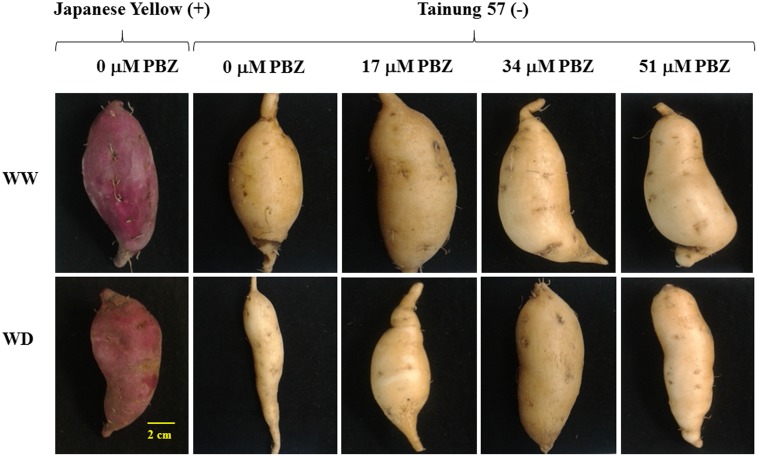
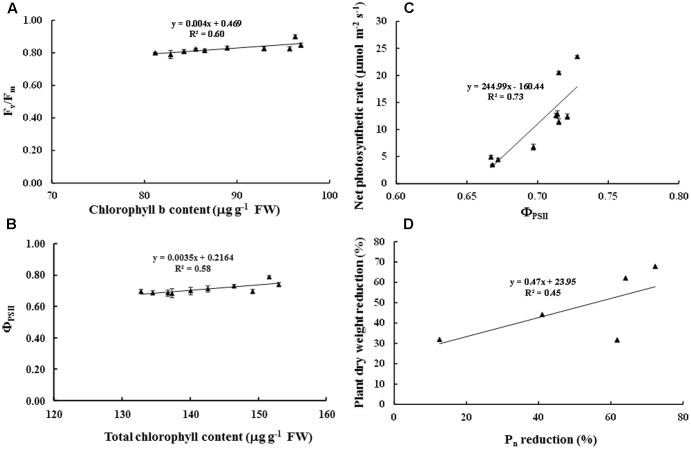
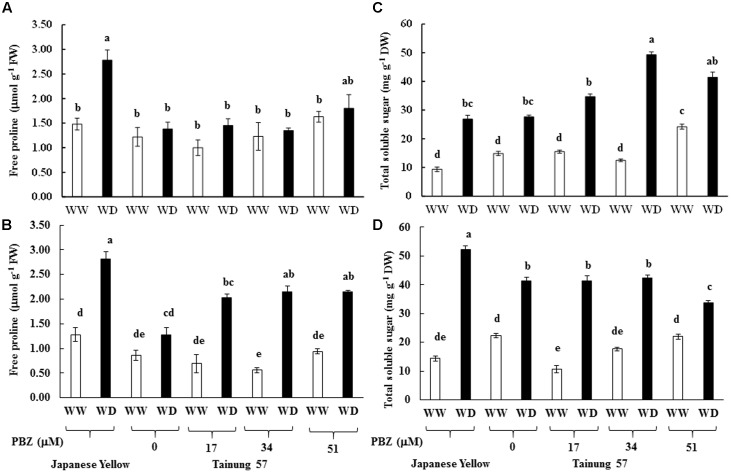
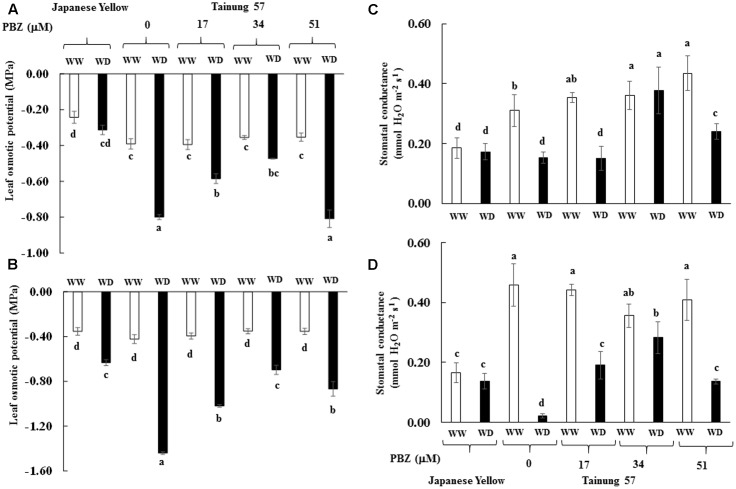
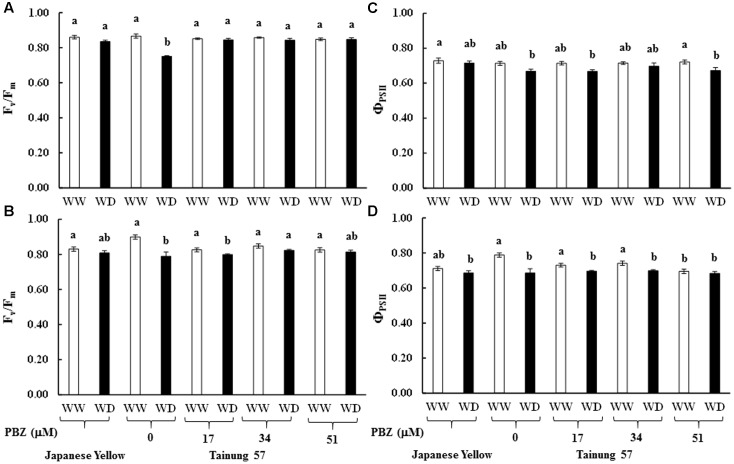
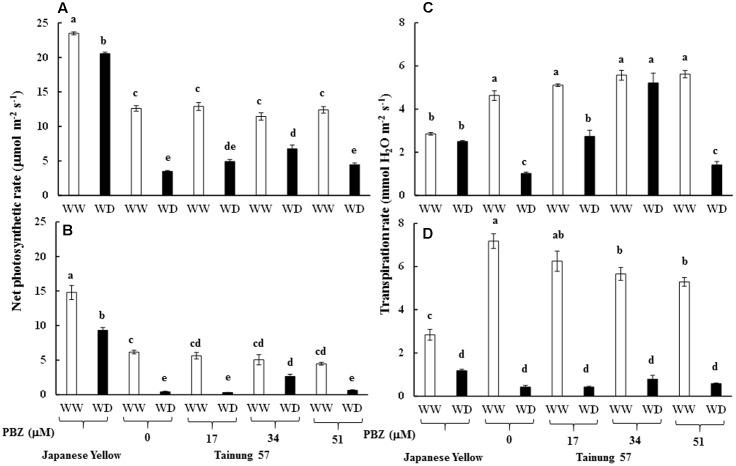
The objective of this study was to elevate water deficit tolerance by improving soluble sugar and free proline accumulation, photosynthetic pigment stabilization, photosynthetic abilities, growth performance and storage root yield in sweet potato cv. 'Tainung 57' using a foliar application of paclobutrazol (PBZ). The experiment followed a Completely Randomized Block Design with four concentrations of PBZ: 0 (control), 17, 34, and 51 μM before exposure to 47.5% (well irrigation), 32.3% (mild water deficit) or 17.5% (severe water deficit) soil water content. A sweet potato cultivar, 'Japanese Yellow', with water deficit tolerance attributes was the positive check in this study. Total soluble sugar content (sucrose, glucose, and fructose) increased by 3.96-folds in 'Tainung 57' plants treated with 34 μM PBZ grown under 32.3% soil water content (SWC) compared to the untreated plants, adjusting osmotic potential in the leaves and controlling stomatal closure (represented by stomatal conductance and transpiration rate). In addition, under the same treatment, free proline content (2.15 μmol g FW) increased by 3.84-folds when exposed to 17.5% SWC. PBZ had an improved effect on leaf size, vine length, photosynthetic pigment stability, chlorophyll fluorescence, and net photosynthetic rate; hence, delaying wilting symptoms and maintaining storage root yield (26.93 g plant) at the harvesting stage. A positive relationship between photon yield of PSII (Φ) and net photosynthetic rate was demonstrated ( = 0.73). The study concludes that soluble sugar and free proline enrichment in PBZ-pretreated plants may play a critical role as major osmoprotectant to control leaf osmotic potential and stomatal closure when plants were subjected to low soil water content, therefore, maintaining the physiological and morphological characters as well as storage root yield.
本研究的目的是通过叶面喷施多效唑(PBZ),提高甘薯品种‘台农57号’中可溶性糖和游离脯氨酸的积累、光合色素稳定性、光合能力、生长性能和块根产量,从而提升其对水分亏缺的耐受性。试验采用完全随机区组设计,设置四种PBZ浓度:0(对照)、17、34和51 μM,然后将植株暴露于47.5%(充分灌溉)、32.3%(轻度水分亏缺)或17.5%(重度水分亏缺)的土壤含水量条件下。本研究中,具有水分亏缺耐受性特征的甘薯品种‘日本黄’作为阳性对照。与未处理植株相比,在32.3%土壤含水量(SWC)条件下生长的经34 μM PBZ处理的‘台农57号’植株,其总可溶性糖含量(蔗糖、葡萄糖和果糖)增加了3.96倍,调节了叶片的渗透势并控制气孔关闭(以气孔导度和蒸腾速率表示)。此外,在相同处理下,当暴露于17.5% SWC时,游离脯氨酸含量(2.15 μmol g FW)增加了3.84倍。PBZ对叶片大小、藤蔓长度、光合色素稳定性、叶绿素荧光和净光合速率有改善作用;因此,延迟了萎蔫症状,并在收获期维持了块根产量(26.93 g/株)。PSII的光子产量(Φ)与净光合速率之间呈正相关( = 0.73)。研究得出结论,PBZ预处理植株中可溶性糖和游离脯氨酸的富集可能作为主要的渗透保护剂发挥关键作用,在植株遭受低土壤含水量时控制叶片渗透势和气孔关闭,从而维持其生理和形态特征以及块根产量。