Ye Yuqin, Yang Yongxiang, Chen Chen, Li Ze, Jia Yanfeng, Su Xinhong, Wang Chaoxian, He Xiaosheng
Department of Neurosurgery, Xijing Hospital, Fourth Military Medical University, Xi'an 710032, China.
Department of Neurosurgery, PLA 163rd Hospital (Second Affiliated Hospital of Hunan Normal University), Changsha 410000, China.
Stem Cells Int. 2017;2017:5841814. doi: 10.1155/2017/5841814. Epub 2017 Aug 7.
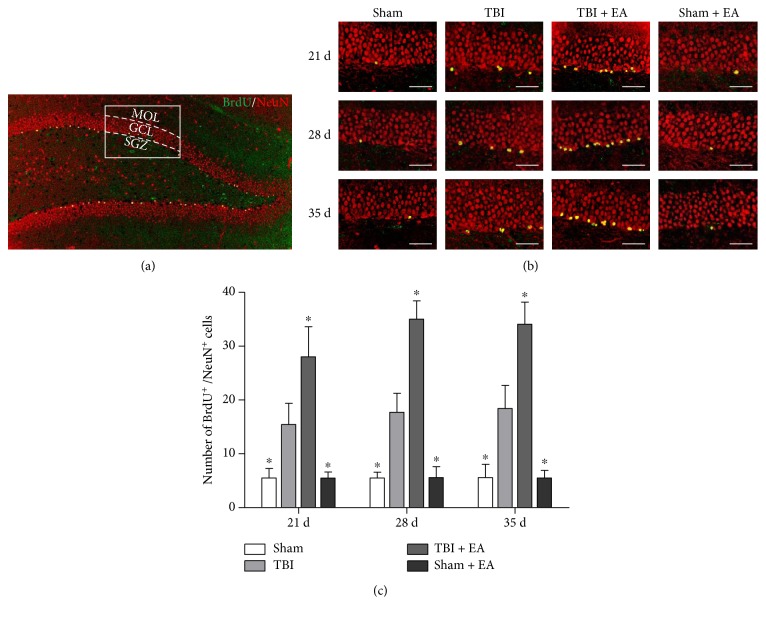
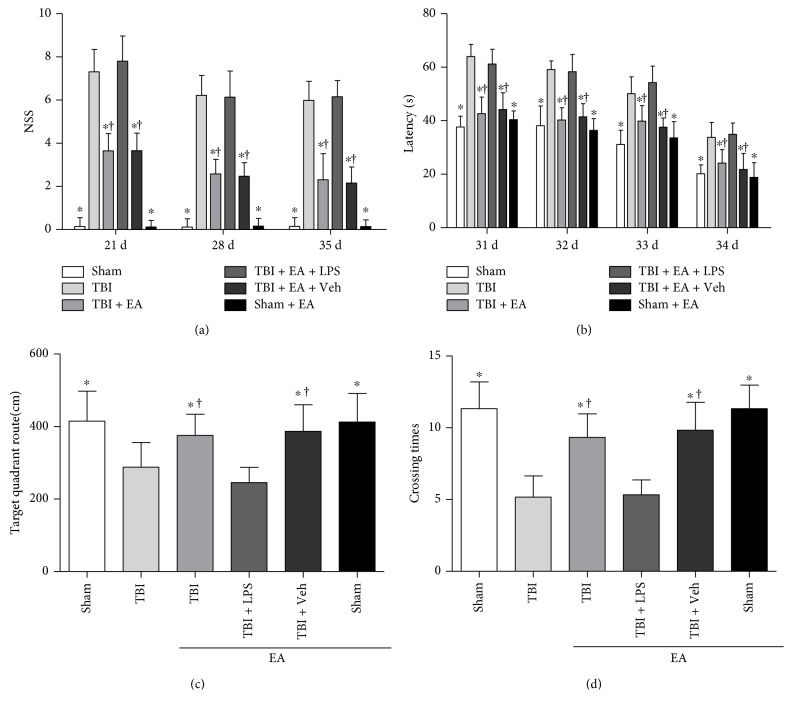
The protective role of electroacupuncture (EA) treatment in diverse neurological diseases such as ischemic stroke is well acknowledged. However, whether and how EA act on hippocampal neurogenesis following traumatic brain injury (TBI) remains poorly understood. This study aims to investigate the effect of EA on hippocampal neurogenesis and neurological functions, as well as its underlying association with toll-like receptor 4 (TLR4) signaling in TBI mice. BrdU/NeuN immunofluorescence was performed to label newborn neurons in the hippocampus after EA treatment. Water maze test and neurological severity score were used to evaluate neurological function posttrauma. The hippocampal level of TLR4 and downstream molecules and inflammatory cytokines were, respectively, detected by Western blot and enzyme-linked immunosorbent assay. EA enhanced hippocampal neurogenesis and inhibited TLR4 expression at 21, 28, and 35 days after TBI, but the beneficial effects of EA on posttraumatic neurogenesis and neurological functions were attenuated by lipopolysaccharide-induced TLR4 activation. In addition, EA exerted an inhibitory effect on both TLR4/Myd88/NF-B and TLR4/TRIF/NF-B pathways, as well as the inflammatory cytokine expression in the hippocampus following TBI. In conclusion, EA promoted hippocampal neurogenesis and neurological recovery through inhibition of TLR4 signaling pathway posttrauma, which may be a potential approach to improve the outcome of TBI.
电针(EA)治疗在多种神经系统疾病如缺血性卒中中的保护作用已得到广泛认可。然而,EA在创伤性脑损伤(TBI)后是否以及如何作用于海马神经发生仍知之甚少。本研究旨在探讨EA对TBI小鼠海马神经发生和神经功能的影响,以及其与Toll样受体4(TLR4)信号通路的潜在关联。在EA治疗后,采用BrdU/NeuN免疫荧光法标记海马中的新生神经元。利用水迷宫试验和神经严重程度评分评估创伤后的神经功能。分别通过蛋白质印迹法和酶联免疫吸附测定法检测海马中TLR4及其下游分子和炎性细胞因子的水平。TBI后21、28和35天时,EA增强了海马神经发生并抑制了TLR4表达,但脂多糖诱导的TLR4激活减弱了EA对创伤后神经发生和神经功能的有益作用。此外,EA对TBI后海马中的TLR4/Myd88/NF-κB和TLR4/TRIF/NF-κB信号通路以及炎性细胞因子表达均具有抑制作用。总之,EA通过抑制创伤后的TLR4信号通路促进海马神经发生和神经功能恢复,这可能是改善TBI预后的一种潜在方法。