
柚皮苷可减轻机械拉伸诱导的肥厚性瘢痕小鼠模型中成纤维细胞的激活和炎症反应。
Naringenin attenuates fibroblast activation and inflammatory response in a mechanical stretch-induced hypertrophic scar mouse model.
机构信息
Department of Plastic and Reconstructive Surgery, Shanghai Ninth People's Hospital, Shanghai Jiao Tong University School of Medicine, Shanghai 200011, P.R. China.
Clinical College of General Hospital of Beijing Military Region, Anhui Medical University, Hefei, Anhui, 230000, P.R. China.
出版信息
Mol Med Rep. 2017 Oct;16(4):4643-4649. doi: 10.3892/mmr.2017.7209. Epub 2017 Aug 10.
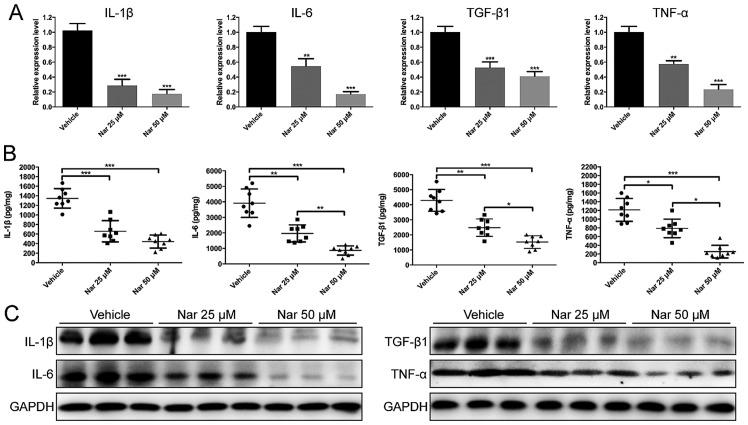
The pathogenesis and therapy of hypertrophic scars (HS) have not yet been established. The aim of the present study was to investigate the potential effect of naringenin on HS and its underlying mechanisms. The mouse model of HS was prepared by a mechanical stretch device and then treated with naringenin at various concentrations. Histological studies were performed to evaluate scar hypertrophy by hematoxylin and eosin, as well as Masson's trichrome staining. The activation of HS fibroblasts was determined based on reverse transcription‑quantitative polymerase chain reaction (RT‑qPCR), western blotting and immunohistochemical staining. Following observing the retention of inflammation cells by immunohistochemistry, the cytokines, including tumor necrosis factor (TNF)‑α, interleukin (IL)‑1β, IL‑6 and transforming growth factor (TGF)‑β1, mRNA and protein levels were quantitated by RT‑qPCR, ELISA and western blotting methods. As a result, naringenin significantly inhibited the formation of HS in a concentration‑dependent manner. In addition, naringenin inhibited fibroblast activation and inflammatory cell recruitment. In addition, mRNA and protein expression levels of TNF‑α, IL‑1β, IL‑6 and TGF‑β1 were downregulated following naringenin treatment. The current study highlighted a new pharmacological activity of naringenin on HS. The mechanism of action of naringenin was associated with the inhibition of fibroblast activation and local inflammation. These results suggested that naringenin may serve as a novel agent for treatment of HS.
增生性瘢痕(HS)的发病机制和治疗方法尚未确定。本研究旨在探讨柚皮素对 HS 的潜在作用及其潜在机制。通过机械拉伸装置制备 HS 小鼠模型,然后用不同浓度的柚皮素进行处理。通过苏木精和伊红以及 Masson 三色染色进行组织学研究,以评估瘢痕增生。根据逆转录-定量聚合酶链反应(RT-qPCR)、Western blot 和免疫组织化学染色来确定 HS 成纤维细胞的激活情况。通过免疫组织化学观察到炎症细胞的保留后,通过 RT-qPCR、ELISA 和 Western blot 方法定量测定肿瘤坏死因子(TNF)-α、白细胞介素(IL)-1β、IL-6 和转化生长因子(TGF)-β1 的 mRNA 和蛋白水平。结果表明,柚皮素呈浓度依赖性地显著抑制 HS 的形成。此外,柚皮素抑制成纤维细胞活化和炎症细胞募集。此外,柚皮素处理后 TNF-α、IL-1β、IL-6 和 TGF-β1 的 mRNA 和蛋白表达水平下调。本研究强调了柚皮素在 HS 中的新的药理学活性。柚皮素的作用机制与抑制成纤维细胞活化和局部炎症有关。这些结果表明,柚皮素可能成为治疗 HS 的新型药物。


 Zotero 插件