Department of Cardiology Medicine, Shengjing Hospital of China Medical University, Shenyang, Liaoning 110022, P.R. China.
Department of Geriatrics, Shengjing Hospital of China Medical University, Shenyang, Liaoning 110022, P.R. China.
Mol Med Rep. 2017 Nov;16(5):5847-5854. doi: 10.3892/mmr.2017.7344. Epub 2017 Aug 23.
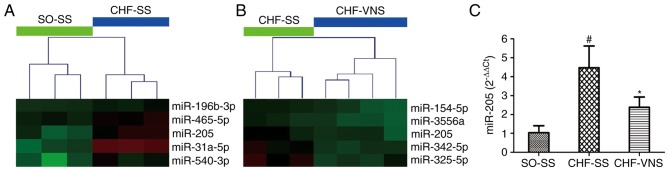
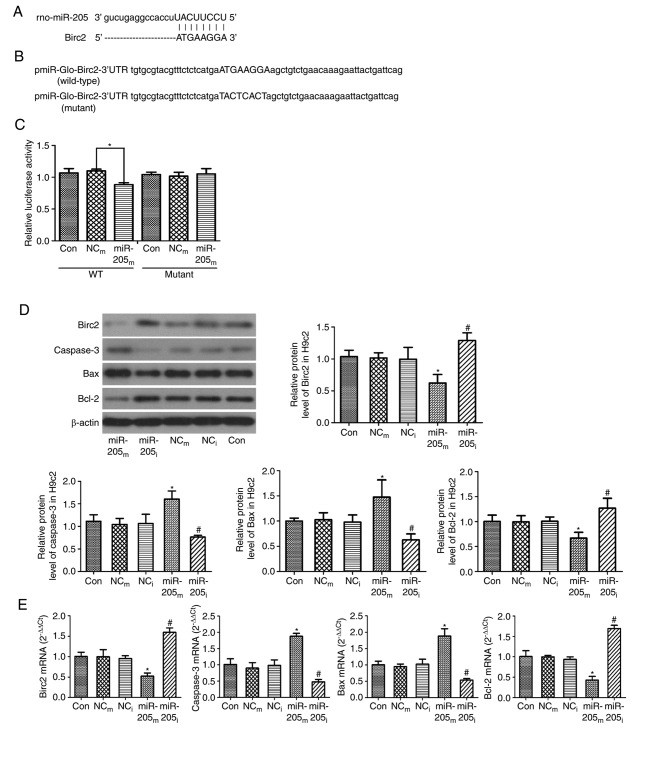
Previous studies have reported that short‑term vagus nerve stimulation (VNS) improves cardiac function in rats with chronic heart failure (CHF). The molecular mechanisms are unclear. The potential effect of microRNA (miR)‑205 in apoptosis of short‑term VNS was examined. A total of 3 weeks after inducing CHF, the rats were divided into three groups: Sham stimulation in sham operated rats, sham stimulation in CHF rats (CHF‑SS), and treated with VNS in CHF rats (CHF‑VNS). The right vagus nerve of the neck was stimulated for 72 h in CHF rats with rectangular pulses of 40 msec duration at 1 Hz and 5 V. miR‑205 was focused on, which exhibited differential expression in the miRNA microarray analysis of CHF rats, and the effects of VNS on apoptosis were examined. It was verified that the expression level of miR‑205 in the CHF‑SS group was increased, and the expression was reduced in the CHF‑VNS group. Furthermore, mimics or inhibitor of miR‑205 was transfected into H9c2 to investigate its function on apoptosis. Baculoviral IAP repeat‑containing protein 2 (Birc2) was confirmed a target of miR‑205 through a dual luciferase reporter assay and western blotting. It was demonstrated that downregulated miR‑205 decreased apoptosis in H9c2 cells. The apoptosis‑associated proteins were further detected in H9c2 cells and rat tissue. The mRNA and protein expression levels of caspase‑3 and Bcl‑2‑associated X protein were decreased in the CHF‑VNS group, the expression of Birc2 and B‑cell lymphoma 2 were increased. The results were consistent with the in vitro study in the miR‑205 inhibitor group. The present study demonstrated that short‑term VNS decreased apoptosis by downregulating miR‑205 in rats with CHF. Therefore, the results of the present study provide basic evidence for short‑term VNS in the clinical treatment of CHF.
先前的研究报告称,短期迷走神经刺激(VNS)可改善慢性心力衰竭(CHF)大鼠的心脏功能。但其分子机制尚不清楚。本研究旨在探讨微小 RNA(miR)-205 在短期 VNS 诱导的细胞凋亡中的潜在作用。CHF 诱导 3 周后,将大鼠分为三组:假手术大鼠的假刺激组(Sham 刺激组)、CHF 大鼠的假刺激组(CHF-SS 组)和 CHF 大鼠的 VNS 治疗组(CHF-VNS 组)。CHF 大鼠采用矩形脉冲(持续 40ms,频率 1Hz,电压 5V)刺激右侧颈迷走神经 72h。miR-205 在 CHF 大鼠的 miRNA 微阵列分析中差异表达,研究了 VNS 对细胞凋亡的影响。验证 CHF-SS 组 miR-205 表达水平升高,CHF-VNS 组表达水平降低。此外,将 miR-205 模拟物或抑制剂转染至 H9c2 细胞,研究其对凋亡的作用。双荧光素酶报告基因检测和 Western blot 验证了凋亡相关蛋白 2(Birc2)是 miR-205 的靶基因。结果表明,下调 miR-205 可减少 H9c2 细胞凋亡。进一步检测 H9c2 细胞和大鼠组织中凋亡相关蛋白。CHF-VNS 组 caspase-3 和 Bcl-2 相关 X 蛋白的 mRNA 和蛋白表达水平降低,Birc2 和 B 细胞淋巴瘤 2 的表达水平升高。与 miR-205 抑制剂组的体外研究结果一致。本研究表明,短期 VNS 通过下调 CHF 大鼠的 miR-205 减少细胞凋亡。因此,本研究为短期 VNS 治疗 CHF 提供了基础依据。