Department of Human Functional Genomics, Advanced Science Research Promotion Center, Mie University, Tsu 514‑8507, Japan.
CREST, Japan Science and Technology Agency, Kawaguchi 332‑0012, Japan.
Mol Med Rep. 2017 Nov;16(5):5823-5832. doi: 10.3892/mmr.2017.7334. Epub 2017 Aug 23.
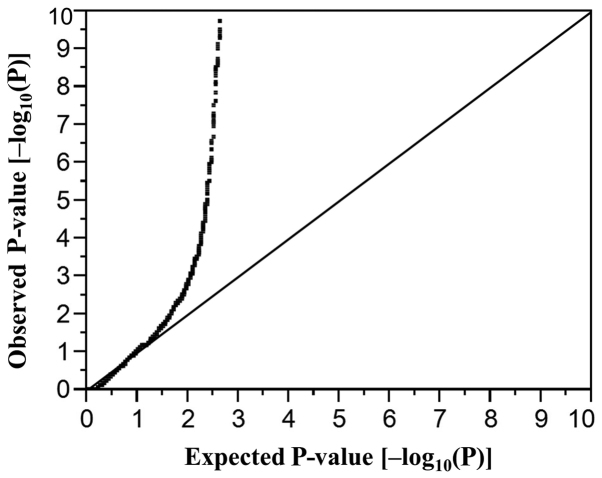
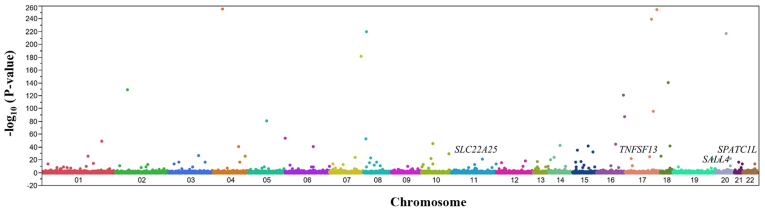
An exome‑wide association study (EWAS) was performed to identify genetic variants, particularly low‑frequency or rare coding variants with a moderate to large effect size, that confer susceptibility to atrial fibrillation in Japanese. The EWAS for atrial fibrillation was performed with 13,166 subjects (884 patients with atrial fibrillation and 12,282 controls) using an Illumina HumanExome‑12 DNA Analysis BeadChip or Infinium Exome‑24 BeadChip arrays. The association of atrial fibrillation with allele frequencies of 41,243 single nucleotide polymorphisms (SNPs) that passed quality control was examined with Fisher's exact test. Based on Bonferroni's correction, a P<1.21x10‑6 was considered statistically significant. The EWAS for atrial fibrillation revealed that 122 SNPs were significantly associated with this condition. The association of the identified SNPs to atrial fibrillation was further examined by multivariable logistic regression analysis with adjustment for age, sex and the prevalence of hypertension. Eight SNPs were related (P<0.01) to atrial fibrillation, among which three polymorphisms, rs11552708 [G/A (G67R)]of TNF superfamily member 13 (TNFSF13; dominant model; P=9.36x10‑9; odds ratio, 0.58), rs113710653 [C/T (E231 K)] of spermatogenesis and centriole associated 1 like (SPATC1L; dominant model; P=1.09x10‑5; odds ratio, 3.27), and rs11231397 [G/C (R300T)] of solute carrier family 22 member 25 (SLC22A25; additive model; P=3.71x10‑5; odds ratio, 1.77), were significantly (P<1.02x10‑4) associated with this condition. The minor T allele of rs113710653 and the minor C allele of rs11231397 were risk factors for atrial fibrillation, whereas the minor A allele of rs11552708 was protective against this condition. In addition, rs77538589 [C/T (G117R)] of SALL4 exhibited a tendency to be associated with atrial fibrillation (dominant model; P=0.0002; odds ratio, 1.88), with the minor T allele representing a risk factor for this condition. TNFSF13, SPATC1L, SLC22A25 and SALL4 may thus be novel susceptibility loci for atrial fibrillation in the Japanese population.
一项外显子组全基因组关联研究(EWAS)旨在鉴定与心房颤动易感性相关的遗传变异,特别是低频或罕见的编码变异,这些变异具有中度至较大的效应大小。该研究纳入了 13166 名受试者(884 名心房颤动患者和 12282 名对照者),使用了 Illumina HumanExome-12 DNA 分析 BeadChip 或 Infinium Exome-24 BeadChip 阵列。采用 Fisher 精确检验分析与心房颤动相关的等位基因频率为 41243 个单核苷酸多态性(SNP)与质量控制通过。基于 Bonferroni 校正,P<1.21x10⁻⁶ 被认为具有统计学意义。该 EWAS 研究显示,有 122 个 SNP 与这种情况显著相关。通过多变量逻辑回归分析,调整年龄、性别和高血压患病率,进一步研究了所鉴定 SNP 与心房颤动的关系。有 8 个 SNP 与心房颤动相关(P<0.01),其中三个多态性 rs11552708[G/A(G67R)] 于肿瘤坏死因子超家族成员 13(TNFSF13;显性模型;P=9.36x10⁻⁹;比值比,0.58)、rs113710653 [C/T(E231 K)] 于生精和中心粒相关 1 样(SPATC1L;显性模型;P=1.09x10⁻⁵;比值比,3.27)和 rs11231397 [G/C(R300T)] 于溶质载体家族 22 成员 25(SLC22A25;加性模型;P=3.71x10⁻⁵;比值比,1.77)与这种情况显著相关(P<1.02x10⁻⁴)。rs113710653 的 T 等位基因和 rs11231397 的 C 等位基因是心房颤动的危险因素,而 rs11552708 的 A 等位基因则对此病有保护作用。此外,SALL4 的 rs77538589 [C/T(G117R)] 显示出与心房颤动相关的趋势(显性模型;P=0.0002;比值比,1.88),其中 T 等位基因是这种疾病的危险因素。因此,TNFSF13、SPATC1L、SLC22A25 和 SALL4 可能是日本人群心房颤动的新易感基因座。