Maastricht University Medical Center, Maastricht, The Netherlands.
School of Health And Related Research, University of Sheffield, Sheffield, UK.
Pharmacoeconomics. 2017 Dec;35(12):1287-1296. doi: 10.1007/s40273-017-0562-9.
Recent changes to the regulatory landscape of pharmaceuticals may sometimes require reimbursement authorities to issue guidance on technologies that have a less mature evidence base. Decision makers need to be aware of risks associated with such health technology assessment (HTA) decisions and the potential to manage this risk through managed entry agreements (MEAs).
This work develops methods for quantifying risk associated with specific MEAs and for clearly communicating this to decision makers.
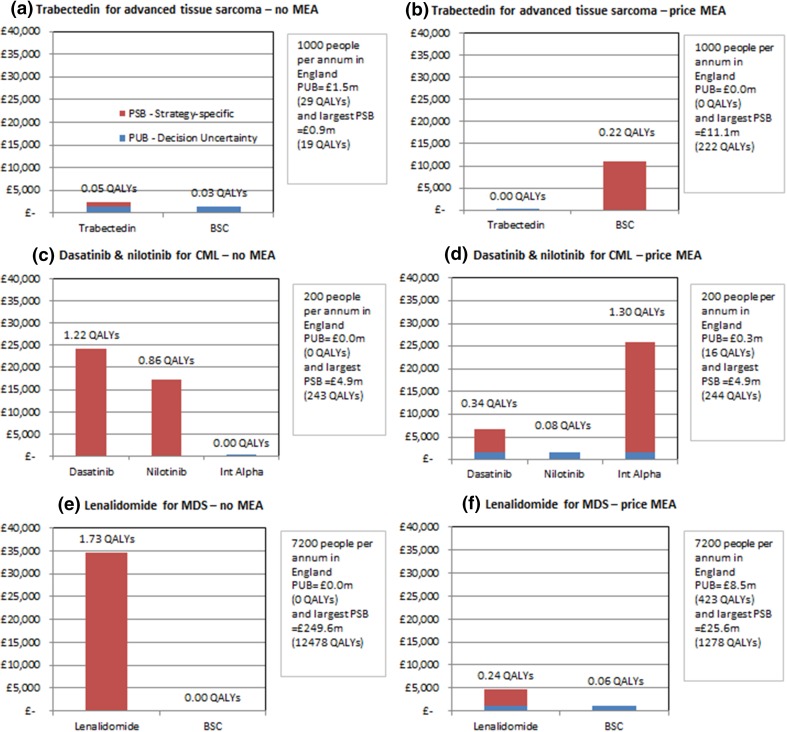
We develop the 'HTA risk analysis chart', in which we present the payer strategy and uncertainty burden (P-SUB) as a measure of overall risk. The P-SUB consists of the payer uncertainty burden (PUB), the risk stemming from decision uncertainty as to which is the truly optimal technology from the relevant set of technologies, and the payer strategy burden (PSB), the additional risk of approving a technology that is not expected to be optimal. We demonstrate the approach using three recent technology appraisals from the UK National Institute for Health and Clinical Excellence (NICE), each of which considered a price-based MEA.
The HTA risk analysis chart was calculated using results from standard probabilistic sensitivity analyses. In all three HTAs, the new interventions were associated with substantial risk as measured by the P-SUB. For one of these technologies, the P-SUB was reduced to zero with the proposed price reduction, making this intervention cost effective with near complete certainty. For the other two, the risk reduced substantially with a much reduced PSB and a slightly increased PUB.
The HTA risk analysis chart shows the risk that the healthcare payer incurs under unresolved decision uncertainty and when considering recommending a technology that is not expected to be optimal given current evidence. This allows the simultaneous consideration of financial and data-collection MEA schemes in an easily understood format. The use of HTA risk analysis charts will help to ensure that MEAs are considered within a standard utility-maximising health economic decision-making framework.
药品监管环境的最新变化有时可能要求报销机构就证据基础较不成熟的技术发布指导意见。决策者需要意识到与这种卫生技术评估(HTA)决策相关的风险,以及通过管理准入协议(MEA)管理这种风险的可能性。
本研究旨在开发用于量化特定 MEA 相关风险的方法,并将其清晰地传达给决策者。
我们开发了“HTA 风险分析图表”,其中我们将支付者策略和不确定性负担(P-SUB)作为衡量总体风险的指标。P-SUB 由支付者不确定性负担(PUB)、由于决策不确定性而导致的风险组成,即从相关技术集合中选择真正最优技术的风险,以及支付者策略负担(PSB),即批准预期不是最优技术的额外风险。我们使用英国国家卫生与临床优化研究所(NICE)最近的三项技术评估来演示该方法,其中每一项都考虑了基于价格的 MEA。
HTA 风险分析图表是使用标准概率敏感性分析的结果计算得出的。在所有这三个 HTA 中,新干预措施的 P-SUB 表明存在重大风险。对于其中一种技术,通过拟议的降价,P-SUB 降至零,使得该干预措施具有成本效益,且几乎可以完全确定。对于其他两种技术,PSB 和 PUB 的风险均大幅降低。
HTA 风险分析图表显示了在未解决的决策不确定性下,医疗保健支付者承担的风险,以及在考虑推荐当前证据表明并非最优的技术时所承担的风险。这允许以易于理解的格式同时考虑财务和数据收集的 MEA 计划。使用 HTA 风险分析图表将有助于确保 MEA 在标准的效用最大化健康经济决策框架内得到考虑。