Golla Vera, Snow Kathryn, Mandalakas Anna M, Schaaf H Simon, Du Preez Karen, Hesseling Anneke C, Seddon James A
Desmond Tutu TB Centre, Department of Paediatrics and Child Health, Faculty of Medicine and Health Sciences, Stellenbosch University, PO Box 241, 8000, Cape Town, South Africa.
Department of Paediatrics, University of Melbourne, Melbourne, Australia.
BMC Infect Dis. 2017 Aug 29;17(1):593. doi: 10.1186/s12879-017-2668-2.
The relative fitness of organisms causing drug-susceptible (DS) and multidrug-resistant (MDR) tuberculosis (TB) is unclear. We compared the risk of TB infection and TB disease in young child household contacts of adults with confirmed DS-TB and MDR-TB.
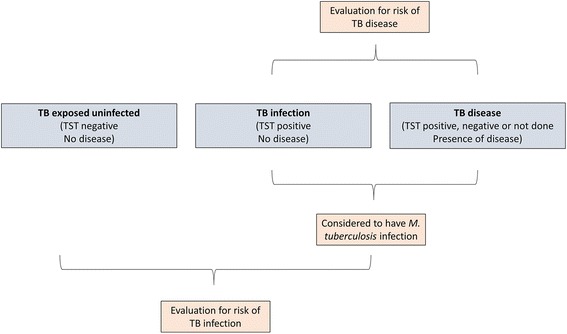
In this cross-sectional analysis we included data from two community-based contact cohort investigation studies conducted in parallel in Cape Town, South Africa. Children <5 years of age with household exposure to an infectious TB case were included between August 2008 to June 2011. Children completed investigation for TB infection (tuberculin skin test) and TB disease (symptom evaluation, chest radiograph, bacteriology) in both studies using standard approaches. The impact of MDR-TB exposure on each covariate of TB infection and TB disease was assessed using univariable and multivariable logistic regression.
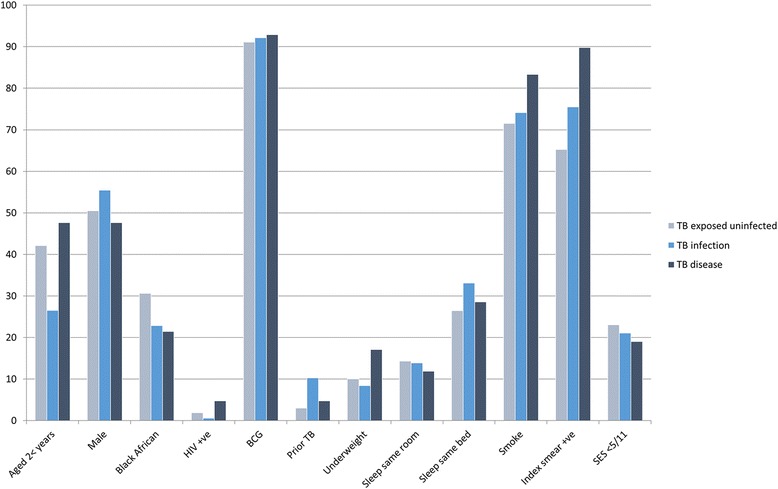
Of 538 children included, 312 had DS-TB and 226 had MDR-TB exposure. 107 children with DS-TB exposure had TB infection (34.3%) vs. 101 (44.7%) of children with MDR-TB exposure (adjusted Odds Ratio [aOR]: 2.05; 95% confidence interval [CI]: 1.34-3.12). A total of 15 (6.6%) MDR-TB vs. 27 (8.7%) DS-TB child contacts had TB disease at enrolment (aOR: 0.43; 95% CI: 0.19-0.97).
Our results suggest a higher risk of TB infection in child contacts with household MDR-TB vs. DS-TB exposure, but a lower risk of TB disease. Although potentially affected by residual confounding or selection bias, our results are consistent with the hypothesis of impaired virulence in MDR-TB strains in this setting.
引起药物敏感(DS)和耐多药(MDR)结核病(TB)的生物体的相对适应性尚不清楚。我们比较了确诊为DS-TB和MDR-TB的成人的幼儿家庭接触者中感染TB和患TB疾病的风险。
在这项横断面分析中,我们纳入了在南非开普敦同时进行的两项基于社区的接触队列调查研究的数据。2008年8月至2011年6月期间,纳入了5岁以下有家庭接触传染性TB病例的儿童。两项研究均采用标准方法对儿童进行TB感染(结核菌素皮肤试验)和TB疾病(症状评估、胸部X光片、细菌学检查)调查。使用单变量和多变量逻辑回归评估MDR-TB暴露对TB感染和TB疾病的每个协变量的影响。
纳入的538名儿童中,312名有DS-TB暴露,226名有MDR-TB暴露。107名有DS-TB暴露的儿童感染了TB(34.3%),而101名有MDR-TB暴露的儿童感染了TB(44.7%)(调整后的优势比[aOR]:2.05;95%置信区间[CI]:1.34-3.12)。共有15名(6.6%)MDR-TB儿童接触者在入组时有TB疾病,而DS-TB儿童接触者有27名(8.7%)(aOR:0.43;95%CI:0.19-0.97)。
我们的结果表明,与DS-TB暴露的家庭接触儿童相比,MDR-TB暴露的家庭接触儿童感染TB的风险更高,但患TB疾病的风险更低。尽管可能受到残余混杂因素或选择偏倚的影响,但我们的结果与在这种情况下MDR-TB菌株毒力受损的假设一致。