Department of Chronic Communicable Disease, Center for Disease Control and Prevention of Jiangsu Province, Nanjing, Jiangsu Province, People's Republic of China.
School of Medicine, Division of Infectious Diseases and Geographic Medicine, Stanford University, Stanford, California.
Am J Trop Med Hyg. 2018 Feb;98(2):364-371. doi: 10.4269/ajtmh.17-0325. Epub 2017 Nov 30.
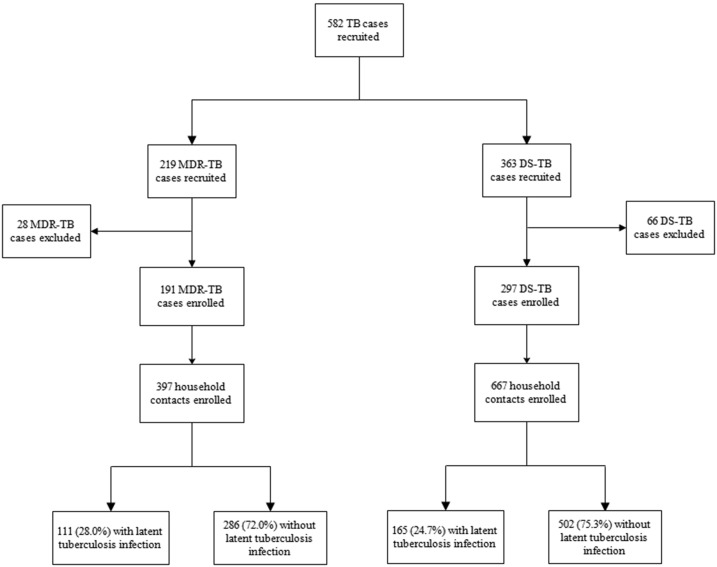
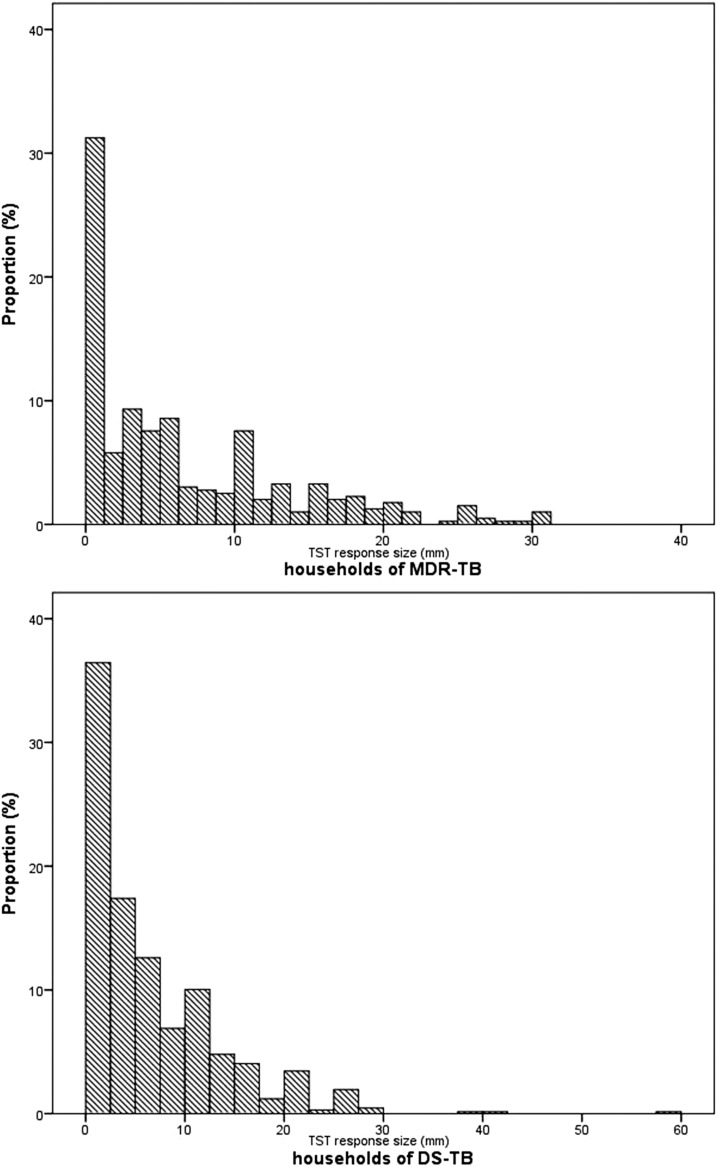
Primary transmission is an important driver of the global epidemic of resistance to tuberculosis drugs. A few studies have compared tuberculosis infection in contacts of index cases with different drug-resistant profiles, suggesting that contacts of multidrug-resistant (MDR) tuberculosis cases are at higher risk. Repeated tuberculosis exposure in contacts of MDR tuberculosis patients through recurrent tuberculosis may modify this relationship. We compared tuberculosis infection in household contacts of MDR and drug-susceptible (DS) tuberculosis patients from six cities in southeastern China and investigated whether repeated tuberculosis exposure was a mediating factor. Tuberculosis infection was defined as a tuberculin skin test induration ≥ 10 mm. In all, 111 (28.0%) of 397 household contacts of MDR tuberculosis patients and 165 (24.7%) of 667 contacts of DS tuberculosis index cases were infected with tuberculosis. In a multivariate model not including the previous tuberculosis exposure, contacts of MDR tuberculosis patients had a higher likelihood of tuberculosis infection (adjusted odds ratio [AOR] = 1.37; 95% confidence interval [CI] = 1.01-1.84; = 0.041). In a separate multivariate model adjusted for the previous tuberculosis exposure, the odds ratio of tuberculosis infection flipped and contacts of MDR cases were now at lower risk for tuberculosis infection (AOR = 0.55; 95% CI = 0.38-0.81; = 0.003). These findings suggest prior tuberculosis exposure in contacts strongly mediates the relationship between tuberculosis infection and the index drug resistance profile. Prior studies showing lower risk of developing tuberculosis among contacts of MDR tuberculosis patients may be partially explained by a lower rate of tuberculosis infection at baseline.
原发性传播是全球结核病耐药性流行的重要驱动因素。有一些研究比较了不同耐药谱指数病例的接触者中的结核病感染情况,表明耐多药(MDR)结核病病例的接触者面临更高的风险。通过复发性结核病,MDR 结核病患者的接触者反复暴露于结核病可能会改变这种关系。我们比较了来自中国东南部六个城市的 MDR 和药敏(DS)结核病患者的家庭接触者中的结核病感染情况,并调查了重复的结核病暴露是否是一个中介因素。结核病感染定义为结核菌素皮肤试验硬结≥10mm。在所有 397 名 MDR 结核病患者的家庭接触者中,有 111 名(28.0%)和 667 名 DS 结核病指数病例的接触者中,有 165 名(24.7%)感染了结核病。在不包括先前结核病暴露的多变量模型中,MDR 结核病患者的接触者更有可能感染结核病(调整后的优势比[OR] = 1.37;95%置信区间[CI] = 1.01-1.84;P = 0.041)。在单独调整了先前结核病暴露的多变量模型中,结核病感染的比值比发生了翻转,MDR 病例的接触者现在结核病感染的风险较低(OR = 0.55;95%CI = 0.38-0.81;P = 0.003)。这些发现表明,接触者先前的结核病暴露强烈介导了结核病感染与指数耐药谱之间的关系。先前的研究表明,MDR 结核病患者的接触者患结核病的风险较低,这可能部分是由于基线时结核病感染率较低。