Yang Ching-Po, Samuels Tamsin J, Huang Yaling, Yang Lu, Ish-Horowicz David, Davis Ilan, Lee Tzumin
Howard Hughes Medical Institute, Janelia Research Campus, 19700 Helix Drive, Ashburn, VA 20147, USA.
Department of Biochemistry, University of Oxford, Oxford OX1 3QU, United Kingdom.
Development. 2017 Oct 1;144(19):3454-3464. doi: 10.1242/dev.149500. Epub 2017 Aug 29.
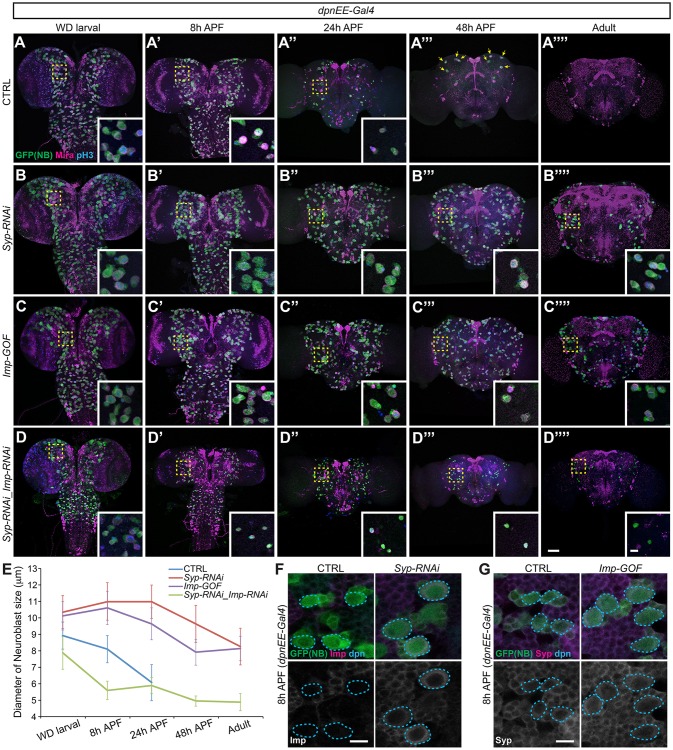
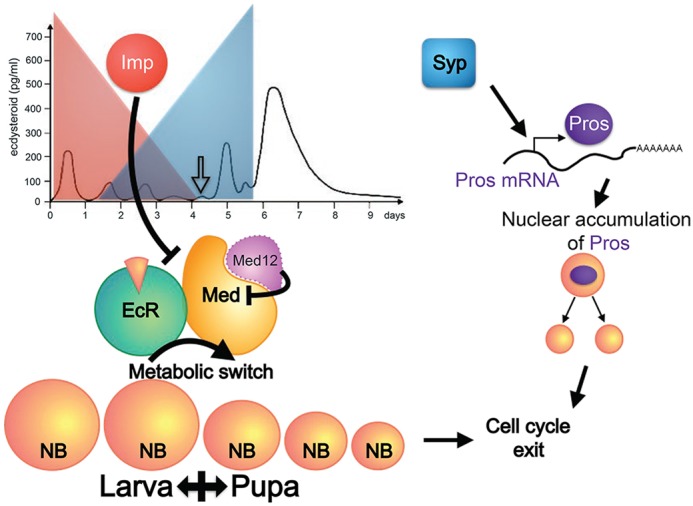
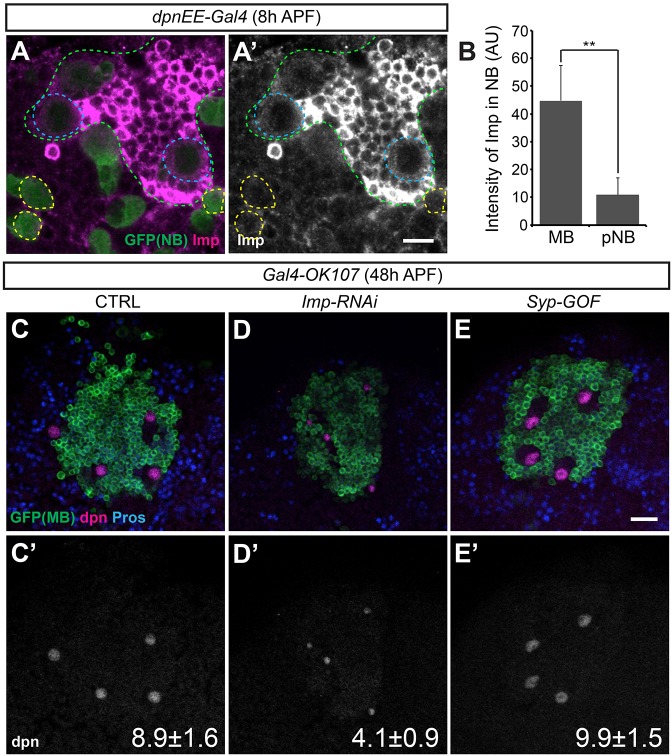
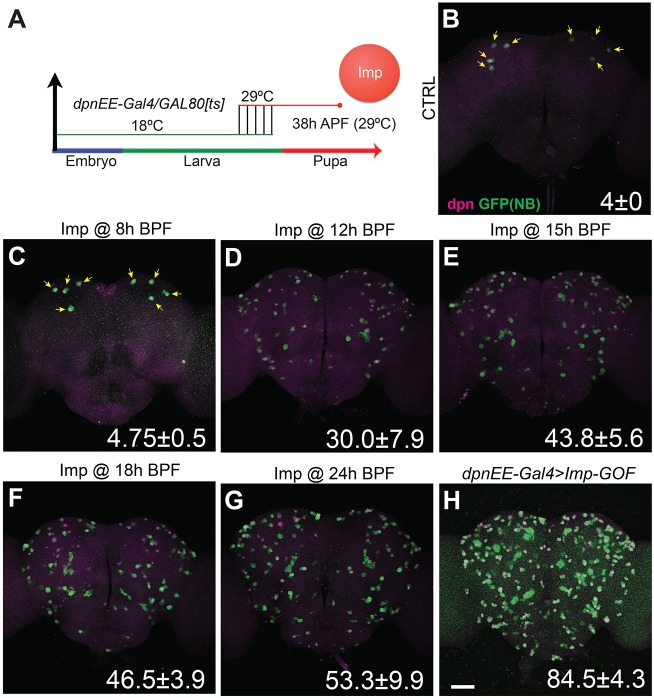
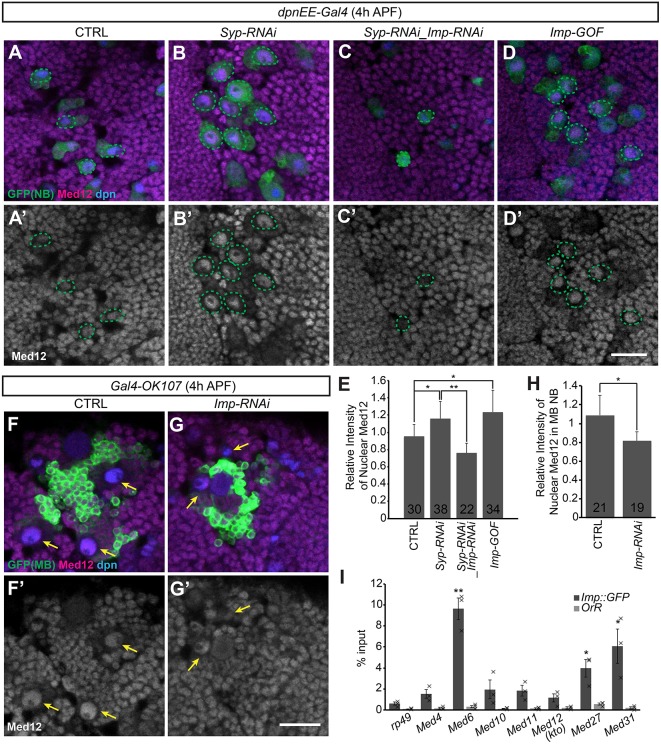
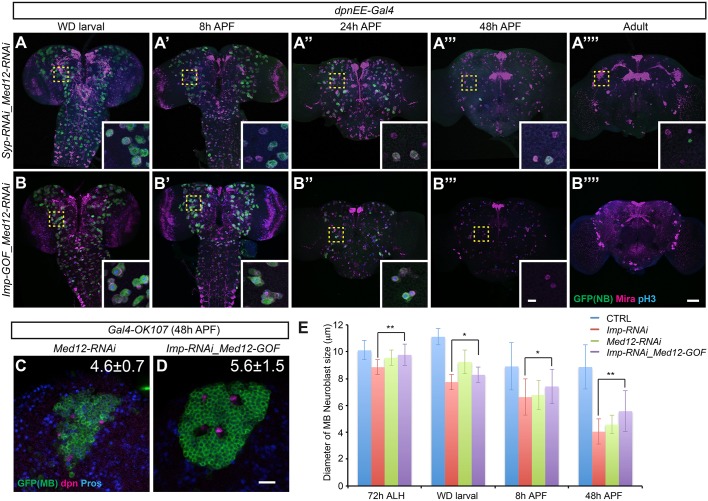
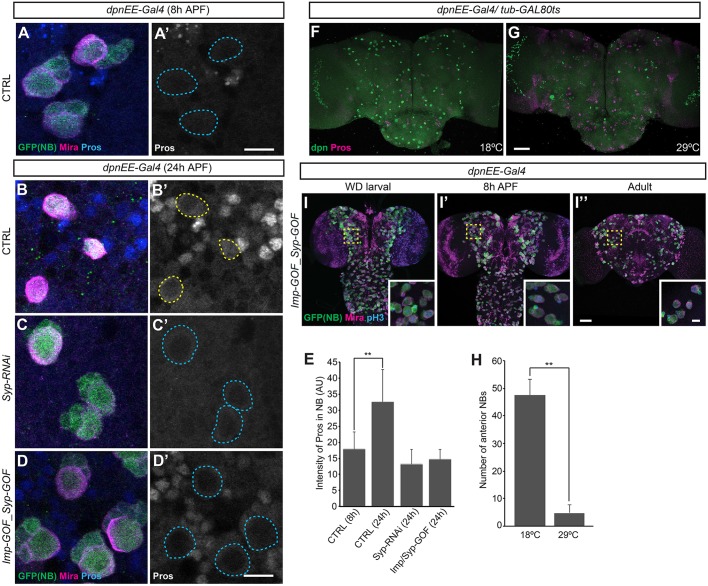
The termination of the proliferation of neural stem cells, also known as neuroblasts (NBs), requires a 'decommissioning' phase that is controlled in a lineage-specific manner. Most NBs, with the exception of those of the mushroom body (MB), are decommissioned by the ecdysone receptor and mediator complex, causing them to shrink during metamorphosis, followed by nuclear accumulation of Prospero and cell cycle exit. Here, we demonstrate that the levels of Imp and Syp RNA-binding proteins regulate NB decommissioning. Descending Imp and ascending Syp expression have been shown to regulate neuronal temporal fate. We show that Imp levels decline slower in the MB than in other central brain NBs. MB NBs continue to express Imp into pupation, and the presence of Imp prevents decommissioning partly by inhibiting the mediator complex. Late-larval induction of transgenic Imp prevents many non-MB NBs from decommissioning in early pupae. Moreover, the presence of abundant Syp in aged NBs permits Prospero accumulation that, in turn, promotes cell cycle exit. Together, our results reveal that progeny temporal fate and progenitor decommissioning are co-regulated in protracted neuronal lineages.
神经干细胞(也称为神经母细胞,NBs)增殖的终止需要一个以谱系特异性方式控制的“退役”阶段。除了蘑菇体(MB)的神经母细胞外,大多数神经母细胞通过蜕皮激素受体和中介体复合物退役,导致它们在变态过程中收缩,随后Prospero在细胞核中积累并退出细胞周期。在这里,我们证明了Imp和Syp RNA结合蛋白的水平调节神经母细胞的退役。已表明下降的Imp表达和上升的Syp表达调节神经元的时间命运。我们发现,蘑菇体中的Imp水平下降速度比其他中枢脑区神经母细胞慢。蘑菇体神经母细胞在化蛹前持续表达Imp,Imp的存在部分通过抑制中介体复合物来阻止退役。在幼虫后期诱导转基因Imp可防止许多非蘑菇体神经母细胞在蛹早期退役。此外,衰老神经母细胞中大量Syp的存在允许Prospero积累,进而促进细胞周期退出。总之,我们的结果表明,在持久的神经元谱系中,子代的时间命运和祖细胞的退役是共同调节的。