Nguyen Phuong-Khanh, Cheng Louise Y
Peter MacCallum Cancer Centre, Melbourne, Victoria 3000, Australia.
Department of Anatomy and Physiology, The University of Melbourne, Victoria 3010, Australia.
Oxf Open Neurosci. 2022 May 4;1:kvac004. doi: 10.1093/oons/kvac004. eCollection 2022.
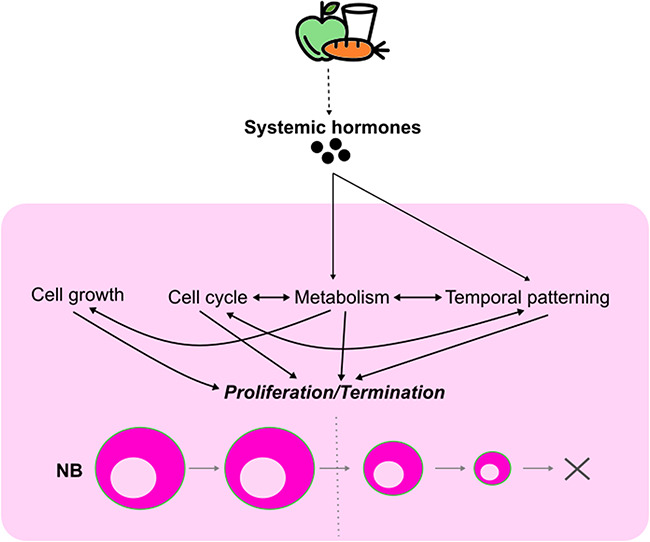
The formation of a functional circuitry in the central nervous system (CNS) requires the correct number and subtypes of neural cells. In the developing brain, neural stem cells (NSCs) self-renew while giving rise to progenitors that in turn generate differentiated progeny. As such, the size and the diversity of cells that make up the functional CNS depend on the proliferative properties of NSCs. In the fruit fly , where the process of neurogenesis has been extensively investigated, extrinsic factors such as the microenvironment of NSCs, nutrients, oxygen levels and systemic signals have been identified as regulators of NSC proliferation. Here, we review decades of work that explores how extrinsic signals non-autonomously regulate key NSC characteristics such as quiescence, proliferation and termination in the fly.
中枢神经系统(CNS)中功能性神经回路的形成需要正确数量和亚型的神经细胞。在发育中的大脑中,神经干细胞(NSCs)自我更新,同时产生祖细胞,祖细胞进而产生分化的后代。因此,构成功能性中枢神经系统的细胞大小和多样性取决于神经干细胞的增殖特性。在果蝇中,神经发生过程已得到广泛研究,外部因素如神经干细胞的微环境、营养物质、氧水平和全身信号已被确定为神经干细胞增殖的调节因子。在这里,我们回顾了几十年来的研究工作,这些工作探索了外部信号如何非自主地调节果蝇中神经干细胞的关键特性,如静止、增殖和终止。