van Lieshout Eline C C, Visser-Meily Johanna M A, Neggers Sebastiaan F W, van der Worp H Bart, Dijkhuizen Rick M
Biomedical MR Imaging and Spectroscopy Group, Center for Image Sciences, University Medical Center Utrecht, Utrecht, The Netherlands.
Department of Rehabilitation, Brain Center Rudolf Magnus and Center of Excellence for Rehabilitation Medicine, University Medical Center, Utrecht, The Netherlands.
BMJ Open. 2017 Aug 28;7(8):e016566. doi: 10.1136/bmjopen-2017-016566.
Many patients with stroke have moderate to severe long-term sensorimotor impairments, often including inability to execute movements of the affected arm or hand. Limited recovery from stroke may be partly caused by imbalanced interaction between the cerebral hemispheres, with reduced excitability of the ipsilesional motor cortex while excitability of the contralesional motor cortex is increased. Non-invasive brain stimulation with inhibitory repetitive transcranial magnetic stimulation (rTMS) of the contralesional hemisphere may aid in relieving a post-stroke interhemispheric excitability imbalance, which could improve functional recovery. There are encouraging effects of theta burst stimulation (TBS), a form of TMS, in patients with chronic stroke, but evidence on efficacy and long-term effects on arm function of contralesional TBS in patients with subacute hemiparetic stroke is lacking.
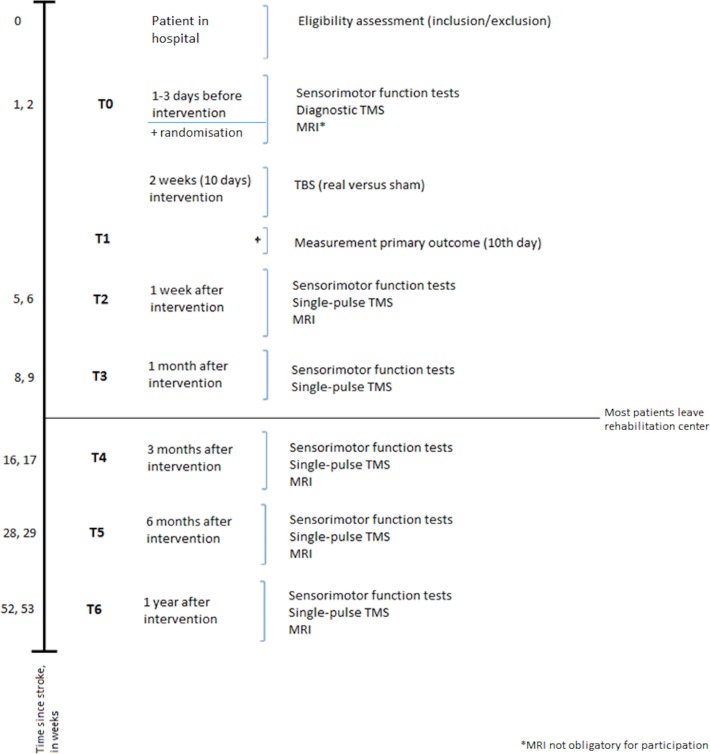
In a randomised clinical trial, we will assign 60 patients with a first-ever ischaemic stroke in the previous 7-14 days and a persistent paresis of one arm to 10 sessions of real stimulation with TBS of the contralesional primary motor cortex or to sham stimulation over a period of 2 weeks. Both types of stimulation will be followed by upper limb training. A subset of patients will undergo five MRI sessions to assess post-stroke brain reorganisation. The primary outcome measure will be the upper limb function score, assessed from grasp, grip, pinch and gross movements in the action research arm test, measured at 3 months after stroke. Patients will be blinded to treatment allocation. The primary outcome at 3 months will also be assessed in a blinded fashion.
The study has been approved by the Medical Research Ethics Committee of the University Medical Center Utrecht, The Netherlands. The results will be disseminated through (open access) peer-reviewed publications, networks of scientists, professionals and the public, and presented at conferences.
NTR6133.
许多中风患者存在中度至重度的长期感觉运动障碍,通常包括受影响的手臂或手部无法执行动作。中风后恢复有限可能部分是由于大脑半球之间的相互作用失衡,患侧运动皮层的兴奋性降低,而对侧运动皮层的兴奋性增加。对侧半球进行抑制性重复经颅磁刺激(rTMS)的非侵入性脑刺激可能有助于缓解中风后的半球间兴奋性失衡,从而改善功能恢复。theta爆发刺激(TBS)是rTMS的一种形式,对慢性中风患者有令人鼓舞的效果,但缺乏关于亚急性偏瘫性中风患者对侧TBS对手臂功能的疗效和长期影响的证据。
在一项随机临床试验中,我们将把60例在过去7至14天内首次发生缺血性中风且一侧手臂持续无力的患者,分配接受对侧初级运动皮层TBS的10次真实刺激,或在2周内接受假刺激。两种刺激之后都将进行上肢训练。一部分患者将接受五次MRI检查,以评估中风后脑重组情况。主要结局指标将是上肢功能评分,通过动作研究手臂测试中的抓握、紧握、捏取和整体动作进行评估,在中风后3个月测量。患者将对治疗分配不知情。3个月时的主要结局也将以盲法进行评估。
该研究已获得荷兰乌得勒支大学医学中心医学研究伦理委员会的批准。研究结果将通过(开放获取)同行评审出版物、科学家、专业人员和公众网络进行传播,并在会议上展示。
NTR6133。