University Medical Center Utrecht, Utrecht University, Utrecht, Netherlands.
De Hoogstraat Rehabilition Utrecht, Utrecht, Netherlands.
Neurorehabil Neural Repair. 2021 May;35(5):457-467. doi: 10.1177/15459683211005022. Epub 2021 Apr 7.
Assessment of skilled reaching enables extensive analysis of upper limb function in clinical and preclinical studies on poststroke outcome. However, translational research if often limited by lack of correspondence between tests of human and rodent motor function.
To determine (1) the translational value of skilled reaching performance for preclinical research by comparing the behavioral recovery profiles of skilled reaching characteristics between humans and rats recovering from stroke and (2) the relationship between skilled reaching performance and commonly used clinical outcome measures after stroke.
Twelve patients with ischemic or hemorrhagic stroke and 17 rats with photothrombotic stroke underwent an equivalent skilled reaching test at different time points, representing early to late subacute stages poststroke. Success scores and a movement element rating scale were used to measure the skilled reaching performance. The Fugl-Meyer Upper Extremity (FM-UE) assessment and the Action Research Arm Test (ARAT) were used as clinical outcome measures.
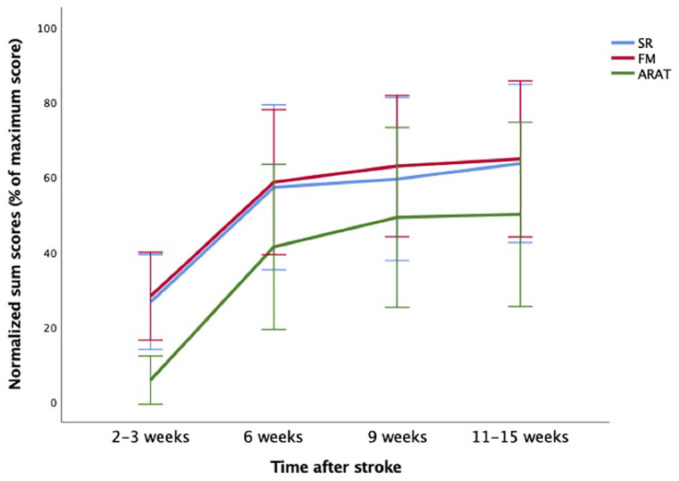
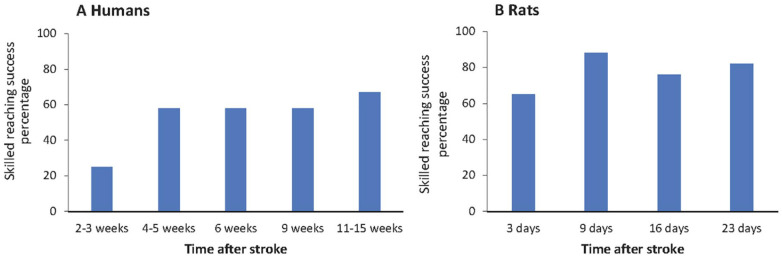
Both species had muscle flaccidity at the early subacute stage after stroke and showed motor recovery following a proximal-distal principle toward the early subacute stage, albeit for rats within a shorter time course. Human skilled reaching scores and FM-UE and ARAT scores in the first 3 months poststroke were significantly correlated ( < .05).
Our study demonstrates that poststroke changes in skilled reaching performance are highly similar between rats and humans and correspond with standard clinical outcome measures. Skilled reaching testing therefore offers an effective and highly translational means for assessment of motor recovery in experimental and clinical stroke settings.
评估熟练的伸手动作可以在脑卒中后结果的临床前和临床研究中对上肢功能进行广泛分析。然而,转化研究通常受到人类和啮齿动物运动功能测试之间缺乏对应关系的限制。
通过比较人类和脑卒中后恢复的大鼠在熟练伸手特征方面的技能恢复曲线,确定熟练伸手表现对临床前研究的转化价值;并确定熟练伸手表现与脑卒中后常用临床结局测量之间的关系。
12 名缺血性或出血性脑卒中患者和 17 只光血栓性脑卒中大鼠在不同时间点接受了等效的熟练伸手测试,代表脑卒中后早期至晚期亚急性期。使用成功评分和运动元素评分量表来测量熟练伸手表现。使用 Fugl-Meyer 上肢(FM-UE)评估和动作研究上肢测试(ARAT)作为临床结局测量。
两种物种在脑卒中后早期亚急性期都有肌肉弛缓,并且都表现出朝着早期亚急性期的远近原则的运动恢复,尽管大鼠的时间过程较短。脑卒中后 3 个月内,人类的熟练伸手得分与 FM-UE 和 ARAT 得分显著相关(<0.05)。
我们的研究表明,大鼠和人类脑卒中后熟练伸手表现的变化高度相似,与标准临床结局测量相对应。因此,熟练伸手测试为评估实验和临床脑卒中环境中的运动恢复提供了一种有效且高度转化的方法。