Gyan Thomas, McAuley Kimberley, O'Leary Maureen, Strobel Natalie A, Edmond Karen M
Division of Paediatrics, School of Medicine, Faculty of Health and Medical Sciences, University of Western Australia, Perth, Australia.
Maternal, Newborn and Adolescent Health Cluster, Kintampo Health Research Centre, Ghana Health Service, Kintampo, Ghana.
BMJ Open. 2017 Aug 29;7(8):e018185. doi: 10.1136/bmjopen-2017-018185.
This study assessed healthcare seeking patterns of families of infants with circumcision-related morbidities and families of infants with acute illnesses in rural Ghana.
Two population-based cohort studies.
Brong Ahafo Region of central rural Ghana.
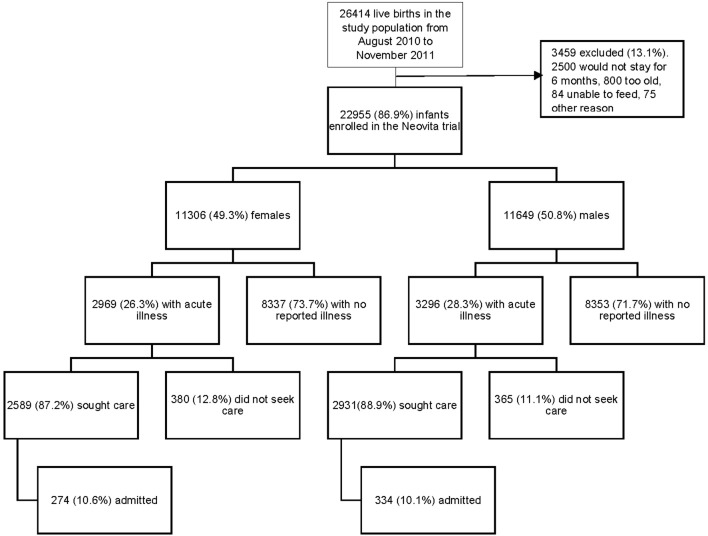
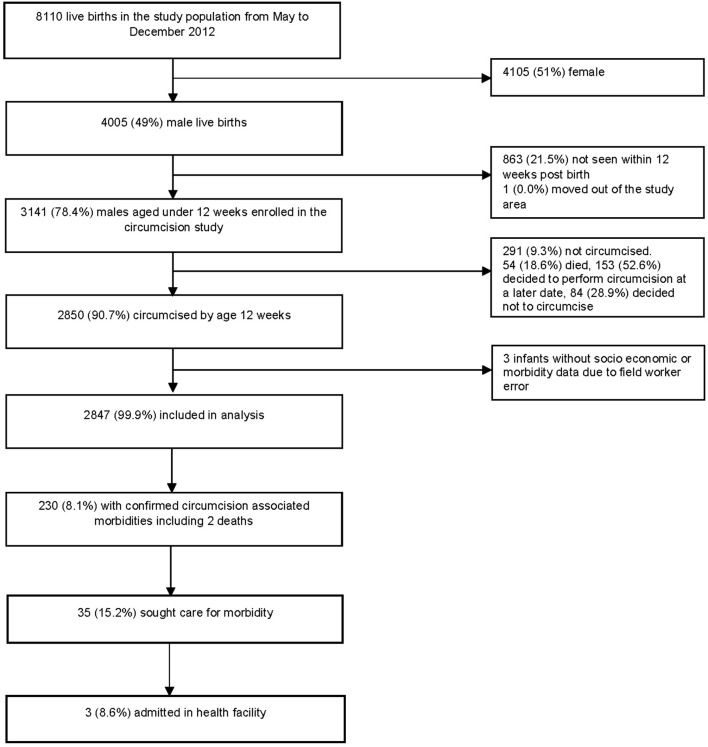
A total of 22 955 infants enrolled in a large population-based trial (Neovita trial) from 16 August 2010 to 7 November 2011 and 3141 infants in a circumcision study from 21 May 2012 to 31 December 2012.
Care seeking for circumcision-related morbidities and acute illnesses unrelated to circumcision.
Two hundred and thirty (8.1%) infants from the circumcision study had circumcision-related morbidities and 6265 (27.3%) infants from the Neovita study had acute illnesses unrelated to circumcision. A much lower proportion (35, 15.2%) of families of infants with circumcision-related morbidities sought healthcare compared with families of infants with acute illnesses in the Neovita study (5520, 88.1%). More families sought care from formal providers (24, 69%) compared with informal providers (11, 31%) for circumcision-related morbidities. There were no obvious determinants of care seeking for acute illnesses or circumcision-related morbidities in the population.
Government and non-government organisations need to improve awareness about the complications and care seeking needed for circumcision-related morbidities.
本研究评估了加纳农村地区患有包皮环切术相关疾病的婴儿家庭以及患有急性疾病的婴儿家庭的就医模式。
两项基于人群的队列研究。
加纳中部农村的布朗阿哈福地区。
2010年8月16日至2011年11月7日,共有22955名婴儿参加了一项大型基于人群的试验(Neovita试验);2012年5月21日至2012年12月31日,3141名婴儿参加了一项包皮环切术研究。
针对包皮环切术相关疾病和与包皮环切术无关的急性疾病寻求治疗。
包皮环切术研究中的230名(8.1%)婴儿患有包皮环切术相关疾病,Neovita研究中的6265名(27.3%)婴儿患有与包皮环切术无关的急性疾病。与Neovita研究中患有急性疾病的婴儿家庭(5520名,88.1%)相比,患有包皮环切术相关疾病的婴儿家庭寻求医疗保健的比例要低得多(35名,15.2%)。对于包皮环切术相关疾病,更多家庭向正规医疗机构寻求治疗(24名,69%),而非正规医疗机构(11名,31%)。该人群中,对于急性疾病或包皮环切术相关疾病寻求治疗没有明显的决定因素。
政府和非政府组织需要提高对包皮环切术相关疾病并发症及所需治疗的认识。