School of Biotechnology and Biomolecular Sciences, University of New South Wales, Sydney, New South Wales, Australia.
Public Health Microbiology Laboratory, Forensic and Scientific Services, Queensland Department of Health, Brisbane, Queensland, Australia.
Sci Rep. 2017 Aug 29;7(1):9733. doi: 10.1038/s41598-017-06079-1.
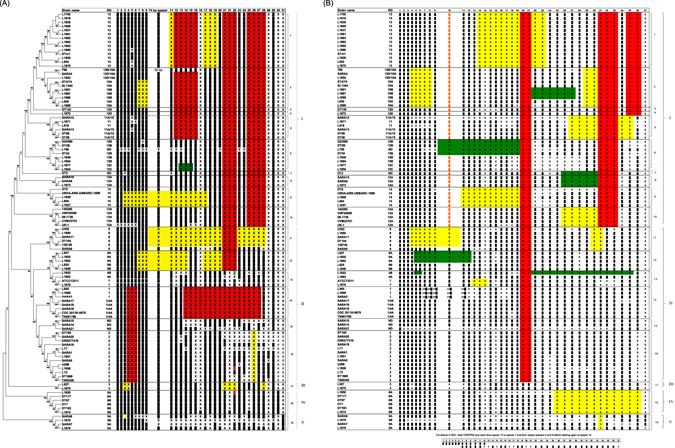
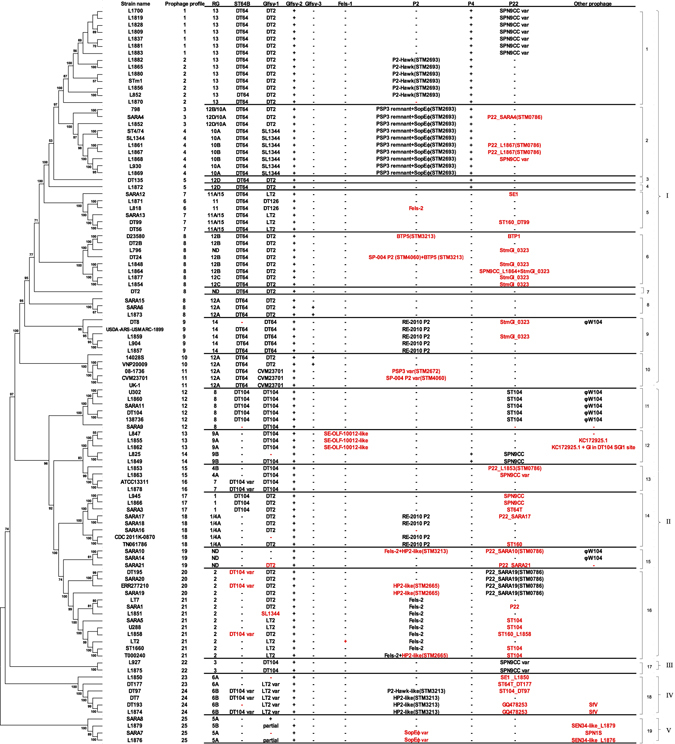
Salmonella enterica subsp enterica serovar Typhimurium (S. Typhimurium) is a serovar with broad host range. To determine the genomic diversity of S. Typhimurium, we sequenced 39 isolates (37 Australian and 2 UK isolates) representing 14 Repeats Groups (RGs) determined primarily by clustered regularly interspaced short palindromic repeats (CRISPR). Analysis of single nucleotide polymorphisms (SNPs) among the 39 isolates yielded an average of 1,232 SNPs per isolate, ranging from 128 SNPs to 11,339 SNPs relative to the reference strain LT2. Phylogenetic analysis of the 39 isolates together with 66 publicly available genomes divided the 105 isolates into five clades and 19 lineages, with the majority of the isolates belonging to clades I and II. The composition of CRISPR profiles correlated well with the lineages, showing progressive deletion and occasional duplication of spacers. Prophage genes contributed nearly a quarter of the S. Typhimurium accessory genome. Prophage profiles were found to be correlated with lineages and CRISPR profiles. Three new variants of HP2-like P2 prophage, several new variants of P22 prophage and a plasmid-like genomic island StmGI_0323 were found. This study presents evidence of horizontal transfer from other serovars or species and provides a broader understanding of the global genomic diversity of S. Typhimurium.
鼠伤寒沙门氏菌亚种鼠伤寒血清型(S. Typhimurium)是一种宿主范围广泛的血清型。为了确定 S. Typhimurium 的基因组多样性,我们对 39 株代表 14 个重复群(RGs)的分离株进行了测序,这些分离株主要由成簇的规则间隔短回文重复序列(CRISPR)确定。对 39 株分离株中的单核苷酸多态性(SNPs)进行分析,平均每个分离株产生 1,232 个 SNPs,相对于参考菌株 LT2,范围从 128 个 SNPs 到 11,339 个 SNPs。对 39 株分离株与 66 个公开可用基因组的系统发育分析将 105 株分离株分为五个枝系和 19 个谱系,其中大多数分离株属于枝系 I 和 II。CRISPR 图谱的组成与谱系密切相关,显示间隔区的渐进性缺失和偶尔的重复。噬菌体基因几乎占鼠伤寒沙门氏菌辅助基因组的四分之一。噬菌体图谱与谱系和 CRISPR 图谱相关。发现了三种新的 HP2 样 P2 噬菌体变体、几种新的 P22 噬菌体变体和一个质粒样基因组岛 StmGI_0323。这项研究提供了来自其他血清型或物种的水平转移的证据,并更广泛地了解了鼠伤寒沙门氏菌的全球基因组多样性。