María Carmen Cenit, Yolanda Sanz, Microbial Ecology, Nutrition and Health Research Group, Institute of Agrochemistry and Food Technology, National Research Council (IATA-CSIC), Paterna, 46980 Valencia, Spain.
World J Gastroenterol. 2017 Aug 14;23(30):5486-5498. doi: 10.3748/wjg.v23.i30.5486.
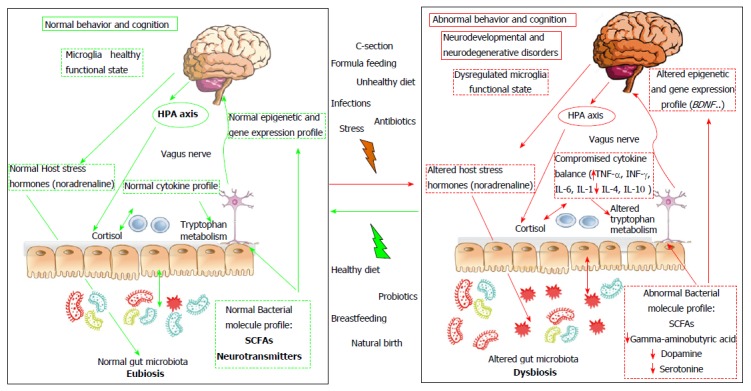
The last decade has witnessed a growing appreciation of the fundamental role played by an early assembly of a diverse and balanced gut microbiota and its subsequent maintenance for future health of the host. Gut microbiota is currently viewed as a key regulator of a fluent bidirectional dialogue between the gut and the brain (gut-brain axis). A number of preclinical studies have suggested that the microbiota and its genome (microbiome) may play a key role in neurodevelopmental and neurodegenerative disorders. Furthermore, alterations in the gut microbiota composition in humans have also been linked to a variety of neuropsychiatric conditions, including depression, autism and Parkinson's disease. However, it is not yet clear whether these changes in the microbiome are causally related to such diseases or are secondary effects thereof. In this respect, recent studies in animals have indicated that gut microbiota transplantation can transfer a behavioral phenotype, suggesting that the gut microbiota may be a modifiable factor modulating the development or pathogenesis of neuropsychiatric conditions. Further studies are warranted to establish whether or not the findings of preclinical animal experiments can be generalized to humans. Moreover, although different communication routes between the microbiota and brain have been identified, further studies must elucidate all the underlying mechanisms involved. Such research is expected to contribute to the design of strategies to modulate the gut microbiota and its functions with a view to improving mental health, and thus provide opportunities to improve the management of psychiatric diseases. Here, we review the evidence supporting a role of the gut microbiota in neuropsychiatric disorders and the state of the art regarding the mechanisms underlying its contribution to mental illness and health. We also consider the stages of life where the gut microbiota is more susceptible to the effects of environmental stressors, and the possible microbiota-targeted intervention strategies that could improve health status and prevent psychiatric disorders in the near future.
过去十年,人们越来越认识到早期形成多样化和平衡的肠道微生物群及其随后对宿主未来健康的维持所起的基本作用。肠道微生物群目前被视为肠道和大脑(肠道-大脑轴)之间流畅双向对话的关键调节剂。许多临床前研究表明,微生物群及其基因组(微生物组)可能在神经发育和神经退行性疾病中发挥关键作用。此外,人类肠道微生物群组成的改变也与多种神经精神疾病有关,包括抑郁症、自闭症和帕金森病。然而,目前尚不清楚这些微生物组的变化是否与这些疾病有因果关系,还是其继发效应。在这方面,最近的动物研究表明,肠道微生物群移植可以转移行为表型,这表明肠道微生物群可能是调节神经精神疾病发展或发病机制的可改变因素。需要进一步的研究来确定临床前动物实验的结果是否可以推广到人类。此外,尽管已经确定了微生物群和大脑之间的不同通讯途径,但仍需要进一步的研究来阐明所有涉及的潜在机制。这种研究有望有助于设计调节肠道微生物群及其功能的策略,以改善心理健康,从而为改善精神疾病的管理提供机会。在这里,我们回顾了支持肠道微生物群在神经精神疾病中的作用的证据,并介绍了其对精神疾病和健康的贡献的潜在机制的最新进展。我们还考虑了肠道微生物群更容易受到环境应激源影响的生命阶段,以及可能的针对微生物群的干预策略,这些策略可能在不久的将来改善健康状况并预防精神疾病。