Yang Andrew, Peng Shiwen, Farmer Emily, Zeng Qi, Cheng Max A, Pang Xiaowu, Wu T-C, Hung Chien-Fu
Department of Pathology, Johns Hopkins Medical Institutions, Baltimore, MD USA.
Department of Oral Pathology, Howard University College of Dentistry, Washington, DC USA.
Cell Biosci. 2017 Aug 23;7:46. doi: 10.1186/s13578-017-0171-5. eCollection 2017.
Human papillomavirus (HPV) has been identified as the primary etiologic factor of cervical cancer, the fourth leading cause of cancer death in females worldwide. We have previously shown that coadministration of DNA encoding L1 capsid protein of Bovine papillomavirus (BPV) can enhance the antigen-specific immune response elicited by a therapeutic HPV16-E7 DNA vaccination. In this study, we sought to generate and evaluate the immunogenicity of a therapeutic HPV16-E7 DNA vaccine that encodes the fusion construct of HPV16-E7 and BPV-L1.
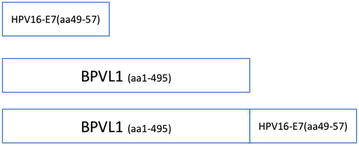
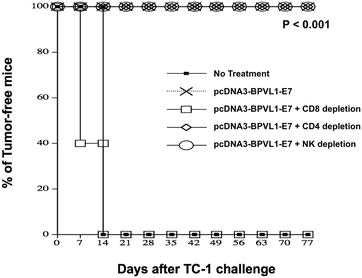
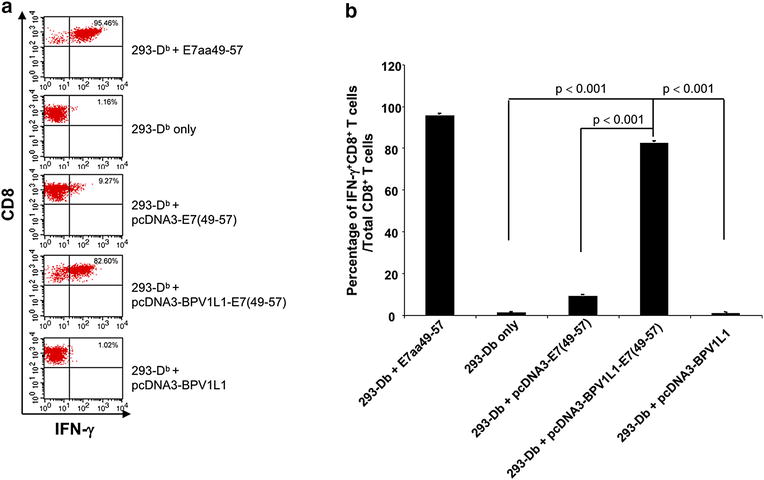
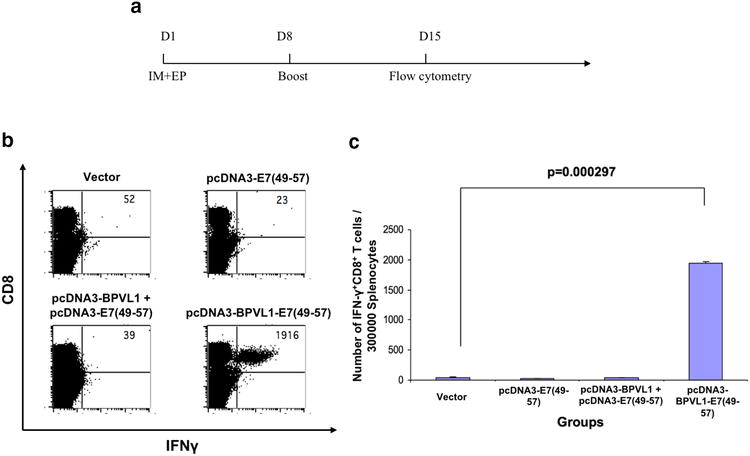
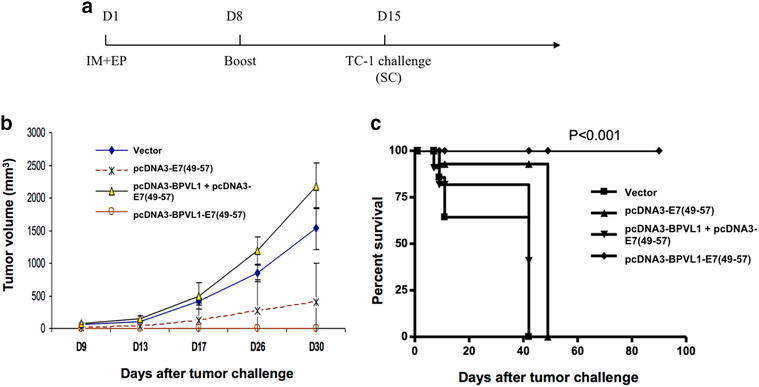
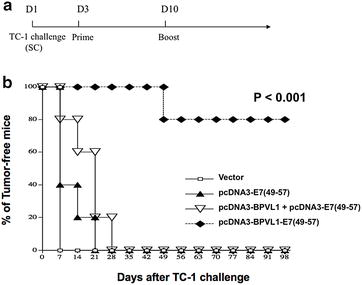
We generated a therapeutic HPV16-E7 DNA vaccine construct, pcDNA3-BPVL1-E7(49-57), encoding the fusion sequence of full-length BPVL1 protein and a murine E7 antigenic epitope, aa49-57. Transfecting 293-D cells with pcDNA3-BPVL1-E7(49-57) demonstrated that this DNA construct can effectively lead to the presentation of E7 epitope for the activation of E7-specific CD8+ T cells in vitro. Intramuscular vaccination of pcDNA3-BPVL1-E7(49-57) with electroporation generated a stronger E7-specific CD8+ T cell-mediated immune response than coadministration of pcDNA3-BPVL1 and pcDNA3-E7(49-57) in C57BL/6 mice. Furthermore, we observed that the strong E7-specific CD8+ T cell response elicited by pcDNA3-BPVL1-E7(49-57) vaccination translated into potent protective and therapeutic antitumor effects in C57BL/6 mice against HPV16-E7 expressing TC-1 tumor cells. Finally, using antibody depletion experiment, we showed that the antitumor immune response generated by pcDNA3-BPVL1-E7(49-57) is CD8+ T cell dependent, and CD4+ T cell and NK cell independent.
Treatment with fusion construct of BPV-L1 and HPV16-E7 epitope can elicit effective E7-specific antitumor immune response in mice. Due to the potential ability of the fusion DNA construct to also trigger immune responses specific to the L1 protein, the current study serves to support future design of HPV DNA vaccines encoding fusion HPVL1-E6/E7 constructs for the generation of both T cell and B cell mediated immune responses against HPV infections and associated diseases.
人乳头瘤病毒(HPV)已被确认为宫颈癌的主要病因,宫颈癌是全球女性癌症死亡的第四大原因。我们之前已经表明,共同给予编码牛乳头瘤病毒(BPV)L1衣壳蛋白的DNA可以增强治疗性HPV16-E7 DNA疫苗引发的抗原特异性免疫反应。在本研究中,我们试图构建并评估一种治疗性HPV16-E7 DNA疫苗的免疫原性,该疫苗编码HPV16-E7与BPV-L1的融合构建体。
我们构建了一种治疗性HPV16-E7 DNA疫苗构建体pcDNA3-BPVL1-E7(49-57),其编码全长BPVL1蛋白与鼠E7抗原表位aa49-57的融合序列。用pcDNA3-BPVL1-E7(49-57)转染293-D细胞表明,该DNA构建体在体外可有效导致E7表位的呈递,以激活E7特异性CD8+ T细胞。在C57BL/6小鼠中,通过电穿孔进行pcDNA3-BPVL1-E7(49-57)肌肉内接种产生了比共同给予pcDNA3-BPVL1和pcDNA3-E7(49-57)更强的E7特异性CD8+ T细胞介导的免疫反应。此外,我们观察到,pcDNA3-BPVL1-E7(49-57)接种引发的强烈E7特异性CD8+ T细胞反应转化为C57BL/6小鼠对表达HPV16-E7的TC-1肿瘤细胞的有效保护和治疗性抗肿瘤作用。最后,通过抗体清除实验,我们表明pcDNA3-BPVL1-E7(49-57)产生的抗肿瘤免疫反应依赖于CD8+ T细胞,而不依赖于CD4+ T细胞和NK细胞。
用BPV-L1与HPV16-E7表位的融合构建体进行治疗可在小鼠中引发有效的E7特异性抗肿瘤免疫反应。由于融合DNA构建体还具有触发针对L1蛋白的特异性免疫反应的潜在能力,本研究有助于支持未来设计编码融合HPVL1-E6/E7构建体的HPV DNA疫苗,以产生针对HPV感染及相关疾病的T细胞和B细胞介导的免疫反应。