Wander Katherine, Shell-Duncan Bettina, Brindle Eleanor
Department of Anthropology, Binghamton University (SUNY), Binghamton, NY, USA.
Department of Anthropology, University of Washington, Seattle, WA, USA.
Evol Med Public Health. 2017 Jun 28;2017(1):109-119. doi: 10.1093/emph/eox010. eCollection 2017.
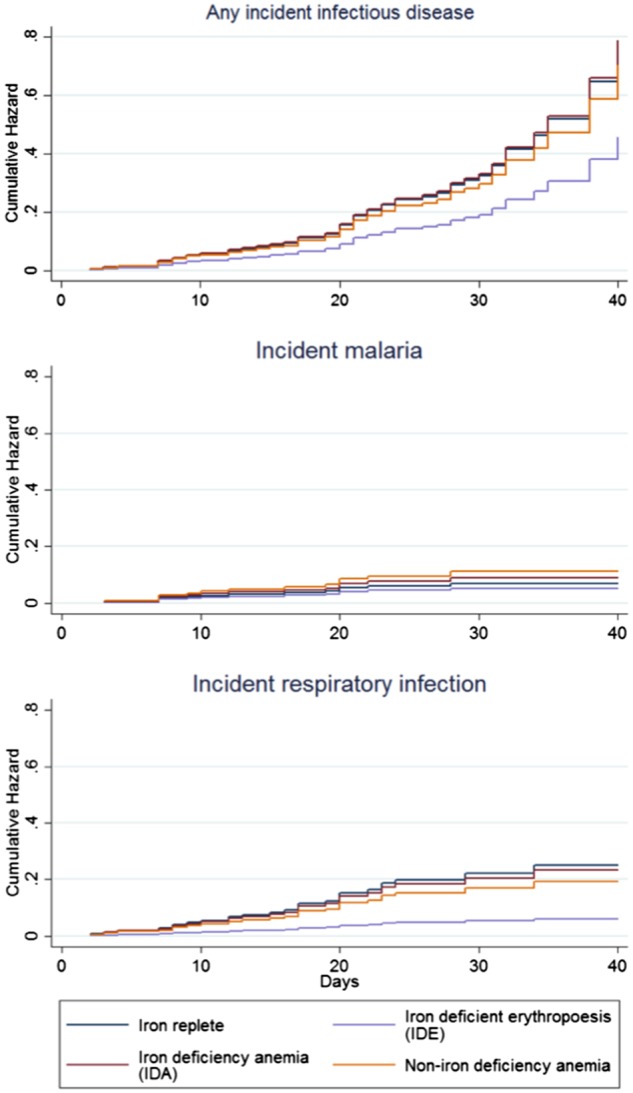
: We posited a trade-off in iron nutrition, with iron deficiency decreasing risk for infection by depriving infectious agents of iron while increasing risk for infection by compromising immune protection. We described associations between iron deficiency and prevalent and incident infectious disease episodes and cell-mediated immunity (CMI) among 283 children in Kilimanjaro, Tanzania. : Whole blood specimens were evaluated for hemoglobin and dried blood spots (DBS) were evaluated for biomarkers of iron deficiency (transferrin receptor) and inflammation (C-reactive protein and α-acid glycoprotein). Prevalent and incident infectious disease episodes were identified by physician's diagnosis. CMI was evaluated as delayed-type hypersensitivity to (DTH-). Associations between iron status and elevated inflammation, prevalent infectious disease episodes and DTH- were described with logistic regression models; associations between iron status and incident infectious disease episodes were described with Cox proportional hazards models. Elevated inflammation and diagnosed infectious diseases were more common among children with iron-deficiency anemia (IDA, severe iron deficiency), but not significantly so. The incidence of infectious disease was lowest among children with moderate iron deficiency (iron-deficient erythropoiesis, IDE); this pattern was most apparent for respiratory infections (aHR: 0.24; p: 0.030). DTH- was not compromised among children with any degree of iron deficiency. We observed no adverse effect of iron deficiency on CMI, but did observe patterns consistent with the hypothesis that moderate iron deficiency respiratory infections and may represent a nutritional adaptation to infectious disease. This suggests that interventions targeting iron deficiency should be coupled with effective infectious disease control measures.
我们假设在铁营养方面存在一种权衡,缺铁通过剥夺感染因子的铁来降低感染风险,同时通过损害免疫保护来增加感染风险。我们描述了坦桑尼亚乞力马扎罗的283名儿童中缺铁与常见和新发传染病发作以及细胞介导免疫(CMI)之间的关联。对全血样本进行血红蛋白评估,对干血斑(DBS)进行缺铁生物标志物(转铁蛋白受体)和炎症生物标志物(C反应蛋白和α-酸性糖蛋白)评估。通过医生诊断确定常见和新发传染病发作情况。将CMI评估为对[具体物质]的迟发型超敏反应(DTH-[具体物质])。用逻辑回归模型描述铁状态与炎症升高、常见传染病发作和DTH-[具体物质]之间的关联;用Cox比例风险模型描述铁状态与新发传染病发作之间的关联。炎症升高和确诊的传染病在缺铁性贫血(IDA,严重缺铁)儿童中更为常见,但差异不显著。中度缺铁(缺铁性红细胞生成,IDE)儿童的传染病发病率最低;这种模式在呼吸道感染中最为明显(风险比:0.24;P值:0.030)。任何程度缺铁的儿童的DTH-[具体物质]均未受损。我们未观察到缺铁对CMI有不良影响,但确实观察到与以下假设一致的模式:中度缺铁可预防呼吸道感染,可能代表对传染病的一种营养适应。这表明针对缺铁的干预措施应与有效的传染病控制措施相结合。