Lehmann Tim, Paschen Linda, Baumeister Jochen
Exercise Neuroscience & Health Lab, Institute of Health, Nutrition and Sport Sciences, University of Flensburg, Campusallee 2, 24943, Flensburg, Germany.
Exercise Science, Department of Exercise & Health, Faculty of Science, Paderborn University, Paderborn, Germany.
Sports Med Open. 2017 Aug 29;3(1):32. doi: 10.1186/s40798-017-0100-5.
Previous reports of single-leg assessment demonstrated functional deficits in postural stability following anterior cruciate ligament (ACL) injury. However, quantified measures describing postural stability vary among investigations and results seem not to be clear. The first aim of this systematic review was to quantify postural deficits in eyes open single-leg stance in patients after ACL injury. Moreover, the second aim was to examine the potential of traditional center of pressure (CoP) measures in order to distinguish postural stability between ACL patients and healthy controls.
A systematic literature search in the databases PubMed and Scopus was conducted from their inception to December 2016 to identify relevant articles. Eligibility criteria were limited to controlled trials of eyes open static single-leg stance on a force or pressure plate recording CoP measures in patients after ACL injury.
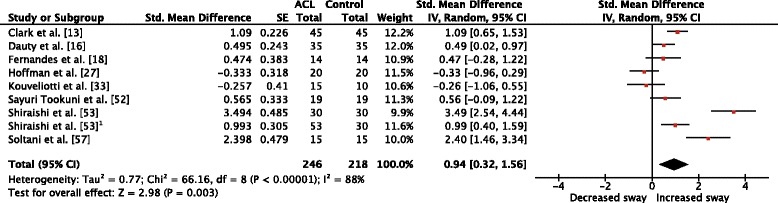
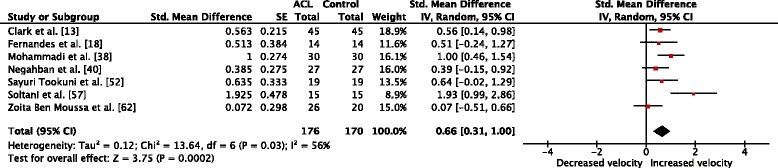
Eleven studies were included, involving a total of 329 ACL-injured and 265 control subjects. Random-effects meta-analysis showed significantly increased sway magnitudes (SMD = 0.94, p = 0.003) and velocities (SMD = 0.66, p = 0.0002) in the ACL group compared to the healthy controls. Sway magnitude in anteroposterior (SMD = 0.58, p = 0.02) and mediolateral (SMD = 1.15, p = 0.02) direction were significantly increased in ACL patients. No differences were found for the non-injured side. Similarly, no differences have been observed among ACL patients between the injured and non-injured side for sway velocity, while sway magnitude significantly differed (SMD = 0.58, p = 0.05).
The findings of this systematic review and meta-analysis demonstrated decreased postural stability in individuals with ACL injury. Sway magnitude and velocity were significantly increased in the ACL group compared to the healthy controls. Although the included research still exhibited considerable heterogeneity, it may be proposed that fundamental CoP measures are suitable to differentiate patients after ACL injury and healthy controls with respect to postural stability in eyes open single-leg stance.
先前关于单腿评估的报告显示,前交叉韧带(ACL)损伤后姿势稳定性存在功能缺陷。然而,描述姿势稳定性的量化指标在不同研究中有所不同,结果似乎并不明确。本系统评价的首要目的是量化ACL损伤患者睁眼单腿站立时的姿势缺陷。此外,第二个目的是检验传统压力中心(CoP)测量指标区分ACL患者和健康对照者姿势稳定性的潜力。
在PubMed和Scopus数据库中从建库至2016年12月进行系统文献检索,以识别相关文章。纳入标准仅限于对ACL损伤患者在测力板或压力板上进行睁眼静态单腿站立并记录CoP测量指标的对照试验。
共纳入11项研究,涉及329例ACL损伤患者和265例对照者。随机效应荟萃分析显示,与健康对照者相比,ACL组的摆动幅度(标准化均数差[SMD]=0.94,p=0.003)和速度(SMD=0.66,p=0.0002)显著增加。ACL患者在前后方向(SMD=0.58,p=0.02)和内外侧方向(SMD=1.15,p=0.02)的摆动幅度显著增加。未受伤侧未发现差异。同样,ACL患者受伤侧和未受伤侧在摆动速度方面未观察到差异,但摆动幅度有显著差异(SMD=0.58,p=0.05)。
本系统评价和荟萃分析的结果表明,ACL损伤个体的姿势稳定性降低。与健康对照者相比,ACL组的摆动幅度和速度显著增加。尽管纳入的研究仍存在相当大的异质性,但可以提出,基本的CoP测量指标适用于区分ACL损伤患者和健康对照者在睁眼单腿站立时的姿势稳定性。