Cai Limei, Yu Rufen, Hao Xi, Ding Xiangcui
Department of Gynaecology and Obstetrics, Ruian People's Hospital, Ruian, Zhejiang, 325200, China.
Nanoscale Res Lett. 2017 Aug 29;12(1):509. doi: 10.1186/s11671-017-2253-z.
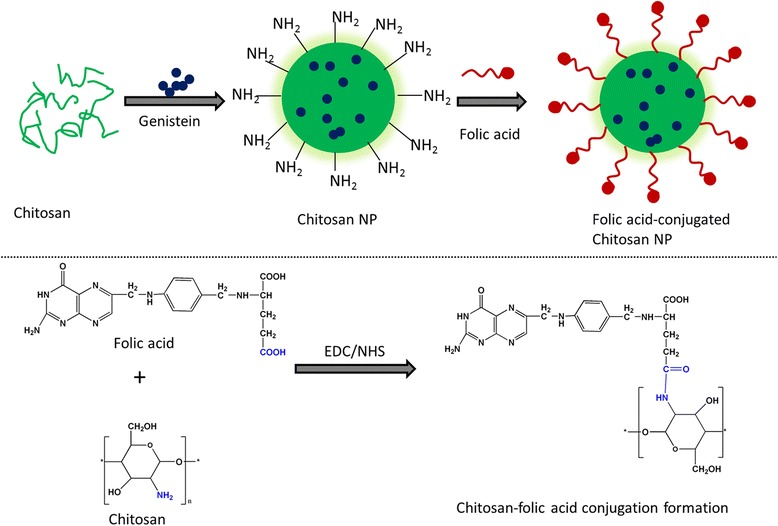
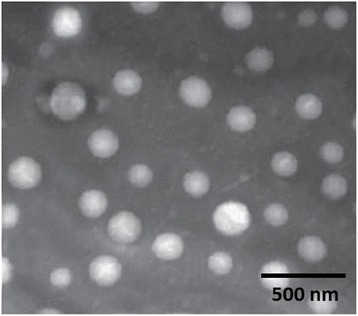
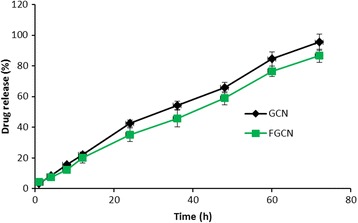
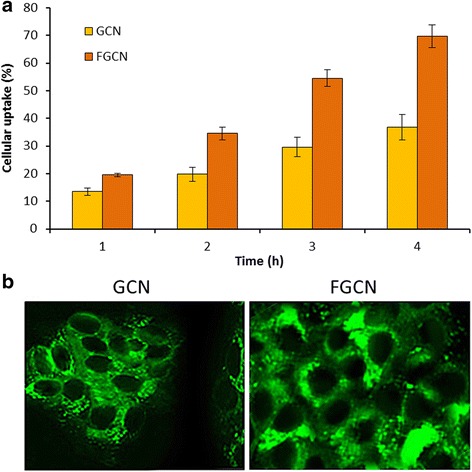
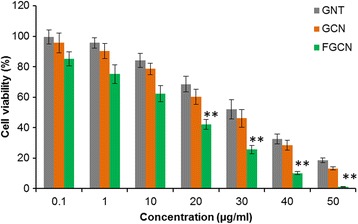
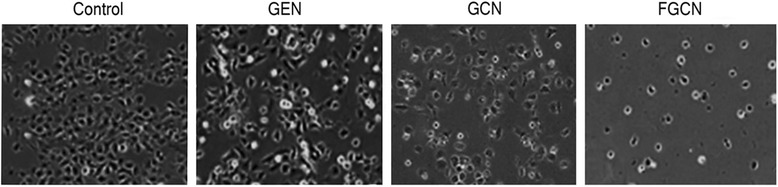
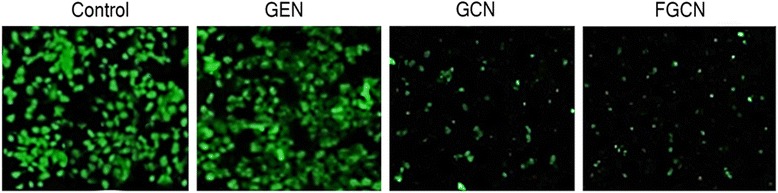
In this study, novel folic acid-conjugated chitosan nanoparticle was formulated for specific delivery of bioflavonoid, Genistein (GEN), to the cervical cancer cells. The prepared GEN-loaded chitosan nanoparticles (GCN) and folic acid-conjugated GCN (FGCN) showed smaller size with a controlled drug release profile. FGCN exhibited enhanced internalization potential in HeLa cells than that of GCN. The specific internalization of FGCN was mainly due to the affinity of folic acid (FA) with FRs-α which is present in large numbers in HeLa cells. The results revealed that FGCN has a specific affinity towards HeLa cells that will contribute to the better treatment. Folic acid-tagged nanoformulations exhibited a superior cytotoxic effect compared to that of non-targeted formulations. Consistently, IC50 value of GEN decreased from 33.8 to 14.6 μg/ml when treated with FGCN after 24 h incubation. The apoptosis studies indicated that the FGCN nanoparticles were then either GCN or free GEN in terms of anticancer activity. Overall, results revealed that folate conjugation to the delivery system might have great effect on the survival of cervical cancers that will be beneficial for overall cancer treatment.
在本研究中,制备了新型叶酸偶联壳聚糖纳米颗粒,用于将生物类黄酮染料木黄酮(GEN)特异性递送至宫颈癌细胞。所制备的负载GEN的壳聚糖纳米颗粒(GCN)和叶酸偶联的GCN(FGCN)粒径更小,且具有可控的药物释放曲线。FGCN在HeLa细胞中的内化潜力比GCN更强。FGCN的特异性内化主要归因于叶酸(FA)与HeLa细胞中大量存在的FRs-α的亲和力。结果表明,FGCN对HeLa细胞具有特异性亲和力,这将有助于更好地进行治疗。与非靶向制剂相比,叶酸标记的纳米制剂表现出更强的细胞毒性作用。同样,在孵育24小时后用FGCN处理时,GEN的IC50值从33.8降至14.6μg/ml。凋亡研究表明,就抗癌活性而言,FGCN纳米颗粒与GCN或游离GEN相当。总体而言,结果表明叶酸与递送系统的偶联可能对宫颈癌的存活有很大影响,这将有利于整体癌症治疗。