Hasan Md Mahmudul, Ahmed Qamar Uddin, Soad Siti Zaiton Mat, Latip Jalifah, Taher Muhammad, Syafiq Tengku Muhamad Faris, Sarian Murni Nazira, Alhassan Alhassan Muhammad, Zakaria Zainul Amiruddin
Department of Pharmaceutical Chemistry, Kulliyyah of Pharmacy, International Islamic University Malaysia, Pahang DM, 25200, Kuantan, Malaysia.
School of Chemical Sciences and Food Technology, Faculty of Science and Technology, Universiti Kebangsaan Malaysia, 43600, Bandar Baru Bangi, Selangor, Malaysia.
BMC Complement Altern Med. 2017 Aug 30;17(1):431. doi: 10.1186/s12906-017-1929-3.
Tetracera indica Merr. (Family: Dilleniaceae), known to the Malay as 'Mempelas paya', is one of the medicinal plants used in the treatment of diabetes in Malaysia. However, no proper scientific study has been carried out to verify the traditional claim of T. indica as an antidiabetic agent. Hence, the aims of the present study were to determine the in vitro antidiabetic potential of the T. indica stems ethanol extract, subfractions and isolated compounds.
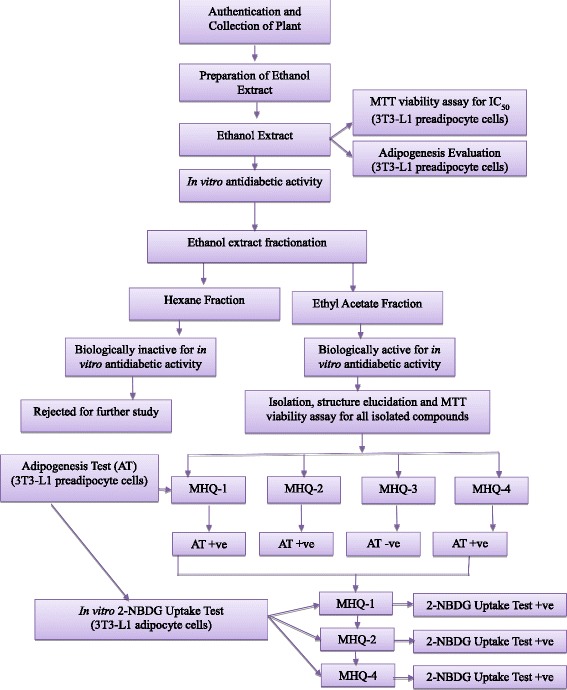
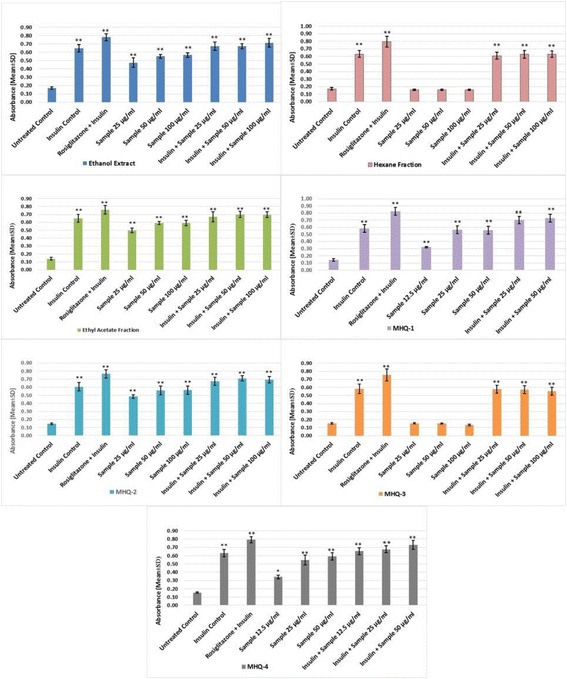
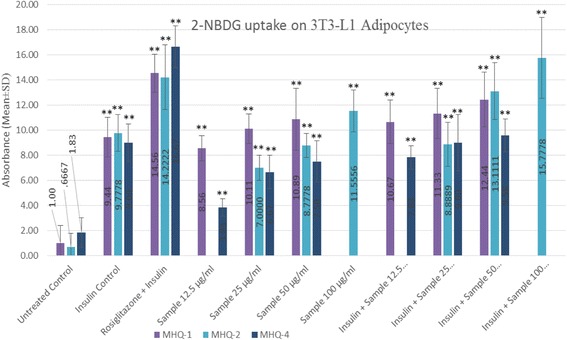
The ethanol extract and its subfractions, and isolated compounds from T. indica stems were subjected to cytotoxicity test using MTT viability assay on 3T3-L1 pre-adipocytes. Then, the test groups were subjected to the in vitro antidiabetic investigation using 3T3-L1 pre-adipocytes and differentiated adipocytes to determine the insulin-like and insulin sensitizing activities. Rosiglitazone was used as a standard antidiabetic agent. All compounds were also subjected to fluorescence glucose (2-NBDG) uptake test on differentiated adipocytes. Test solutions were introduced to the cells in different safe concentrations as well as in different adipogenic cocktails, which were modified by the addition of compounds to be investigated and in the presence or absence of insulin. Isolation of bioactive compounds from the most effective subfraction (ethyl acetate) was performed through repeated silica gel and sephadex LH-20 column chromatographies and their structures were elucidated through H-and C-NMR spectroscopy.
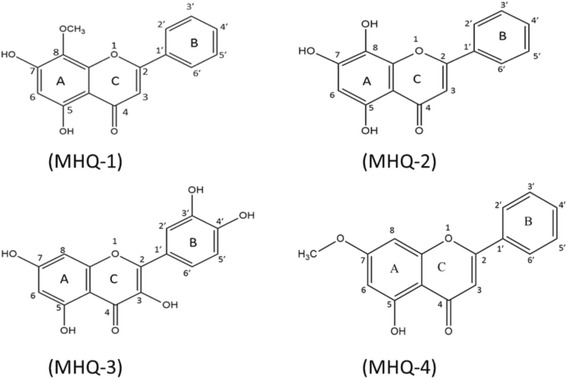
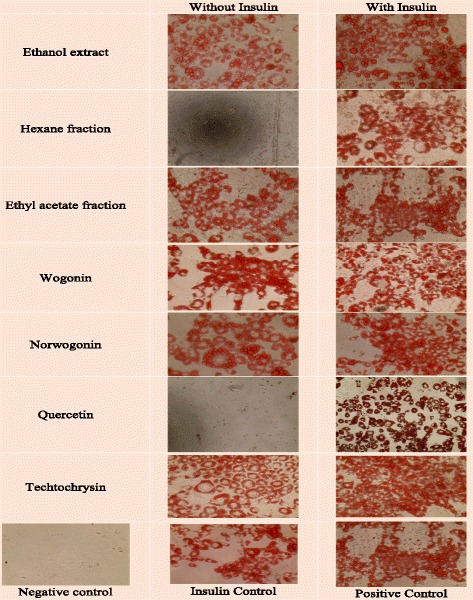
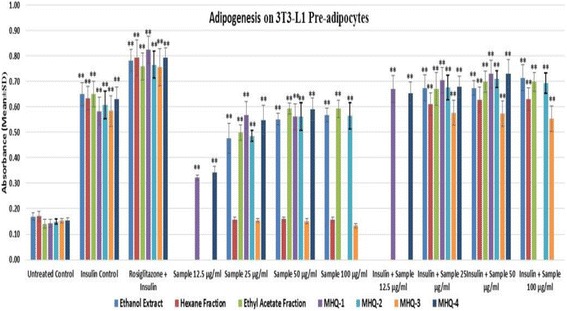
Four monoflavonoids, namely, wogonin, norwogonin, quercetin and techtochrysin were isolated from the T. indica stems ethanol extract. Wogonin, norwogonin and techtochrysin induced significant (P < 0.05) adipogenesis like insulin and enhanced adipogenesis like rosiglitazone. Wogonin and norwogonin also exhibited significant (P < 0.05) glucose uptake activity.
The present study demonstrated that the flavonoids isolated from the T. indica stems possess antidiabetic potential revealing insulin-like and insulin-sensitizing effects which were significant among the compounds. This also rationalizes the traditional use of T. indica in the management of diabetes in Malaysia.
印度四蕊檀(四蕊檀科),马来人称其为“Mempelas paya”,是马来西亚用于治疗糖尿病的药用植物之一。然而,尚未进行适当的科学研究来验证印度四蕊檀作为抗糖尿病药物的传统说法。因此,本研究的目的是确定印度四蕊檀茎乙醇提取物、亚组分和分离化合物的体外抗糖尿病潜力。
使用MTT活力测定法对3T3-L1前脂肪细胞进行印度四蕊檀茎乙醇提取物及其亚组分和分离化合物的细胞毒性试验。然后,使用3T3-L1前脂肪细胞和分化的脂肪细胞对试验组进行体外抗糖尿病研究,以确定胰岛素样和胰岛素增敏活性。罗格列酮用作标准抗糖尿病药物。所有化合物还在分化的脂肪细胞上进行荧光葡萄糖(2-NBDG)摄取试验。将测试溶液以不同的安全浓度以及在不同的成脂混合物中引入细胞,这些混合物通过添加待研究的化合物并在有或没有胰岛素的情况下进行了改良。通过反复硅胶柱色谱和葡聚糖凝胶LH-20柱色谱从最有效的亚组分(乙酸乙酯)中分离生物活性化合物,并通过H-和C-NMR光谱阐明其结构。
从印度四蕊檀茎乙醇提取物中分离出四种单黄酮,即汉黄芩素、去甲汉黄芩素、槲皮素和紫铆因。汉黄芩素、去甲汉黄芩素和紫铆因像胰岛素一样诱导显著(P<0.05)的脂肪生成,并像罗格列酮一样增强脂肪生成。汉黄芩素和去甲汉黄芩素还表现出显著(P<0.05)的葡萄糖摄取活性。
本研究表明,从印度四蕊檀茎中分离出的黄酮类化合物具有抗糖尿病潜力,显示出胰岛素样和胰岛素增敏作用,在这些化合物中作用显著。这也使印度四蕊檀在马来西亚糖尿病管理中的传统用途合理化。