Reblin Maija, Wu Yelena P, Pok Justin, Kane Lauren, Colman Howard, Cohen Adam L, Mendivil Eduardo, Warner Echo L, Meyer Miriah, Agutter James
Department of Health Outcomes & Behavior, Moffitt Cancer Center, Tampa, FL, United States.
University of Utah, Salt Lake City, UT, United States.
JMIR Hum Factors. 2017 Aug 30;4(3):e23. doi: 10.2196/humanfactors.7845.
The number of Web-based psychological and behavioral interventions is growing. Beyond their theoretical underpinnings, a key factor to the success of these interventions is how they are designed and developed to ensure usability over a new method of delivery. Our team has adapted ecomapping, a tool for visualizing family caregiver social network resources, for the Web. Here, we describe how we designed and developed the electronic Social Network Assessment Program (eSNAP) Web-based tool using a framework of the Center for eHealth and Wellbeing Research (CeHRes) Roadmap for Web-based intervention development. The CeHRes Roadmap is still new in terms of tool development and we showcase an example of its application.
The aim of our study was to provide an example of the application of the Web-based intervention development process using the CeHRes Roadmap for other research teams to follow. In doing so, we are also sharing our pilot work to enhance eSNAP's acceptance and usability for users and the feasibility of its implementation.
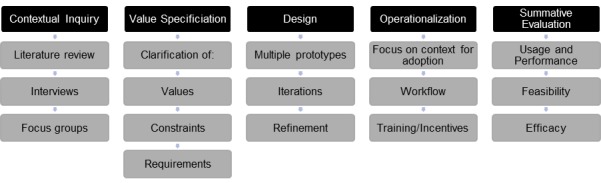
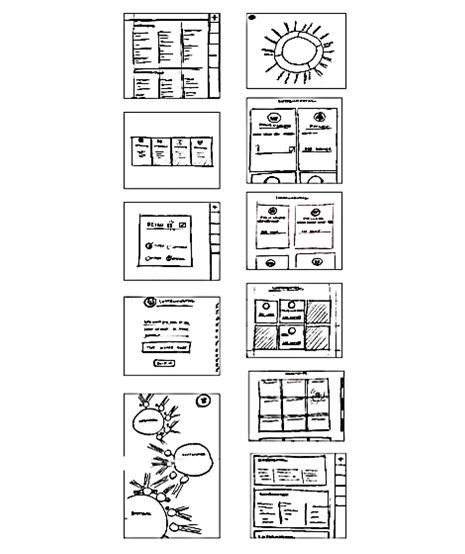
We describe the development of the eSNAP app to support family caregivers of neuro-oncology patients. This development is based on the 5 iterative stages of the CeHRes Roadmap: contextual inquiry, value specification, design, operationalization, and summative evaluation. Research activities to support eSNAP development prior to implementation included literature review, focus groups, and iterative rounds of interviews.
Key lessons learned in developing the eSNAP app broadly fell under a theme of translating theoretical needs and ideas to the real world. This included how to prioritize needs to be addressed at one time, how the modality of delivery may change design requirements, and how to develop a tool to fit within the context it will be used.
Using the CeHRes Roadmap to develop Web-based interventions such as eSNAP helps to address potential issues by outlining important intervention development milestones. In addition, by encouraging inclusion of users and other stakeholders in the process, Web-based intervention developers using the Roadmap can identify what will work in the real world and increase feasibility and effectiveness.
基于网络的心理和行为干预数量不断增加。除了其理论基础外,这些干预成功的一个关键因素是它们如何被设计和开发,以确保在新的交付方式下的可用性。我们的团队已将生态映射(一种用于可视化家庭照顾者社交网络资源的工具)改编用于网络。在此,我们描述如何使用电子健康与幸福研究中心(CeHRes)基于网络的干预开发路线图框架来设计和开发基于网络的电子社交网络评估程序(eSNAP)工具。就工具开发而言,CeHRes路线图仍很新,我们展示了其应用示例。
我们研究的目的是为其他研究团队提供一个使用CeHRes路线图进行基于网络的干预开发过程的应用示例以供参考。在此过程中,我们还分享我们的试点工作,以提高eSNAP对用户的接受度和可用性及其实施的可行性。
我们描述了支持神经肿瘤患者家庭照顾者的eSNAP应用程序的开发。此开发基于CeHRes路线图的5个迭代阶段:情境调查、价值规范、设计、实施和总结评估。在实施前支持eSNAP开发的研究活动包括文献综述、焦点小组讨论和多轮迭代访谈。
在开发eSNAP应用程序过程中吸取的关键经验教训大致可归为将理论需求和想法转化为现实这一主题。这包括如何一次确定需要优先解决的需求、交付方式如何可能改变设计要求以及如何开发一种适合其使用环境的工具。
使用CeHRes路线图来开发诸如eSNAP之类的基于网络的干预措施,有助于通过概述重要的干预开发里程碑来解决潜在问题。此外,通过鼓励在过程中纳入用户和其他利益相关者,使用该路线图的基于网络的干预开发者可以确定在现实世界中可行的方法,并提高可行性和有效性。