• 文献检索
  • 文档翻译
  • 深度研究
  • 学术资讯
  • Suppr Zotero 插件Zotero 插件
  • 邀请有礼
  • 套餐&价格
  • 历史记录
应用&插件
Suppr Zotero 插件Zotero 插件浏览器插件Mac 客户端Windows 客户端微信小程序
定价
高级版会员购买积分包购买API积分包
服务
文献检索文档翻译深度研究API 文档MCP 服务
关于我们
关于 Suppr公司介绍联系我们用户协议隐私条款
关注我们

Suppr 超能文献

核心技术专利:CN118964589B侵权必究
粤ICP备2023148730 号-1Suppr @ 2026

文献检索

告别复杂PubMed语法,用中文像聊天一样搜索,搜遍4000万医学文献。AI智能推荐,让科研检索更轻松。

立即免费搜索

文件翻译

保留排版,准确专业,支持PDF/Word/PPT等文件格式,支持 12+语言互译。

免费翻译文档

深度研究

AI帮你快速写综述,25分钟生成高质量综述,智能提取关键信息,辅助科研写作。

立即免费体验

让卫生服务使用者参与电子健康资源开发的参与式方法:系统评价

Participatory Methods to Engage Health Service Users in the Development of Electronic Health Resources: Systematic Review.

作者信息

Moore Gaye, Wilding Helen, Gray Kathleen, Castle David

机构信息

Mental Health Executive Services, St Vincent's Hospital, Melbourne, Fitzroy, Australia.

Department of Nursing, Faculty of Medicine, Dentistry and Health Sciences, University of Melbourne, Melbourne, Australia.

出版信息

J Particip Med. 2019 Feb 22;11(1):e11474. doi: 10.2196/11474.

DOI:10.2196/11474
PMID:33055069
原文链接:https://pmc.ncbi.nlm.nih.gov/articles/PMC7434099/
Abstract

BACKGROUND

When health service providers (HSP) plan to develop electronic health (eHealth) resources for health service users (HSU), the latter's involvement is essential. Typically, however, HSP, HSU, and technology developers engaged to produce the resources lack expertise in participatory design methodologies suited to the eHealth context. Furthermore, it can be difficult to identify an established method to use, or determine how to work stepwise through any particular process.

OBJECTIVE

We sought to summarize the evidence about participatory methods and frameworks used to engage HSU in the development of eHealth resources from the beginning of the design process.

METHODS

We searched for studies reporting participatory processes in initial development of eHealth resources from 2006 to 2016 in 9 bibliographic databases: MEDLINE, EMBASE, CINAHL, PsycINFO, Emcare, Cochrane Library, Web of Science, ACM Guide to Computing Literature, and IEEE Xplore. From 15,117 records initially screened on title and abstract for relevance to eHealth and early participatory design, 603 studies were assessed for eligibility on full text. The remaining 90 studies were rated by 2 reviewers using the Mixed Methods Appraisal Tool Version 2011 (Pluye et al; MMAT) and analyzed with respect to health area, purpose, technology type, and country of study. The 30 studies scoring 90% or higher on MMAT were included in a detailed qualitative synthesis.

RESULTS

Of the 90 MMAT-rated studies, the highest reported (1) health areas were cancer and mental disorders, (2) eHealth technologies were websites and mobile apps, (3) targeted populations were youth and women, and (4) countries of study were the United States, the United Kingdom, and the Netherlands. Of the top 30 studies the highest reported participatory frameworks were User-Centered Design, Participatory Action Research Framework, and the Center for eHealth Research and Disease Management (CeHRes) Roadmap, and the highest reported model underpinning development and engagement was Social Cognitive Theory. Of the 30 studies, 4 reported on all the 5 stages of the CeHRes Roadmap.

CONCLUSIONS

The top 30 studies yielded 24 participatory frameworks. Many studies referred to using participatory design methods without reference to a framework. The application of a structured framework such as the CeHRes Roadmap and a model such as Social Cognitive Theory creates a foundation for a well-designed eHealth initiative that ensures clarity and enables replication across participatory design projects. The framework and model need to be clearly articulated and address issues that include resource availability, responsiveness to change, and the criteria for good practice. This review creates an information resource for future eHealth developers, to guide the design of their eHealth resource with a framework that can support further evaluation and development.

TRIAL REGISTRATION

PROSPERO CRD42017053838; https://www.crd.york.ac.uk/prospero/display_record.php?RecordID=53838.
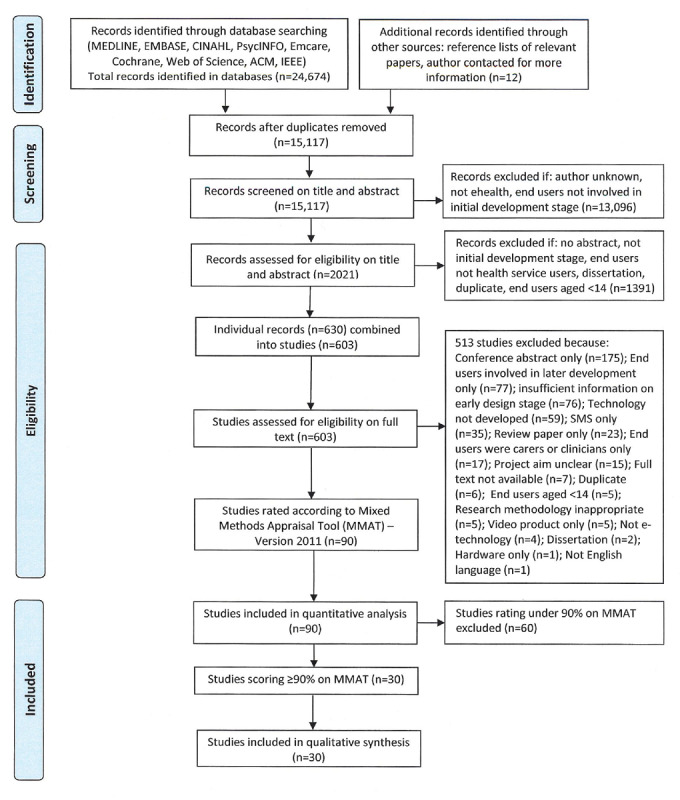
https://cdn.ncbi.nlm.nih.gov/pmc/blobs/3b10/7434099/ecf60a207dc6/jopm_v11i1e11474_fig1.jpg
摘要

背景

当医疗服务提供者(HSP)计划为医疗服务使用者(HSU)开发电子健康(eHealth)资源时,后者的参与至关重要。然而,通常情况下,参与资源制作的HSP、HSU和技术开发者缺乏适合电子健康背景的参与式设计方法方面的专业知识。此外,可能难以确定一种既定的方法来使用,或者难以确定如何逐步完成任何特定流程。

目的

我们试图总结关于在设计过程开始时让HSU参与电子健康资源开发所使用的参与式方法和框架的证据。

方法

我们在9个文献数据库中搜索了2006年至2016年期间报告电子健康资源初始开发中参与式过程的研究:医学索引数据库(MEDLINE)、荷兰医学文摘数据库(EMBASE)、护理学与健康领域数据库(CINAHL)、心理学文摘数据库(PsycINFO)、循证医学数据库(Emcare)、考科蓝图书馆(Cochrane Library)、科学引文索引(Web of Science)、美国计算机协会计算文献指南(ACM Guide to Computing Literature)和电气与电子工程师协会数据库(IEEE Xplore)。从最初根据标题和摘要筛选出的15117条与电子健康和早期参与式设计相关的记录中,对603项研究进行了全文资格评估。其余90项研究由2名评审员使用2011年版混合方法评估工具(Pluye等人;MMAT)进行评分,并就健康领域、目的、技术类型和研究国家进行分析。在MMAT上得分90%或更高的30项研究被纳入详细的定性综合分析。

结果

在90项经MMAT评分的研究中,报告最多的(1)健康领域是癌症和精神障碍,(2)电子健康技术是网站和移动应用程序,(3)目标人群是青年和女性,(4)研究国家是美国、英国和荷兰。在排名前30的研究中,报告最多的参与式框架是用户中心设计、参与式行动研究框架和电子健康研究与疾病管理中心(CeHRes)路线图,报告最多的支撑开发和参与的模型是社会认知理论。在这30项研究中,有4项报告了CeHRes路线图的所有5个阶段。

结论

排名前30的研究产生了24个参与式框架。许多研究提到使用参与式设计方法,但未提及框架。应用诸如CeHRes路线图这样的结构化框架和诸如社会认知理论这样的模型为精心设计的电子健康计划奠定了基础,该计划确保清晰性并能够在参与式设计项目中进行复制。该框架和模型需要清晰阐述,并解决包括资源可用性、对变化的响应能力以及良好实践标准等问题。本综述为未来的电子健康开发者创建了一个信息资源,以指导他们使用能够支持进一步评估和开发的框架来设计电子健康资源。

试验注册

国际系统评价注册库(PROSPERO)CRD42017053838;https://www.crd.york.ac.uk/prospero/display_record.php?RecordID=53838 。

相似文献

1
Participatory Methods to Engage Health Service Users in the Development of Electronic Health Resources: Systematic Review.让卫生服务使用者参与电子健康资源开发的参与式方法:系统评价
J Particip Med. 2019 Feb 22;11(1):e11474. doi: 10.2196/11474.
2
Beyond the black stump: rapid reviews of health research issues affecting regional, rural and remote Australia.超越黑木树:影响澳大利亚地区、农村和偏远地区的健康研究问题的快速综述。
Med J Aust. 2020 Dec;213 Suppl 11:S3-S32.e1. doi: 10.5694/mja2.50881.
3
Folic acid supplementation and malaria susceptibility and severity among people taking antifolate antimalarial drugs in endemic areas.在流行地区,服用抗叶酸抗疟药物的人群中,叶酸补充剂与疟疾易感性和严重程度的关系。
Cochrane Database Syst Rev. 2022 Feb 1;2(2022):CD014217. doi: 10.1002/14651858.CD014217.
4
Toward Inclusive Approaches in the Design, Development, and Implementation of eHealth in the Intellectual Disability Sector: Scoping Review.在智力残疾领域中设计、开发和实施电子健康的包容性方法:范围综述。
J Med Internet Res. 2023 May 30;25:e45819. doi: 10.2196/45819.
5
Supporting Self-Management of Cardiovascular Diseases Through Remote Monitoring Technologies: Metaethnography Review of Frameworks, Models, and Theories Used in Research and Development.通过远程监测技术支持心血管疾病的自我管理:对研发中使用的框架、模型和理论的元民族志综述
J Med Internet Res. 2020 May 21;22(5):e16157. doi: 10.2196/16157.
6
The Importance of Systematically Reporting and Reflecting on eHealth Development: Participatory Development Process of a Virtual Reality Application for Forensic Mental Health Care.系统报告和反思电子健康发展的重要性:用于法医精神卫生保健的虚拟现实应用程序的参与式开发过程
J Med Internet Res. 2019 Aug 19;21(8):e12972. doi: 10.2196/12972.
7
Improving Patients' Medication Adherence and Outcomes in Nonhospital Settings Through eHealth: Systematic Review of Randomized Controlled Trials.通过电子健康改善非医院环境下患者的用药依从性和结局:随机对照试验的系统评价。
J Med Internet Res. 2020 Aug 20;22(8):e17015. doi: 10.2196/17015.
8
Methods for Human-Centered eHealth Development: Narrative Scoping Review.以人为中心的电子健康发展方法:叙事范围综述。
J Med Internet Res. 2022 Jan 27;24(1):e31858. doi: 10.2196/31858.
9
Frameworks, Models, and Theories Used in Electronic Health Research and Development to Support Self-Management of Cardiovascular Diseases Through Remote Monitoring Technologies: Protocol for a Metaethnography Review.用于电子健康研究与开发以通过远程监测技术支持心血管疾病自我管理的框架、模型和理论:一项元民族志综述方案
JMIR Res Protoc. 2019 Jul 16;8(7):e13334. doi: 10.2196/13334.
10
Designing a Mobile App to Enhance Parenting Skills of Latinx Parents: A Community-Based Participatory Approach.设计一款移动应用程序以提升拉丁裔父母的育儿技能:一种基于社区参与的方法。
JMIR Form Res. 2020 Jan 24;4(1):e12618. doi: 10.2196/12618.

引用本文的文献

1
Insights into organizational health literacy in Italian hospitals: findings from the M-POHL network project.意大利医院组织健康素养洞察:M-POHL 网络项目的研究结果
Health Promot Int. 2025 Jul 1;40(4). doi: 10.1093/heapro/daaf137.
2
Evaluating Perceptions of the CANreduce 2.0 eHealth Intervention for Cannabis Use: Focus Group Study.评估对CANreduce 2.0大麻使用电子健康干预措施的认知:焦点小组研究
J Med Internet Res. 2025 Mar 19;27:e65025. doi: 10.2196/65025.
3
Understanding, Assessing, and Improving Social Health Resource Referrals in Healthcare Organizations.

本文引用的文献

1
Developing young person's Face IT: Online psychosocial support for adolescents struggling with conditions or injuries affecting their appearance.为青少年打造“直面现实”:为那些因身体状况或损伤而容貌受损的青少年提供在线心理社会支持。
Health Psychol Open. 2015 Dec 9;2(2):2055102915619092. doi: 10.1177/2055102915619092. eCollection 2015 Jul.
2
Participatory design methods in telemedicine research.远程医疗研究中的参与式设计方法。
J Telemed Telecare. 2017 Oct;23(9):780-785. doi: 10.1177/1357633X16686747. Epub 2016 Dec 27.
3
ProjectHeartforGirls.com: Development of a Web-Based HIV/STD Prevention Program for Adolescent Girls Emphasizing Sexual Communication Skills.
理解、评估和改善医疗机构中的社会健康资源转诊服务。
Health Serv Res. 2025 May;60 Suppl 3(Suppl 3):e14466. doi: 10.1111/1475-6773.14466. Epub 2025 Feb 26.
4
Development and Implementation of MyPainHub, a Web-Based Resource for People With Musculoskeletal Conditions and Their Health Care Professionals: Mixed Methods Study.MyPainHub的开发与实施:一项针对肌肉骨骼疾病患者及其医护人员的基于网络的资源的混合方法研究
JMIR Form Res. 2025 Feb 24;9:e63780. doi: 10.2196/63780.
5
Digital Transformation in Patient Organizations: Interview and Focus Group Study.患者组织中的数字转型:访谈与焦点小组研究
J Med Internet Res. 2025 Feb 13;27:e62750. doi: 10.2196/62750.
6
Development of an eHealth Intervention Including Self-Management for Reducing Sedentary Time in the Transition to Retirement: Participatory Design Study.一项包括自我管理在内的电子健康干预措施的开发,旨在减少退休过渡阶段的久坐时间:参与式设计研究。
JMIR Form Res. 2025 Jan 20;9:e63567. doi: 10.2196/63567.
7
Implementing Oncologic Nursing Care Plans in Electronic Health Records With Two Taxonomies: A Pilot Study.使用两种分类法在电子健康记录中实施肿瘤护理计划:一项试点研究。
West J Nurs Res. 2025 Mar;47(3):159-168. doi: 10.1177/01939459241310402. Epub 2025 Jan 6.
8
Exploring the Needs of People With Chronic Low Back Pain and Health Care Professionals for mHealth Devices to Support Self-Managed Physical Activity and Pain: User-Centered Design Approach.探索慢性下背痛患者和医疗保健专业人员对支持自我管理身体活动和疼痛的移动健康设备的需求:以用户为中心的设计方法。
JMIR Hum Factors. 2024 Nov 7;11:e59897. doi: 10.2196/59897.
9
Patient and public involvement in healthcare: a systematic mapping review of systematic reviews - identification of current research and possible directions for future research.患者和公众参与医疗保健:系统评价的系统综述-当前研究的识别和未来研究的可能方向。
BMJ Open. 2024 Sep 19;14(9):e083215. doi: 10.1136/bmjopen-2023-083215.
10
The Potential Use and Value of a Wearable Monitoring Bracelet for Patients With Chronic Obstructive Pulmonary Disease: Qualitative Study Investigating the Patient and Health Care Professional Perspectives.可穿戴监测手环在慢性阻塞性肺疾病患者中的潜在用途和价值:一项定性研究调查患者和医疗保健专业人员的观点。
JMIR Form Res. 2024 Sep 13;8:e57108. doi: 10.2196/57108.
ProjectHeartforGirls.com:为青少年女孩开发的一个强调性沟通技巧的基于网络的艾滋病毒/性传播感染预防项目。
AIDS Educ Prev. 2016 Oct;28(5):365-377. doi: 10.1521/aeap.2016.28.5.365.
4
Study protocol of the YP Face IT feasibility study: comparing an online psychosocial intervention versus treatment as usual for adolescents distressed by appearance-altering conditions/injuries.YP Face IT可行性研究的研究方案:比较针对因容貌改变状况/损伤而苦恼的青少年的在线心理社会干预与常规治疗。
BMJ Open. 2016 Oct 3;6(10):e012423. doi: 10.1136/bmjopen-2016-012423.
5
Capturing the patients' voices: Planning for patient-centered electronic health record use.倾听患者的声音:以患者为中心的电子健康记录使用规划。
Int J Med Inform. 2016 Nov;95:1-7. doi: 10.1016/j.ijmedinf.2016.08.002. Epub 2016 Aug 12.
6
Development and evaluation of iManage: A self-management app co-designed by adolescents with sickle cell disease.iManage的开发与评估:一款由镰状细胞病青少年共同设计的自我管理应用程序。
Pediatr Blood Cancer. 2017 Jan;64(1):139-145. doi: 10.1002/pbc.26177. Epub 2016 Aug 30.
7
Patient Involvement as Experts in the Development and Assessment of a Smartphone App as a Patient Education Tool for the Management of Thalassemia and Iron Overload Syndromes.患者作为专家参与一款智能手机应用程序的开发和评估,该应用程序作为地中海贫血和铁过载综合征管理的患者教育工具。
Hemoglobin. 2016 Sep;40(5):323-329. doi: 10.1080/03630269.2016.1217875. Epub 2016 Sep 22.
8
BeWell24: development and process evaluation of a smartphone "app" to improve sleep, sedentary, and active behaviors in US Veterans with increased metabolic risk.BeWell24:一款智能手机“应用程序”的开发与过程评估,该程序旨在改善代谢风险增加的美国退伍军人的睡眠、久坐及活动行为。
Transl Behav Med. 2016 Sep;6(3):438-48. doi: 10.1007/s13142-015-0359-3.
9
Integrating Evidence From Systematic Reviews, Qualitative Research, and Expert Knowledge Using Co-Design Techniques to Develop a Web-Based Intervention for People in the Retirement Transition.运用协同设计技术整合系统评价、定性研究和专家知识的证据,为处于退休转型期的人群开发基于网络的干预措施。
J Med Internet Res. 2016 Aug 3;18(8):e210. doi: 10.2196/jmir.5790.
10
Development and Validation of an Interactive Internet Platform for Older People: The Healthy Ageing Through Internet Counselling in the Elderly Study.老年人交互式互联网平台的开发与验证:老年人互联网咨询促进健康老龄化研究
Telemed J E Health. 2017 Feb;23(2):96-104. doi: 10.1089/tmj.2016.0066. Epub 2016 Jul 27.