Drawert Brian, Griesemer Marc, Petzold Linda R, Briggs Cheryl J
Department of Computer Science, University of North Carolina Asheville, Asheville, NC 28804, USA
Biosciences and Biotechnology Division, Lawrence Livermore National Laboratory, Livermore, CA 94551, USA.
J R Soc Interface. 2017 Aug;14(133). doi: 10.1098/rsif.2017.0480.
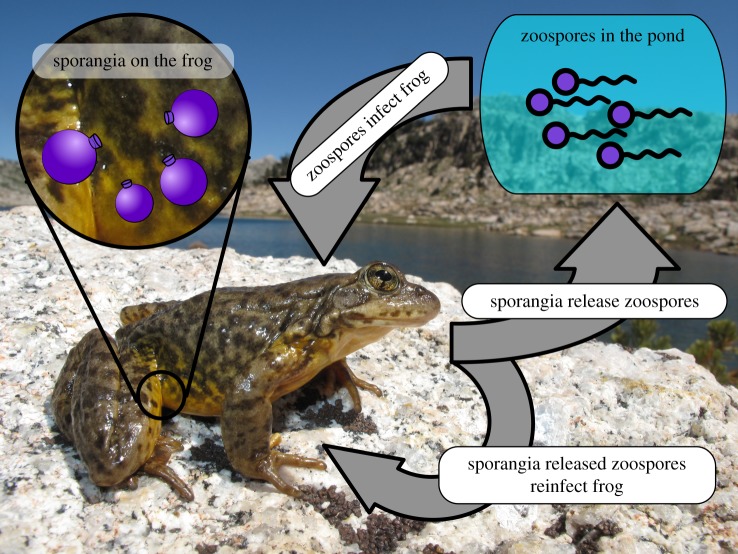
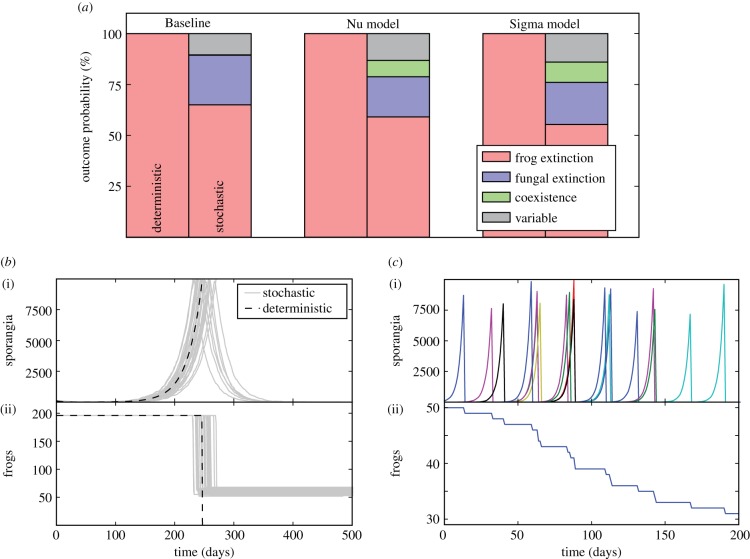
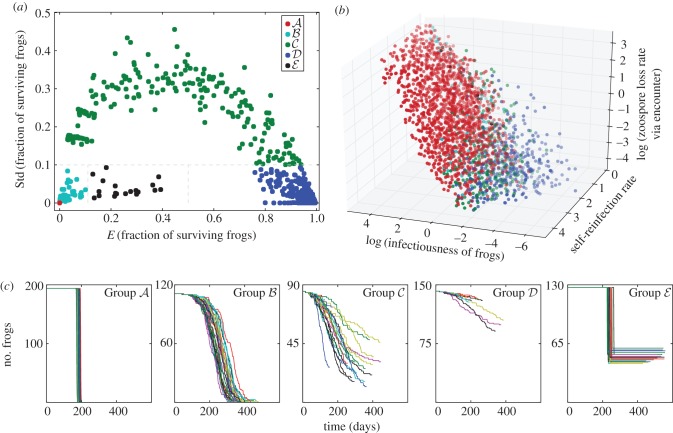
Recent outbreaks of chytridiomycosis, the disease of amphibians caused by the fungal pathogen (Bd), have contributed to population declines of numerous amphibian species worldwide. The devastating impacts of this disease have led researchers to attempt drastic conservation measures to prevent further extinctions and loss of biodiversity. The conservation measures can be labour-intensive or expensive, and in many cases have been unsuccessful. We developed a mathematical model of Bd outbreaks that includes the effects of demographic stochasticity and within-host fungal load dynamics. We investigated the impacts of one-time treatment conservation strategies during the disease outbreak that occurs following the initial arrival of Bd into a previously uninfected frog population. We found that for all versions of the model, for a large fraction of parameter space, none of the one-time treatment strategies are effective at preventing disease-induced extinction of the amphibian population. Of the strategies considered, treating frogs with antifungal agents to reduce their fungal load had the greatest likelihood of a beneficial outcome and the lowest risk of decreasing the persistence of the frog population, suggesting that this disease mitigation strategy should be prioritized over disinfecting the environment or reducing host density.
近期爆发的壶菌病是由真菌病原体(蛙壶菌)引起的两栖动物疾病,已导致全球众多两栖动物物种数量下降。这种疾病的毁灭性影响促使研究人员尝试采取极端的保护措施,以防止进一步的物种灭绝和生物多样性丧失。这些保护措施可能劳动强度大或成本高昂,而且在许多情况下并不成功。我们开发了一个蛙壶菌爆发的数学模型,其中包括种群统计随机性和宿主体内真菌载量动态的影响。我们研究了在蛙壶菌首次进入先前未感染的青蛙种群后疾病爆发期间一次性治疗保护策略的影响。我们发现,对于该模型的所有版本,在很大一部分参数空间内,没有一种一次性治疗策略能有效防止两栖动物种群因疾病而灭绝。在所考虑的策略中,用抗真菌剂治疗青蛙以降低其真菌载量产生有益结果的可能性最大,且降低青蛙种群持续性的风险最低,这表明这种疾病缓解策略应优先于对环境进行消毒或降低宿主密度。