McNamara G I, Davis B A, Browne M, Humby T, Dalley J W, Xia J, John R M, Isles A R
Behavioural Genetics Group, MRC Centre for Neuropsychiatric Genetics and Genomics, Neuroscience and Mental Health Research Institute, Cardiff University, Cardiff, UK.
School of Biosciences, Cardiff University, Cardiff, UK.
Genes Brain Behav. 2018 Feb;17(2):149-157. doi: 10.1111/gbb.12422. Epub 2017 Sep 15.
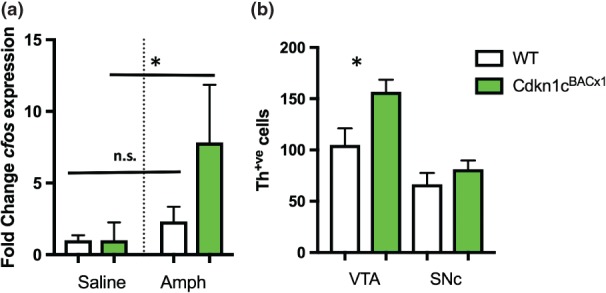
The imprinted gene Cdkn1c is expressed exclusively from the maternally inherited allele as a consequences of epigenetic regulation. Cdkn1c exemplifies many of the functional characteristics of imprinted genes, playing a role in foetal growth and placental development. However, Cdkn1c also plays an important role in the brain, being key to the appropriate proliferation and differentiation of midbrain dopaminergic neurons. Using a transgenic model (Cdkn1c ) with a twofold elevation in Cdkn1c expression that mimics loss-of-imprinting, we show that increased expression of Cdkn1c in the brain gives rise to neurobiological and behavioural changes indicative of a functionally altered dopaminergic system. Cdkn1c mice displayed altered expression of dopamine system-related genes, increased tyrosine hydroxylase (Th) staining and increased tissue content of dopamine in the striatum. In addition, Cdkn1c animals were hypersensitive to amphetamine as showed by c-fos expression in the nucleus accumbens. Cdkn1c mice had significant changes in behaviours that are dependent on the mesolimbic dopaminergic system. Specifically, increased motivation for palatable food stuffs, as indexed on a progressive ratio task. In addition, Cdkn1c mice displayed enhanced social dominance. These data show, for the first time, the consequence of elevated Cdkn1c expression on dopamine-related behaviours highlighting the importance of correct dosage of this imprinted gene in the brain. This work has significant relevance for deepening our understanding of the epigenetic factors that can shape neurobiology and behaviour.
印记基因Cdkn1c由于表观遗传调控而仅从母系遗传的等位基因表达。Cdkn1c体现了许多印记基因的功能特征,在胎儿生长和胎盘发育中发挥作用。然而,Cdkn1c在大脑中也起着重要作用,是中脑多巴胺能神经元适当增殖和分化的关键。使用一种转基因模型(Cdkn1c),其Cdkn1c表达提高了两倍,模拟印记缺失,我们发现大脑中Cdkn1c表达增加会导致神经生物学和行为变化,表明多巴胺能系统功能改变。Cdkn1c小鼠表现出多巴胺系统相关基因表达改变、酪氨酸羟化酶(Th)染色增加以及纹状体中多巴胺组织含量增加。此外,如伏隔核中c-fos表达所示,Cdkn1c动物对苯丙胺超敏。Cdkn1c小鼠在依赖中脑边缘多巴胺能系统的行为上有显著变化。具体而言,在渐进比率任务中,对美味食物的动机增加。此外,Cdkn1c小鼠表现出更强的社会优势。这些数据首次表明Cdkn1c表达升高对多巴胺相关行为的影响,突出了该印记基因在大脑中正确剂量的重要性。这项工作对于深化我们对可塑造神经生物学和行为的表观遗传因素的理解具有重要意义。