Jupp Bianca, Murray Jennifer E, Jordan Emily R, Xia Jing, Fluharty Meg, Shrestha Saurav, Robbins Trevor W, Dalley Jeffrey W
Department of Psychology, University of Cambridge, Downing Street, Cambridge, CB2 3EB, UK.
Behavioural and Clinical Neurosciences Institute, University of Cambridge, Cambridge, CB2 3EB, UK.
Psychopharmacology (Berl). 2016 Feb;233(4):579-89. doi: 10.1007/s00213-015-4122-8. Epub 2015 Nov 10.
Studies in human and non-human primates demonstrate that social status is an important determinant of cocaine reinforcement. However, it is unclear whether social rank is associated with other traits that also predispose to addiction and whether social status similarly predicts cocaine self-administration in rats.
The objective of this study is to investigate whether social ranking assessed using a resource competition task affects (i) the acquisition, maintenance and reinstatement of cocaine self-administration; (ii) the dopaminergic markers in the striatum; and (iii) the expression of ancillary traits for addiction.
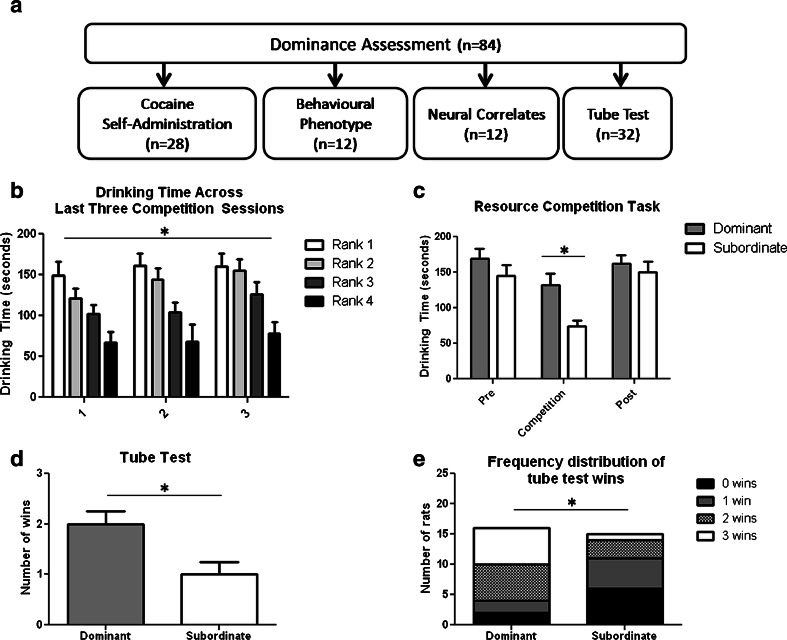
Social ranking was determined in group-housed rats based upon drinking times during competition for a highly palatable liquid. Rats were then evaluated for cocaine self-administration and cue-induced drug reinstatement or individual levels of impulsivity, anxiety and novelty-induced locomotor activity. Finally, dopamine content, dopamine transporter (DAT) and dopamine D2/D3 (D2/3) receptor binding were measured postmortem in the dorsal and ventral striatum.
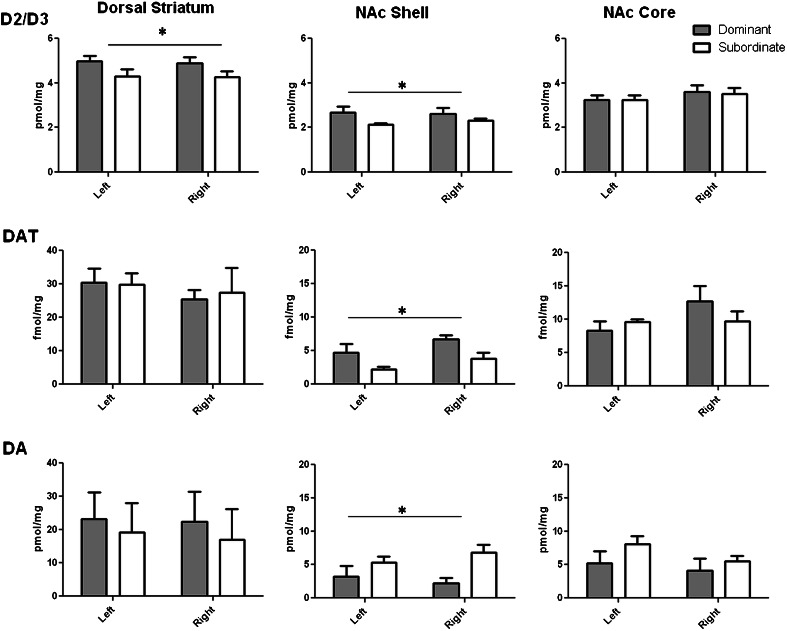
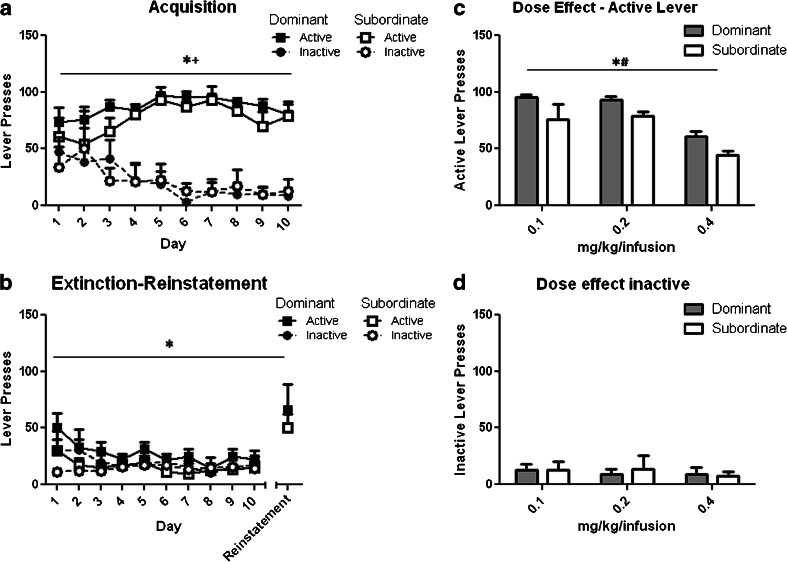
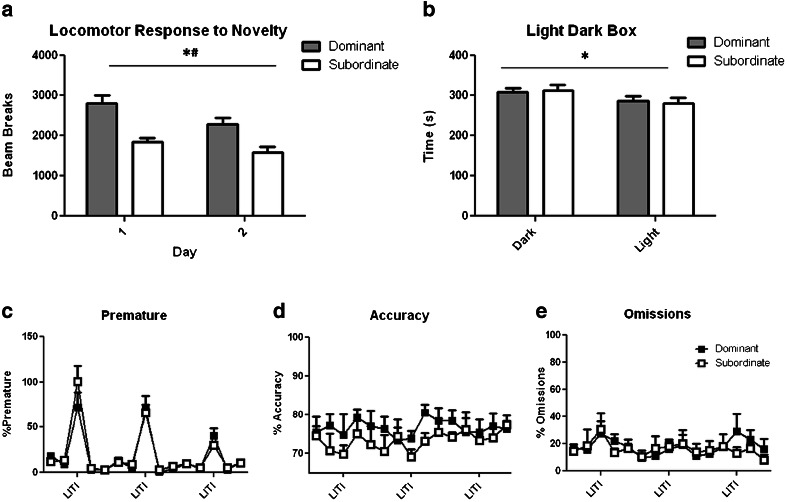
Rats deemed socially dominant showed enhanced novelty reactivity but were neither more impulsive nor anxious compared with subordinate rats. Dominant rats additionally maintained higher rates of cocaine self-administration but showed no differences in the acquisition, extinction and reinstatement of this behaviour. D2/3 binding was elevated in the nucleus accumbens shell and dorsal striatum of dominant rats when compared to subordinate rats, and was accompanied by elevated DAT and reduced dopamine content in the nucleus accumbens shell.
These findings show that social hierarchy influences the rate of self-administered cocaine but not anxiety or impulsivity in rats. Similar to non-human primates, these effects may be mediated by striatal dopaminergic systems.
对人类和非人类灵长类动物的研究表明,社会地位是可卡因强化作用的一个重要决定因素。然而,尚不清楚社会等级是否与其他也易导致成瘾的特质相关,以及社会地位是否同样能预测大鼠的可卡因自我给药行为。
本研究的目的是调查使用资源竞争任务评估的社会等级是否会影响:(i)可卡因自我给药的获得、维持和恢复;(ii)纹状体中的多巴胺能标记物;以及(iii)成瘾辅助特质的表达。
根据群居大鼠在争夺高度可口液体时的饮水时间确定其社会等级。然后评估大鼠的可卡因自我给药情况、线索诱导的药物恢复情况或冲动性、焦虑和新奇诱导的运动活动的个体水平。最后,在死后测量背侧和腹侧纹状体中的多巴胺含量、多巴胺转运体(DAT)和多巴胺D2/D3(D2/3)受体结合情况。
被认为具有社会优势的大鼠表现出增强的新奇反应性,但与从属大鼠相比,既没有更冲动也没有更焦虑。优势大鼠还保持着更高的可卡因自我给药率,但在这种行为的获得、消退和恢复方面没有差异。与从属大鼠相比,优势大鼠伏隔核壳和背侧纹状体中的D2/3结合升高,同时伏隔核壳中的DAT升高且多巴胺含量降低。
这些发现表明,社会等级会影响大鼠自我给药可卡因的速率,但不会影响其焦虑或冲动性。与非人类灵长类动物类似,这些影响可能由纹状体多巴胺能系统介导。