Department of Neurology, MS Center Dresden, Center of Clinical Neuroscience, University Clinic Carl Gustav Carus Dresden, Dresden, Germany.
Multiple Sclerosis Unit, Department of Neurology, University of Ulm, Ulm, Germany.
J Neuroinflammation. 2017 Aug 31;14(1):172. doi: 10.1186/s12974-017-0945-z.
Laquinimod is an oral immunomodulator in clinical development to treat relapsing-remitting multiple sclerosis (RRMS). Laquinimod is in clinical development for the treatment of multiple sclerosis and Huntington Disease (HD). The objective of this study is to assess the safety, tolerability, pharmacokinetics (PK) and cytoimmunologic effects following escalating doses of laquinimod in patients with RRMS.
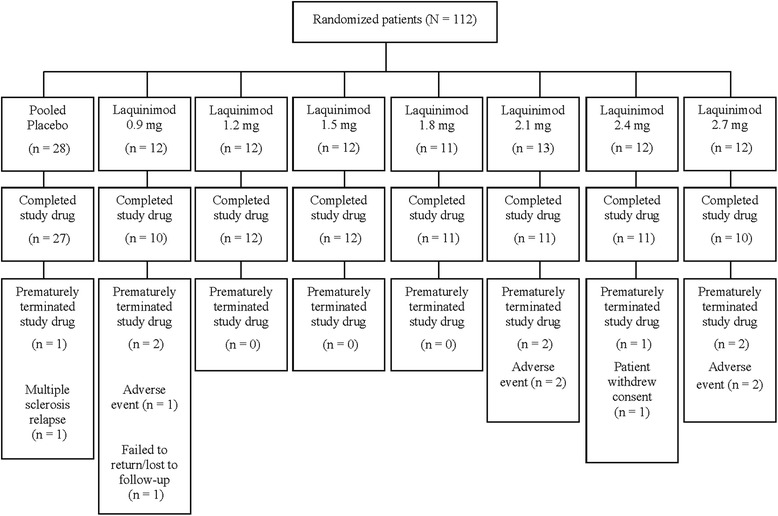
One hundred twelve patients were randomly assigned to laquinimod/placebo in a series of separate dose-escalating cohorts starting from a daily oral dose of 0.9 mg/1.2 mg escalating to 2.7 mg, in 0.3 mg increments.
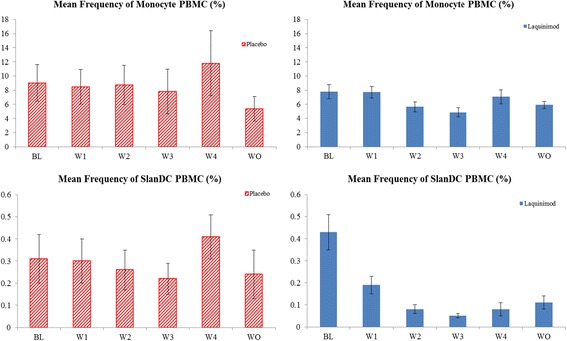
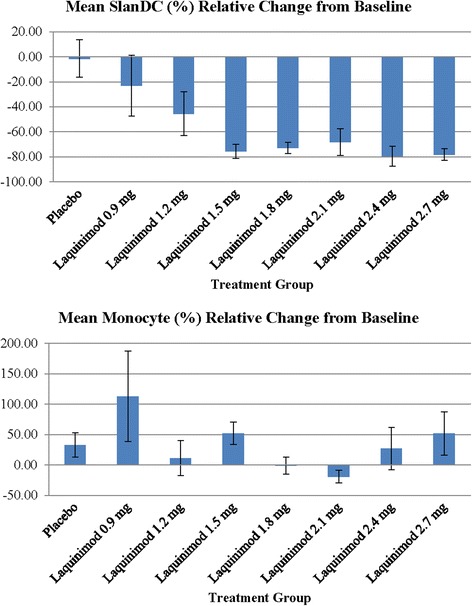
Twenty-eight patients received placebo and 84 received laquinimod ranging from 0.9 to 2.7 mg. No deaths occurred. One serious adverse event (SAE) of perichondritis was reported, which was unrelated to laquinimod (0.9 mg). There was no increased incidence of adverse events (AEs) with escalating doses. Laquinimod-treated patients showed more abnormal laboratory levels in liver enzymes, P-amylase, C-reactive protein (CRP), and fibrinogen, but most shifts were clinically non-significant. The exposure of laquinimod was dose proportional and linear in the tested dose range. An immunological substudy showed significant dose-dependent decreases in 6-sulpho LacNAc + dendritic cell (slanDC) frequency following laquinimod compared to placebo.
Laquinimod doses up to 2.7 mg were safely administered to patients with RRMS. An in vivo effect of laquinimod on the innate immune system was demonstrated.
EudraCT Number: 2009-011234-99 . Registered 23 June 2009.
拉喹莫德是一种临床开发中的口服免疫调节剂,用于治疗复发缓解型多发性硬化症(RRMS)。拉喹莫德正在开发用于治疗多发性硬化症和亨廷顿病(HD)。本研究的目的是评估 RRMS 患者递增剂量拉喹莫德的安全性、耐受性、药代动力学(PK)和细胞免疫效应。
112 名患者被随机分配到拉喹莫德/安慰剂组,分为一系列单独的剂量递增队列,起始剂量为每天口服 0.9mg/1.2mg,逐步递增至 2.7mg,每次递增 0.3mg。
28 名患者接受安慰剂,84 名患者接受拉喹莫德,剂量从 0.9 至 2.7mg。无死亡病例。报告了 1 例与拉喹莫德(0.9mg)无关的肋软骨炎严重不良事件(SAE)。随着剂量的增加,不良事件(AE)的发生率没有增加。拉喹莫德治疗组患者的肝酶、P-淀粉酶、C 反应蛋白(CRP)和纤维蛋白原的实验室水平更常出现异常,但大多数变化无临床意义。拉喹莫德的暴露量在测试剂量范围内呈剂量比例和线性。一项免疫学亚研究表明,与安慰剂相比,拉喹莫德剂量依赖性地降低了 6-硫酸唾液酸 N-乙酰乳糖胺+树突状细胞(slanDC)的频率。
RRMS 患者使用高达 2.7mg 的拉喹莫德是安全的。体内实验证明了拉喹莫德对固有免疫系统的作用。
EudraCT 编号:2009-011234-99。注册日期:2009 年 6 月 23 日。