Department of Hygiene and Epidemiology, University of Ioannina School of Medicine, University Campus, 45110, Ioannina, Greece.
Lab of Cognitive Neuroscience, School of Psychology, Aristotle University of Thessaloniki, 54124, Thessaloniki, Greece.
BMC Psychol. 2017 Aug 31;5(1):31. doi: 10.1186/s40359-017-0200-5.
Psychological interventions are widely implemented for pain management and treatment, but their reported effectiveness shows considerable variation and there is elevated likelihood for bias.
We summarized the strength of evidence and extent of potential biases in the published literature of psychological interventions for pain treatment using a range of criteria, including the statistical significance of the random effects summary estimate and of the largest study of each meta-analysis, number of participants, 95% prediction intervals, between-study heterogeneity, small-study effects and excess significance bias.
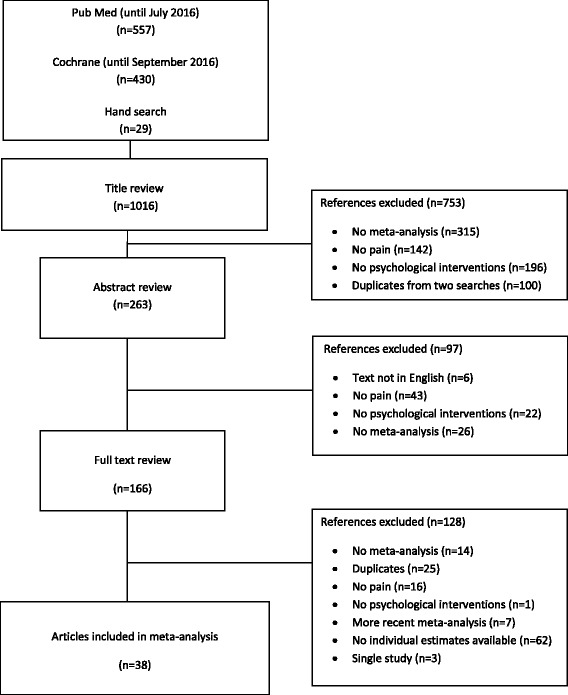
Thirty-eight publications were identified, investigating 150 associations between several psychological interventions and 29 different types of pain. Of the 141 associations based on only randomized controlled trials, none presented strong or highly suggestive evidence by satisfying all the aforementioned criteria. The effect of psychological interventions on reducing cancer pain severity, pain in patients with arthritis, osteoarthritis, rheumatoid arthritis, breast cancer, fibromyalgia, irritable bowel syndrome, self-reported needle-related pain in children/adolescents or with chronic musculoskeletal pain, chronic non-headache pain and chronic pain in general were supported by suggestive evidence.
The present findings reveal the lack of strong supporting empirical evidence for the effectiveness of psychological treatments for pain management and highlight the need to further evaluate the established approach of psychological interventions to ameliorate pain.
心理干预广泛应用于疼痛管理和治疗,但它们的报告效果显示出相当大的差异,并且存在较高的偏差可能性。
我们使用一系列标准,包括随机效应汇总估计值和每个荟萃分析中最大研究的统计显著性、参与者人数、95%预测区间、研究间异质性、小研究效应和过度显著性偏差,总结了心理干预治疗疼痛的已发表文献中的证据强度和潜在偏倚程度。
确定了 38 篇出版物,研究了几种心理干预措施与 29 种不同类型疼痛之间的 150 种关联。在仅基于随机对照试验的 141 种关联中,没有一种满足所有上述标准,提供了强有力或高度提示性的证据。心理干预对减轻癌症疼痛严重程度、关节炎、骨关节炎、类风湿关节炎、乳腺癌、纤维肌痛、肠易激综合征、儿童/青少年自我报告的与针相关的疼痛或慢性肌肉骨骼疼痛、慢性非头痛疼痛和一般慢性疼痛的效果得到了提示性证据的支持。
目前的研究结果表明,缺乏强有力的实证证据支持心理治疗对疼痛管理的有效性,并强调需要进一步评估已建立的心理干预方法来改善疼痛。