Department of Psychology and Neuroscience, and The Center for Neuroscience, University of Colorado, Boulder, CO, USA; Discipline of Pharmacology, School of Medicine, University of Adelaide, Adelaide, SA, Australia.
Department of Psychology and Neuroscience, and The Center for Neuroscience, University of Colorado, Boulder, CO, USA.
Brain Behav Immun. 2018 Aug;72:45-50. doi: 10.1016/j.bbi.2017.08.018. Epub 2017 Aug 30.
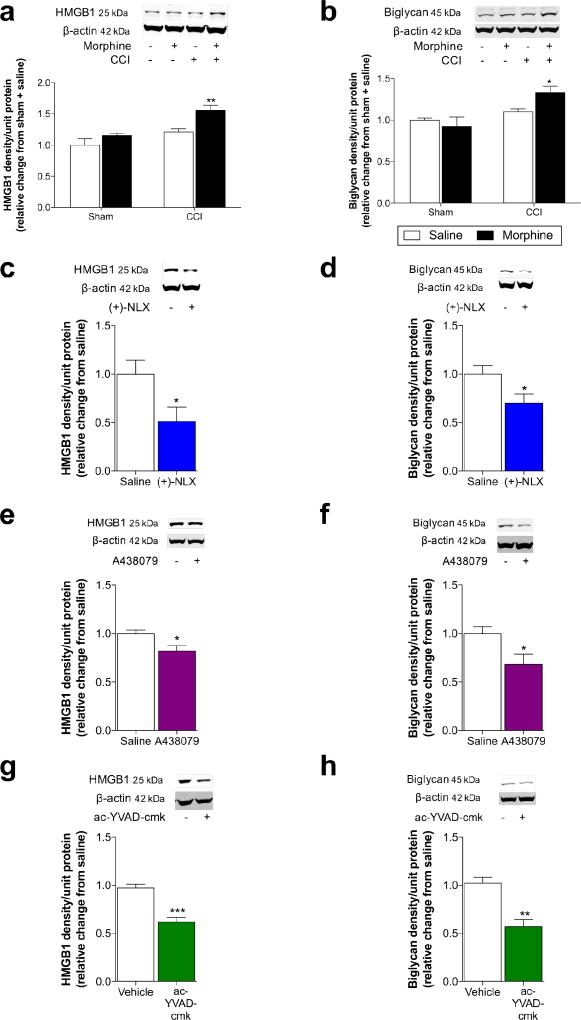
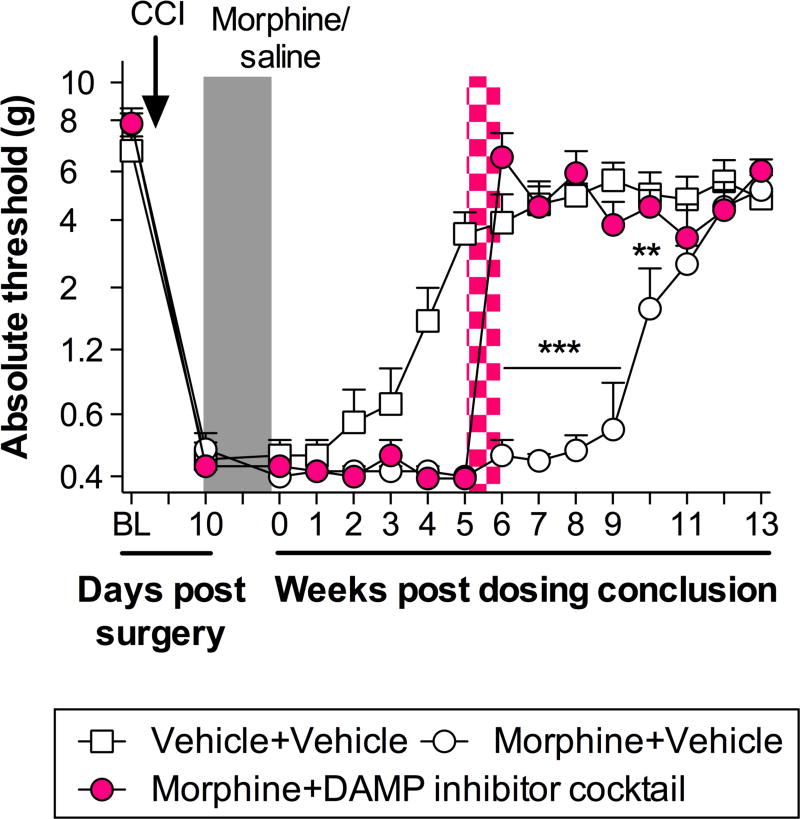
We have recently reported that a short course of morphine, starting 10days after sciatic chronic constriction injury (CCI), prolonged the duration of mechanical allodynia for months after morphine ceased. Maintenance of this morphine-induced persistent sensitization was dependent on spinal NOD-like receptor protein 3 (NLRP3) inflammasomes-protein complexes that proteolytically activate interleukin-1β (IL-1β) via caspase-1. However, it is still unclear how NLRP3 inflammasome signaling is maintained long after morphine is cleared. Here, we demonstrate that spinal levels of the damage associated molecular patterns (DAMPs) high mobility group box 1 (HMGB1) and biglycan are elevated during morphine-induced persistent sensitization in male rats; that is, 5weeks after cessation of morphine dosing. We also show that HMGB1 and biglycan levels are at least partly dependent on the initial activation of caspase-1, as well as Toll like receptor 4 (TLR4) and the purinergic receptor P2X7R-receptors responsible for priming and activation of NLRP3 inflammasomes. Finally, pharmacological attenuation of the DAMPs HMGB1, biglycan, heat shock protein 90 and fibronectin persistently reversed morphine-prolonged allodynia. We conclude that after peripheral nerve injury, morphine treatment results in persistent DAMP release via TLR4, P2X7R and caspase-1, which are involved in formation/activation of NLRP3 inflammasomes. These DAMPs are responsible for maintaining persistent allodynia, which may be due to engagement of a positive feedback loop, in which NLRP3 inflammasomes are persistently activated by DAMPs signaling at TLR4 and P2X7R.
我们最近报道,坐骨神经慢性缩窄性损伤(CCI)后 10 天开始给予短程吗啡治疗,可使吗啡停药后数月内机械性痛觉过敏持续存在。这种吗啡诱导的持续性敏化的维持依赖于脊髓 NOD 样受体蛋白 3(NLRP3)炎性小体-蛋白复合物,该复合物通过半胱天冬酶-1 蛋白水解激活白细胞介素-1β(IL-1β)。然而,目前尚不清楚吗啡清除后很长一段时间内 NLRP3 炎性小体信号是如何维持的。在这里,我们证明在雄性大鼠吗啡诱导的持续性敏化过程中,脊髓损伤相关分子模式(DAMPs)高迁移率族蛋白 B1(HMGB1)和 biglycan 的水平升高;即在吗啡停药 5 周后。我们还表明,HMGB1 和 biglycan 的水平至少部分依赖于半胱天冬酶-1 的初始激活,以及 Toll 样受体 4(TLR4)和嘌呤能受体 P2X7R,这些受体负责 NLRP3 炎性小体的启动和激活。最后,DAMPs HMGB1、biglycan、热休克蛋白 90 和纤维连接蛋白的药理学抑制作用持续逆转了吗啡延长的痛觉过敏。我们得出结论,在外周神经损伤后,吗啡治疗通过 TLR4、P2X7R 和半胱天冬酶-1 导致持续的 DAMPs 释放,这些 DAMPs 参与 NLRP3 炎性小体的形成/激活。这些 DAMPs 负责维持持续性痛觉过敏,这可能是由于 NLRP3 炎性小体通过 TLR4 和 P2X7R 的 DAMPs 信号持续激活而形成的正反馈回路。