ResMed Science Center, ResMed Germany Inc., Martinsried, Germany
Sleep and Ventilation Center Blaubeuren, Respiratory Center Ulm, Ulm, Germany.
Eur Respir J. 2017 Aug 31;50(2). doi: 10.1183/13993003.01692-2016. Print 2017 Aug.
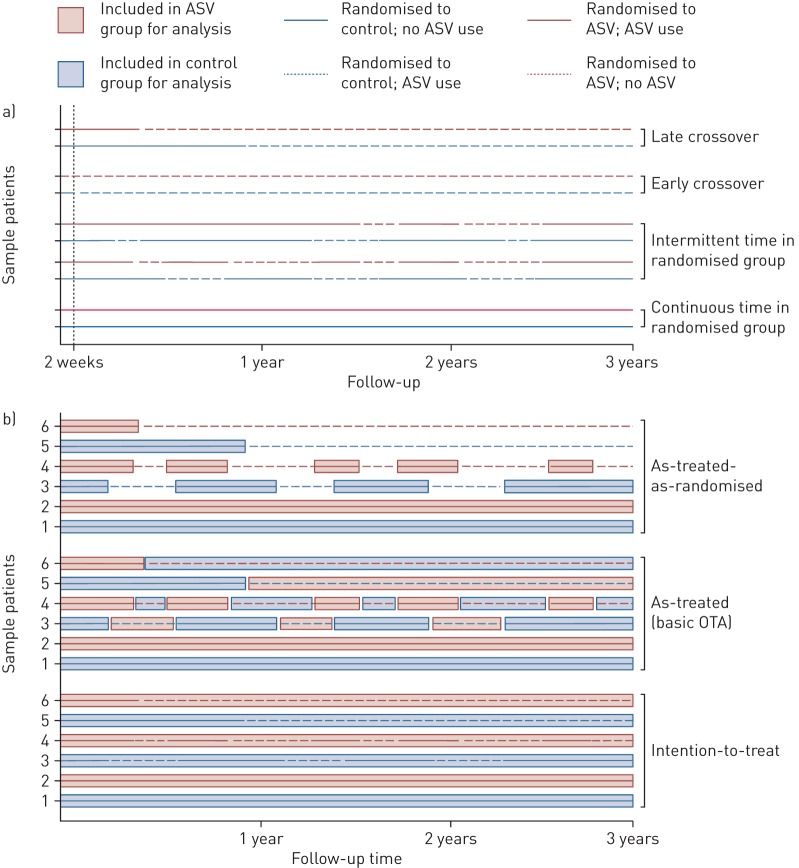
This on-treatment analysis was conducted to facilitate understanding of mechanisms underlying the increased risk of all-cause and cardiovascular mortality in heart failure patients with reduced ejection fraction and predominant central sleep apnoea randomised to adaptive servo ventilation the control group in the SERVE-HF trial.Time-dependent on-treatment analyses were conducted (unadjusted and adjusted for predictive covariates). A comprehensive, time-dependent model was developed to correct for asymmetric selection effects (to minimise bias).The comprehensive model showed increased cardiovascular death hazard ratios during adaptive servo ventilation usage periods, slightly lower than those in the SERVE-HF intention-to-treat analysis. Self-selection bias was evident. Patients randomised to adaptive servo ventilation who crossed over to the control group were at higher risk of cardiovascular death than controls, while control patients with crossover to adaptive servo ventilation showed a trend towards lower risk of cardiovascular death than patients randomised to adaptive servo ventilation. Cardiovascular risk did not increase as nightly adaptive servo ventilation usage increased.On-treatment analysis showed similar results to the SERVE-HF intention-to-treat analysis, with an increased risk of cardiovascular death in heart failure with reduced ejection fraction patients with predominant central sleep apnoea treated with adaptive servo ventilation. Bias is inevitable and needs to be taken into account in any kind of on-treatment analysis in positive airway pressure studies.
本治疗中分析旨在深入了解射血分数降低型心力衰竭伴以中枢性睡眠呼吸暂停为主的患者接受适应性伺服通气治疗后全因和心血管死亡率增加的机制。该分析是 SERVE-HF 试验中适应性伺服通气组(对照组)的事后分析。进行了时间依赖性治疗中分析(未调整和根据预测协变量进行调整)。开发了一个全面的、时间依赖性模型来纠正非对称选择效应(以最小化偏差)。综合模型显示,在使用适应性伺服通气期间,心血管死亡的危害比略有升高,略低于 SERVE-HF 意向治疗分析。自我选择偏倚明显。从对照组交叉到适应性伺服通气组的随机分组患者心血管死亡风险更高,而交叉到适应性伺服通气的对照组患者心血管死亡风险呈下降趋势,低于随机分组到适应性伺服通气的患者。随着每晚适应性伺服通气使用量的增加,心血管风险并未增加。治疗中分析结果与 SERVE-HF 意向治疗分析相似,射血分数降低型心力衰竭伴以中枢性睡眠呼吸暂停为主的患者接受适应性伺服通气治疗后心血管死亡风险增加。在正压通气研究的任何治疗中分析中,都存在不可避免的偏差,需要加以考虑。