Department of Biology, Aquatic Ecology, Lund University, Lund, Sweden.
Sci Rep. 2017 Aug 31;7(1):10254. doi: 10.1038/s41598-017-08772-7.
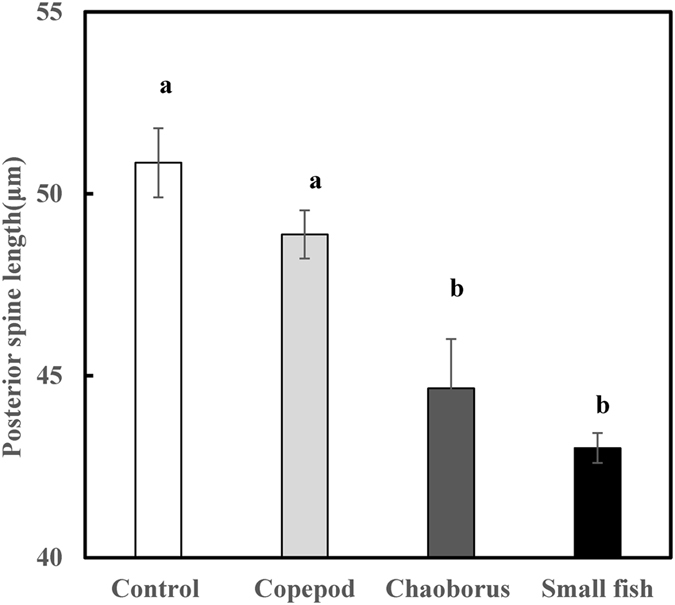
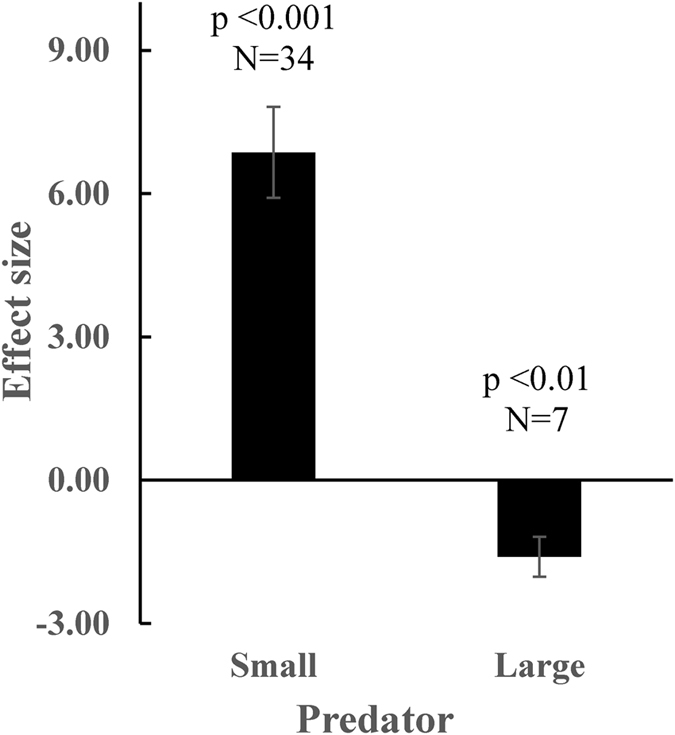
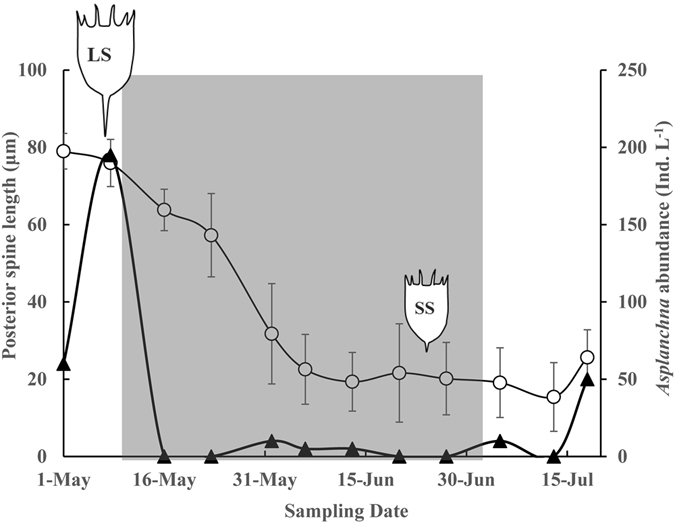
Numerous prey organisms, including many rotifers, exhibit inducible defensive plasticity, such as spines, in response to predators. Here, we test the hypothesis that prey modify their defence response to different predator sizes with a bi-directional adjustment in spine length. First, we show experimentally, that large-sized predators induce a reduction in prey spine length. Second, we conducted a complementary field monitoring study showing that the spine length of the prey rotifer Keratella cochlearis changed in opposite directions, in response to the shift in dominance between small-sized and large-sized predators. Third, in order to test the generality of our novel findings, we conducted a meta-analysis covering a wide array of rotifer prey taxa, strengthening the conclusions from our experimental and field studies. Hence, by combining evidence from experiments and studies in the field with a meta-analysis, we, for the first time, demonstrate that rotifer prey distinguish between predators and adjust their protective spine length accordingly, i.e. rapidly adjust spine length to escape either below or above the dominant predator's gape size window. In a broader perspective, our conclusions advance our knowledge on observed spatial and temporal variations in protective morphologies among prey organisms.
许多猎物生物,包括许多轮虫,表现出可诱导的防御可塑性,如刺,以应对捕食者。在这里,我们测试了这样一个假设,即猎物会根据捕食者的大小,通过对刺长的双向调节来改变它们的防御反应。首先,我们通过实验表明,大型捕食者会诱导猎物刺的长度减小。其次,我们进行了一项补充的野外监测研究,表明猎物轮虫旋轮虫的刺长会发生相反的变化,以响应小体型和大体型捕食者之间优势地位的转变。第三,为了检验我们新发现的普遍性,我们进行了一项涵盖广泛轮虫猎物分类群的荟萃分析,这加强了我们实验和野外研究的结论。因此,通过将实验证据与野外研究以及荟萃分析相结合,我们首次证明了轮虫猎物能够区分捕食者,并相应地调整它们的保护刺长度,即快速调整刺长度以逃避占主导地位的捕食者的口裂大小窗口。从更广泛的角度来看,我们的结论推进了我们对猎物生物中观察到的保护形态的时空变化的认识。