Li Jianqiang, Wang Lifen
Department of Thoracic Oncological Surgery.
Department of Medical Oncology, Zhejiang Cancer Hospital, Hangzhou, People's Republic of China.
Onco Targets Ther. 2017 Aug 7;10:3965-3969. doi: 10.2147/OTT.S132756. eCollection 2017.
No standard chemotherapy is available for patients with advanced esophageal squamous cell carcinoma (ESCC) who have failed prior first-line chemotherapy. The aim of this study was to evaluate the efficacy and safety of apatinib, an oral VEGFR-2 inhibitor, as salvage treatment for advanced ESCC.
After apatinib dosing, the efficacy and toxicity were evaluated in 62 patients with pretreated advanced ESCC from 2014 to 2016 at Zhejiang Cancer Hospital. In addition, survival analysis was performed by the Kaplan-Meier method.
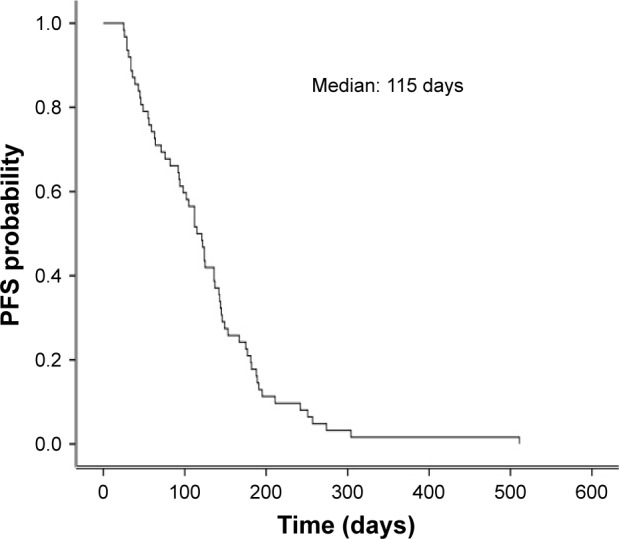
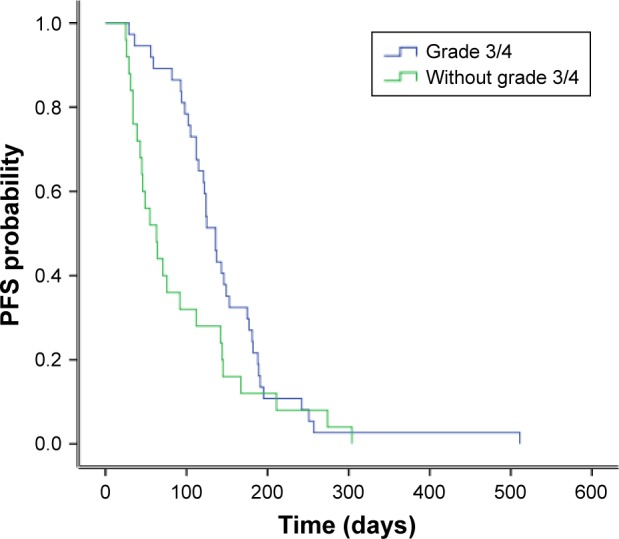
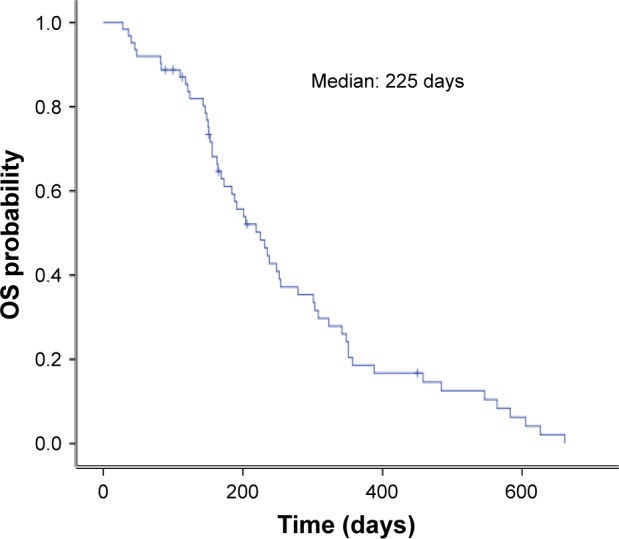
Among the 62 patients, 15 achieved partial response while 31 had stable disease with a response rate of 24.2% and a disease control rate of 74.2%. Median progression-free survival (PFS) and overall survival were 115 and 209 days, respectively. Grade 3/4 toxicities (59.7%) were acceptable. Patients with grade 3/4 toxicities showed a longer PFS than those without (136 vs 63 days, =0.044).
Apatinib is efficacious as second- or further-line treatment for advanced ESCC.
对于一线化疗失败的晚期食管鳞状细胞癌(ESCC)患者,尚无标准的化疗方案。本研究旨在评估口服VEGFR-2抑制剂阿帕替尼作为晚期ESCC挽救治疗的疗效和安全性。
2014年至2016年期间,在浙江省肿瘤医院对62例预处理的晚期ESCC患者进行阿帕替尼给药后,评估其疗效和毒性。此外,采用Kaplan-Meier法进行生存分析。
62例患者中,15例达到部分缓解,31例病情稳定,缓解率为24.2%,疾病控制率为74.2%。中位无进展生存期(PFS)和总生存期分别为115天和209天。3/4级毒性(59.7%)是可接受的。发生3/4级毒性的患者的PFS比未发生的患者更长(136天对63天,P = 0.044)。
阿帕替尼作为晚期ESCC的二线或后续治疗是有效的。