Wang Y Grace, Benmedjahed Khadra, Lambert Jérémy, Evans Christopher J, Hwang Steve, Black Jed, Johns Murray W
Clinical Development, Jazz Pharmaceuticals, Palo Alto, CA, USA.
Patient-Centered Outcomes, Mapi, Lyon, France.
Nat Sci Sleep. 2017 Aug 14;9:201-211. doi: 10.2147/NSS.S140143. eCollection 2017.
The aim of this study was to qualitatively evaluate concepts for incorporation into a daily diary to capture cataplexy frequency and to assess the content validity of the Epworth Sleepiness Scale for Children and Adolescents (ESS-CHAD) in pediatric patients with narcolepsy.
Face-to-face concept elicitation and cognitive interviews were conducted with children (7-9 years; n=13) and adolescents (10-17 years; n=16) who have narcolepsy with cataplexy, and their parents/caregivers.
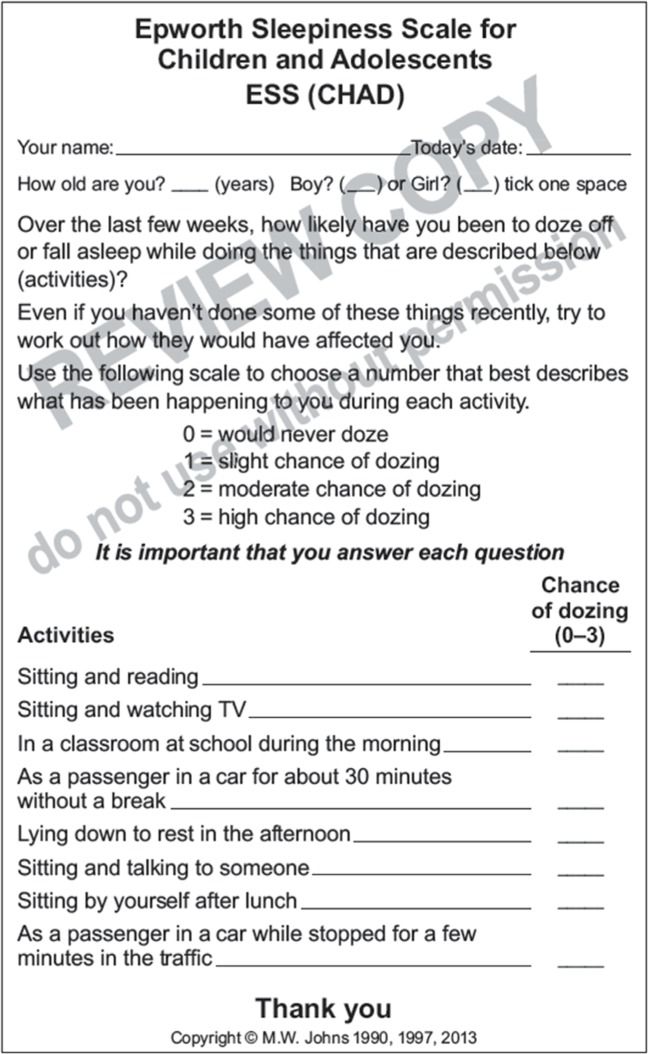
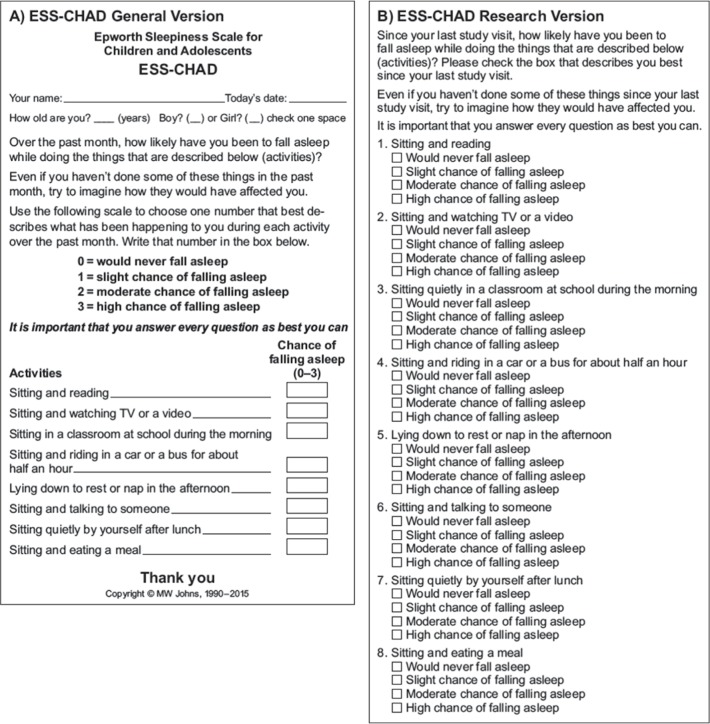
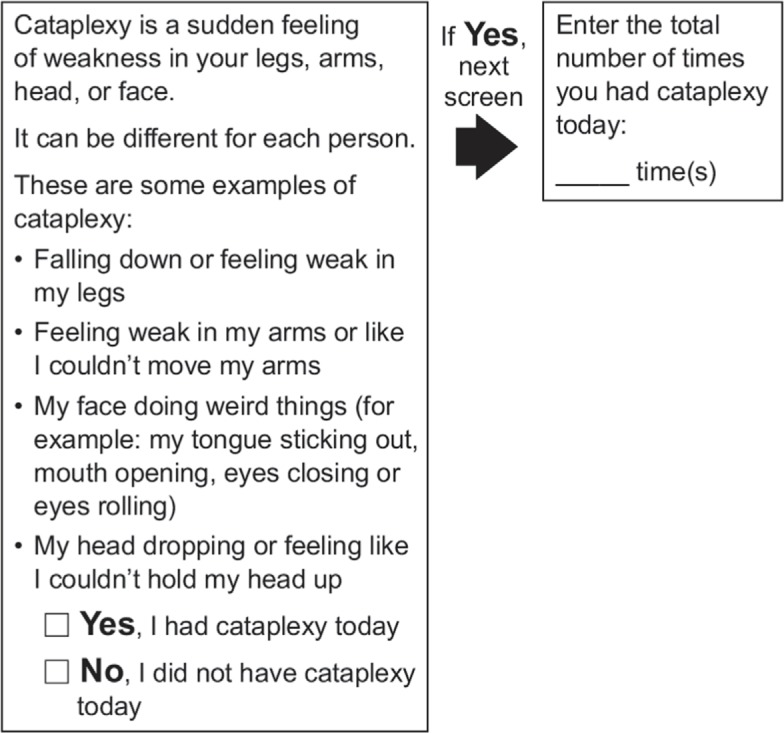
Similarities and differences were noted between narcolepsy concepts described by children and their parents/caregivers, suggesting some different but complementary perspectives; parents may not recognize cataplexy symptoms/triggers as well as children, but parents have greater recognition of the circumstances of falling asleep. Cataplexy diary modifications included changes in definitions and examples of cataplexy, using child-friendly terminology, adding a quantitative question to determine daily frequency, and standardizing the questionnaire for evening administration with self-completion by the child. Modifications were made to ESS-CHAD for child-friendly wording and to ensure that items reflect activities (eating, watching TV/video) and environments (school, bus/car transport) in which children are likely to participate. Two ESS-CHAD versions were proposed: one with a 1-month recall period, for general use, and the other with a recall period of "since your last study visit," for research, which could be shorter or longer than 1 month (as short as 1 week).
The cataplexy diary and ESS-CHAD were modified for the assessment of children and adolescents. Further psychometric validation is recommended. These measures are being used in a Phase III, placebo-controlled clinical trial of sodium oxybate in children and adolescents with narcolepsy.
本研究旨在定性评估纳入日常日记以记录猝倒发作频率的概念,并评估儿童青少年发作性睡病患者中儿童青少年版爱泼华嗜睡量表(ESS-CHAD)的内容效度。
对患有发作性睡病伴猝倒的儿童(7 - 9岁;n = 13)、青少年(10 - 17岁;n = 16)及其父母/照料者进行面对面的概念引出和认知访谈。
注意到儿童及其父母/照料者描述的发作性睡病概念存在异同,这表明了一些不同但互补的观点;父母可能不像儿童那样能很好地识别猝倒症状/触发因素,但父母对入睡情况有更强的认知。猝倒日记的修改包括改变猝倒的定义和示例、使用儿童友好的术语、添加一个定量问题以确定每日发作频率,以及规范问卷以便儿童在晚上自行填写完成。对ESS-CHAD进行了修改,使其措辞更适合儿童,并确保条目反映儿童可能参与的活动(进食、看电视/视频)和环境(学校、乘坐公共汽车/汽车)。提出了两个ESS-CHAD版本:一个用于一般用途,回忆期为1个月;另一个用于研究,回忆期为“自上次研究访视以来”,可能短于或长于1个月(最短为1周)。
对猝倒日记和ESS-CHAD进行了修改,以用于评估儿童和青少年。建议进一步进行心理测量学验证。这些措施正在一项关于羟丁酸钠治疗儿童青少年发作性睡病的III期安慰剂对照临床试验中使用。