Cachera Marie, Le Loc'h François
SHOM Brest Cedex 2 France.
UMR LEMAR CNRS/UBO/IRD/Ifremer, IUEM, Rue Dumont d'Urville, Technopôle Brest Iroise Plouzané France.
Ecol Evol. 2017 Jul 4;7(16):6292-6303. doi: 10.1002/ece3.2871. eCollection 2017 Aug.
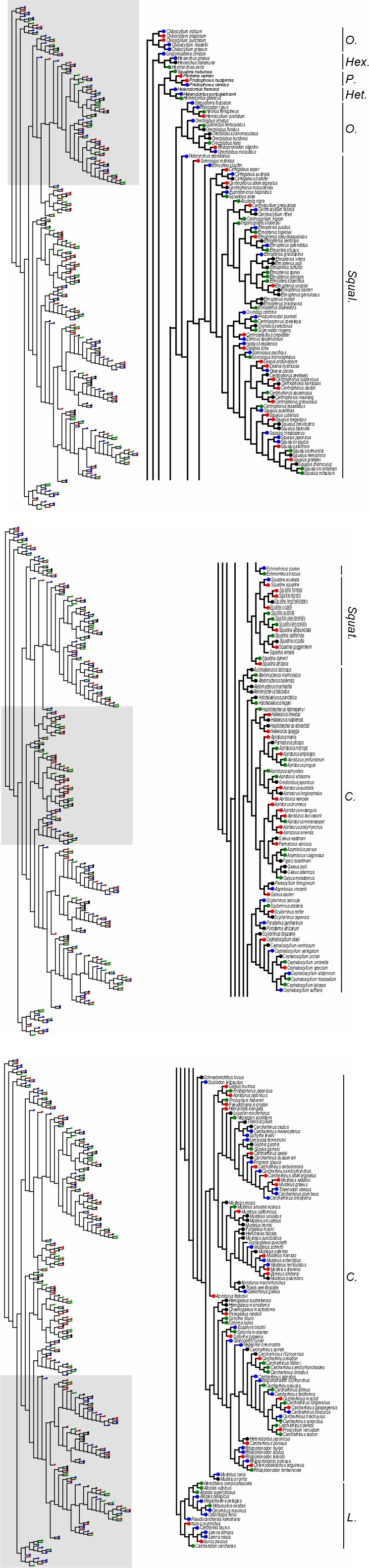
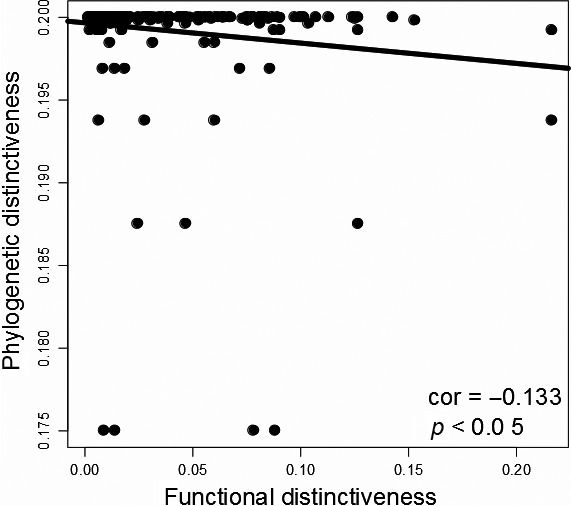
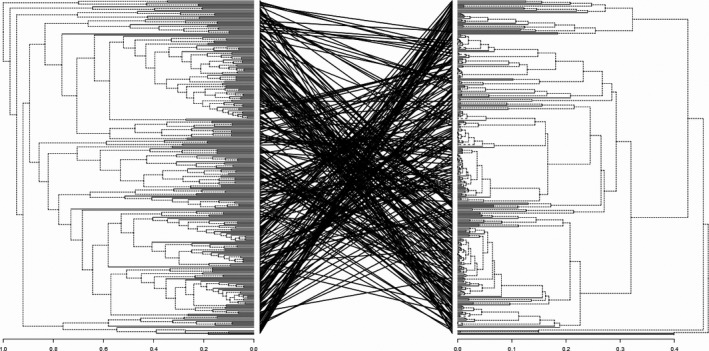
The relationships between diversity and ecosystem functioning have become a major focus of science. A crucial issue is to estimate functional diversity, as it is intended to impact ecosystem dynamics and stability. However, depending on the ecosystem, it may be challenging or even impossible to directly measure ecological functions and thus functional diversity. Phylogenetic diversity was recently under consideration as a proxy for functional diversity. Phylogenetic diversity is indeed supposed to match functional diversity if functions are conservative traits along evolution. However, in case of adaptive radiation and/or evolutive convergence, a mismatch may appear between species phylogenetic and functional singularities. Using highly threatened taxa, sharks, this study aimed to explore the relationships between phylogenetic and functional diversities and singularities. Different statistical computations were used in order to test both methodological issue (phylogenetic reconstruction) and overall a theoretical questioning: the predictive power of phylogeny for function diversity. Despite these several methodological approaches, a mismatch between phylogeny and function was highlighted. This mismatch revealed that (i) functions are apparently nonconservative in shark species, and (ii) phylogenetic singularity is not a proxy for functional singularity. Functions appeared to be not conservative along the evolution of sharks, raising the conservational challenge to identify and protect both phylogenetic and functional singular species. Facing the current rate of species loss, it is indeed of major importance to target phylogenetically singular species to protect genetic diversity and also functionally singular species in order to maintain particular functions within ecosystem.
多样性与生态系统功能之间的关系已成为科学研究的主要焦点。一个关键问题是估计功能多样性,因为它旨在影响生态系统动态和稳定性。然而,根据生态系统的不同,直接测量生态功能以及功能多样性可能具有挑战性,甚至是不可能的。系统发育多样性最近被视为功能多样性的替代指标。如果功能是沿着进化过程中的保守性状,那么系统发育多样性确实应该与功能多样性相匹配。然而,在适应性辐射和/或进化趋同的情况下,物种的系统发育和功能独特性之间可能会出现不匹配。本研究以高度濒危的类群鲨鱼为对象,旨在探索系统发育多样性与功能多样性及独特性之间的关系。使用了不同的统计计算方法,以检验方法学问题(系统发育重建)以及整体的理论问题:系统发育对功能多样性的预测能力。尽管采用了多种方法学途径,但系统发育与功能之间的不匹配仍然很明显。这种不匹配表明:(i)鲨鱼物种的功能显然不是保守的;(ii)系统发育独特性不是功能独特性的替代指标。在鲨鱼的进化过程中,功能似乎并非保守,这给识别和保护系统发育独特物种以及功能独特物种带来了保护方面的挑战。面对当前物种丧失的速度,确定系统发育独特物种以保护遗传多样性,同时确定功能独特物种以维持生态系统内的特定功能确实至关重要。