Nanotechnology Research Laboratory, Research School of Engineering, The Australian National University, Canberra, Australian Capital Territory 2601, Australia.
Department of Mechanical and Biomedical Engineering, City University of Hong Kong, Hong Kong 999077, China.
Sci Adv. 2016 Jun 24;2(6):e1600417. doi: 10.1126/sciadv.1600417. eCollection 2016 Jun.
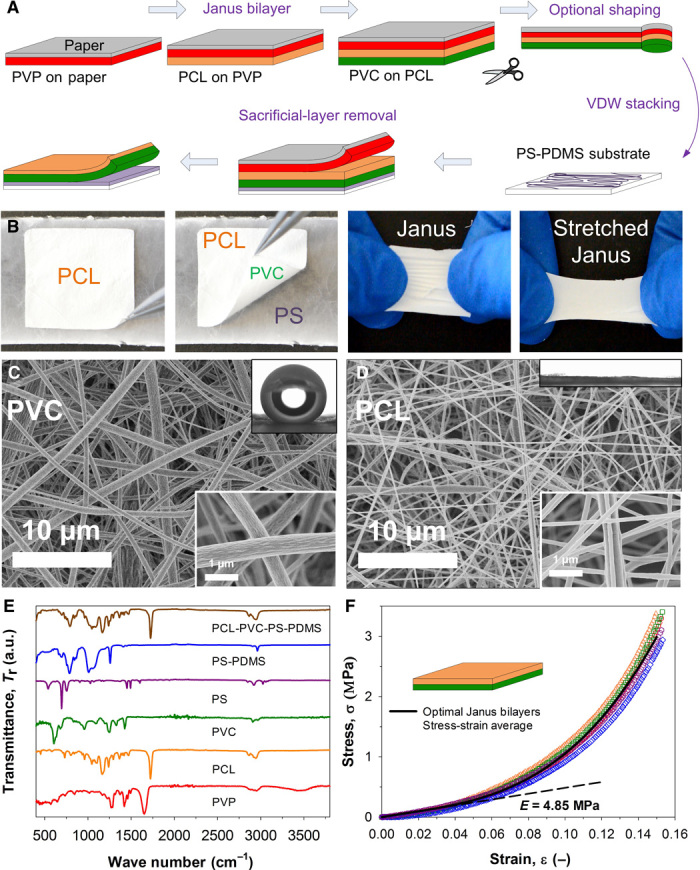
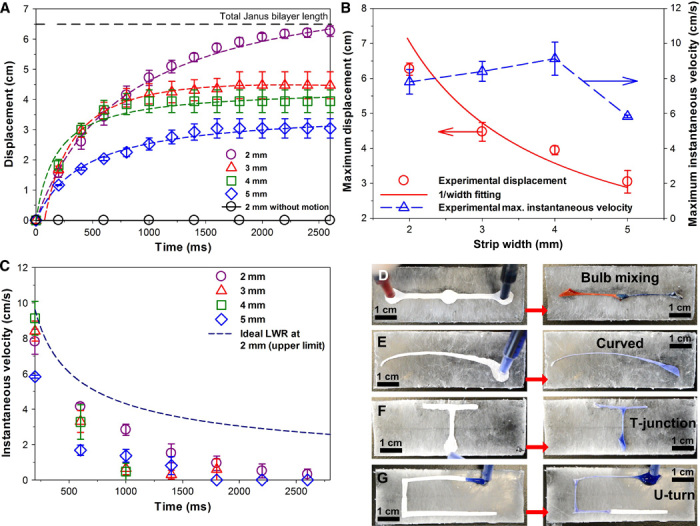
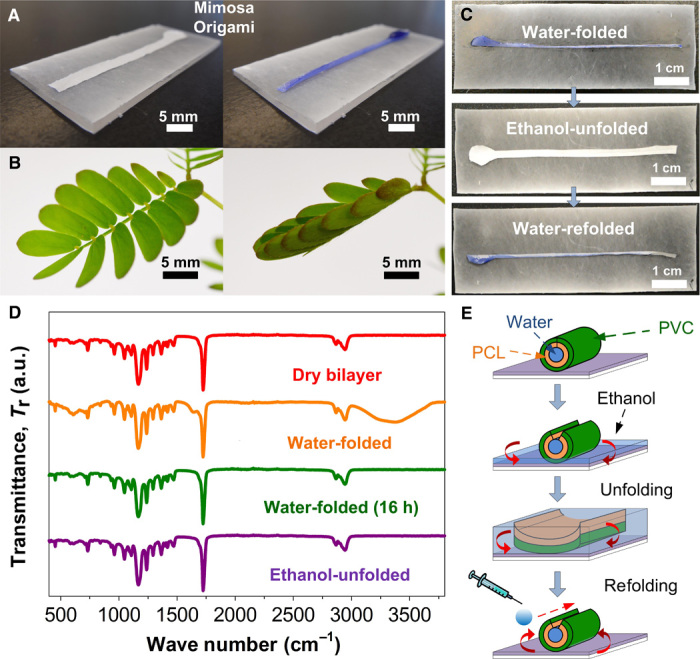
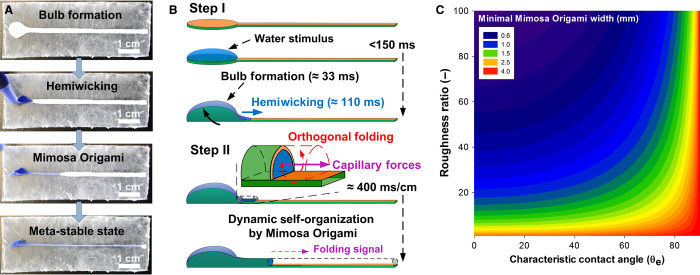
One of the innate fundamentals of living systems is their ability to respond toward distinct stimuli by various self-organization behaviors. Despite extensive progress, the engineering of spontaneous motion in man-made inorganic materials still lacks the directionality and scale observed in nature. We report the directional self-organization of soft materials into three-dimensional geometries by the rapid propagation of a folding stimulus along a predetermined path. We engineer a unique Janus bilayer architecture with superior chemical and mechanical properties that enables the efficient transformation of surface energy into directional kinetic and elastic energies. This Janus bilayer can respond to pinpoint water stimuli by a rapid, several-centimeters-long self-assembly that is reminiscent of the 's leaflet folding. The Janus bilayers also shuttle water at flow rates up to two orders of magnitude higher than traditional wicking-based devices, reaching velocities of 8 cm/s and flow rates of 4.7 μl/s. This self-organization regime enables the ease of fabricating curved, bent, and split flexible channels with lengths greater than 10 cm, demonstrating immense potential for microfluidics, biosensors, and water purification applications.
生命系统的一个固有基础是它们能够通过各种自组织行为对不同的刺激做出反应。尽管已经取得了广泛的进展,但在人为的无机材料中实现自发运动的工程仍然缺乏在自然界中观察到的方向性和规模。我们通过沿着预定路径快速传播折叠刺激,报告了软材料朝着三维形状的定向自组织。我们设计了一种具有优越化学和机械性能的独特的双面体结构,能够将表面能有效地转化为定向动能和弹性能。这种双面体能对精确的水刺激做出快速的、几厘米长的自组装反应,类似于“落叶”的折叠。双面体还能以比传统基于吸液芯的设备高两个数量级的流速输送水,达到 8 厘米/秒的速度和 4.7 μl/s 的流量。这种自组织状态使得制造长度大于 10 厘米的弯曲、弯曲和分裂的柔性通道变得容易,为微流控、生物传感器和水净化应用展示了巨大的潜力。