Ibsen Mikkel Søes, Connor Mark, Glass Michelle
Department of Pharmacology, School of Medical Sciences, University of Auckland, Auckland, New Zealand.
Department of Biomedical Sciences, Faculty of Medicine and Health Sciences, 2 Technology Place, Macquarie University, New South Wales, Australia.
Cannabis Cannabinoid Res. 2017 Mar 1;2(1):48-60. doi: 10.1089/can.2016.0037. eCollection 2017.
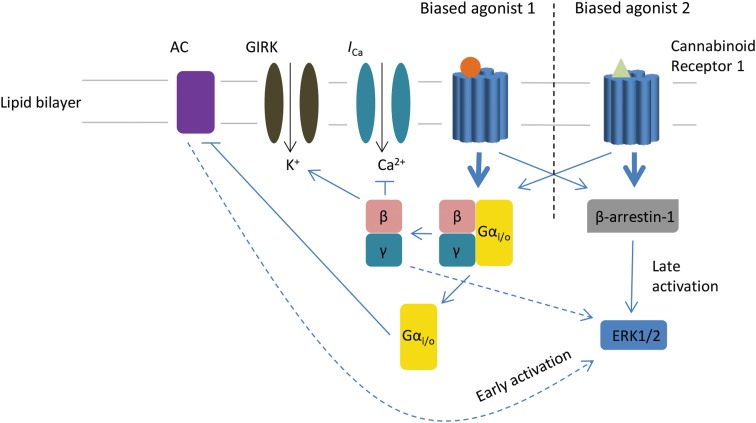
An agonist that acts through a single receptor can activate numerous signaling pathways. Recent studies have suggested that different ligands can differentially activate these pathways by stabilizing a limited range of receptor conformations, which in turn preferentially drive different downstream signaling cascades. This concept, termed "biased signaling" represents an exciting therapeutic opportunity to target specific pathways that elicit only desired effects, while avoiding undesired effects mediated by different signaling cascades. The cannabinoid receptors CB and CB each activate multiple pathways, and evidence is emerging for bias within these pathways. This review will summarize the current evidence for biased signaling through cannabinoid receptor subtypes CB and CB.
通过单一受体起作用的激动剂可激活众多信号通路。最近的研究表明,不同配体可通过稳定有限范围的受体构象来差异性地激活这些通路,进而优先驱动不同的下游信号级联反应。这一概念被称为“偏向性信号传导”,它代表了一个令人兴奋的治疗机会,即能够靶向仅引发预期效应的特定通路,同时避免由不同信号级联反应介导的非预期效应。大麻素受体CB1和CB2各自激活多种通路,并且这些通路中偏向性的证据正在不断涌现。本综述将总结目前关于通过大麻素受体亚型CB1和CB2进行偏向性信号传导的证据。