Ibsen Mikkel Søes, Finlay David B, Patel Monica, Javitch Jonathan A, Glass Michelle, Grimsey Natasha Lillia
Department of Pharmacology and Clinical Pharmacology, School of Medical Sciences, Faculty of Medical and Health Sciences, University of Auckland, Auckland, New Zealand.
Centre for Brain Research, Faculty of Medical and Health Sciences, University of Auckland, Auckland, New Zealand.
Front Pharmacol. 2019 Apr 10;10:350. doi: 10.3389/fphar.2019.00350. eCollection 2019.
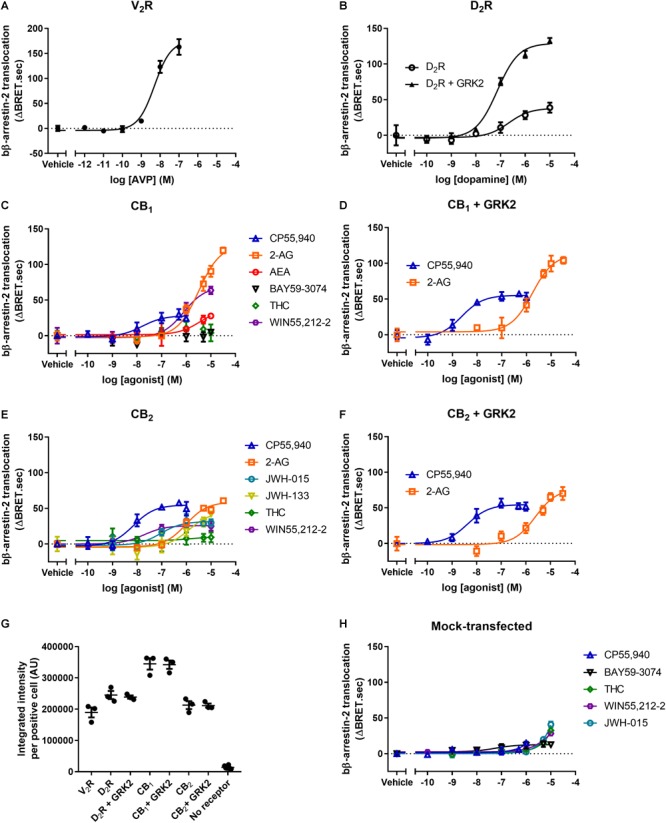
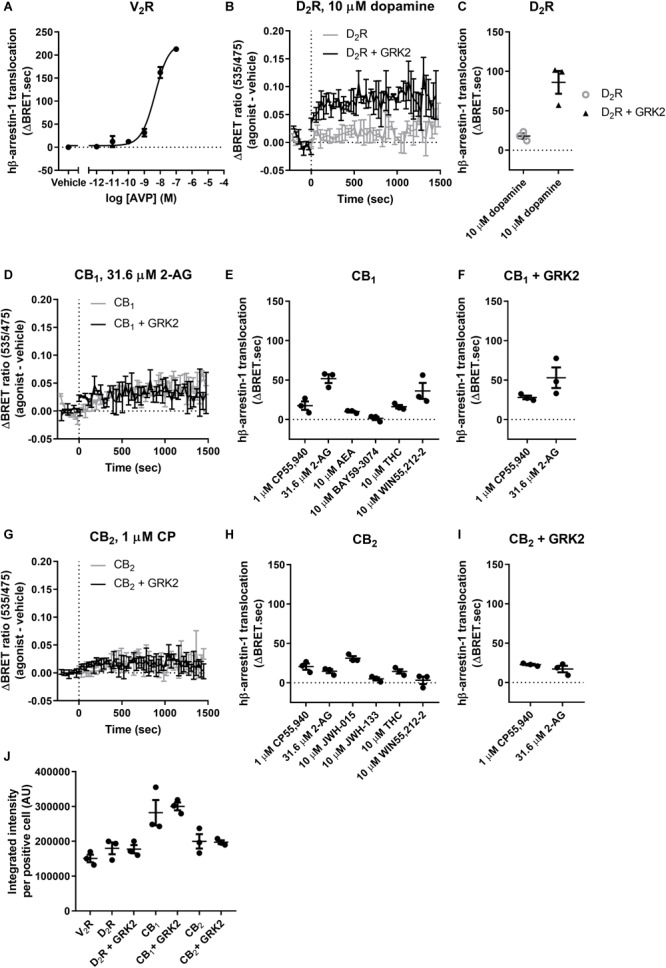
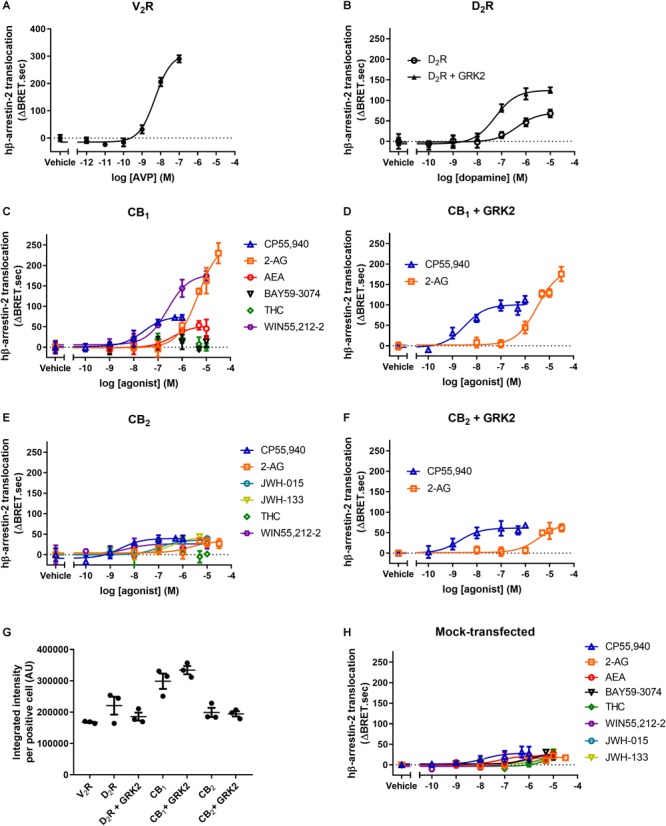
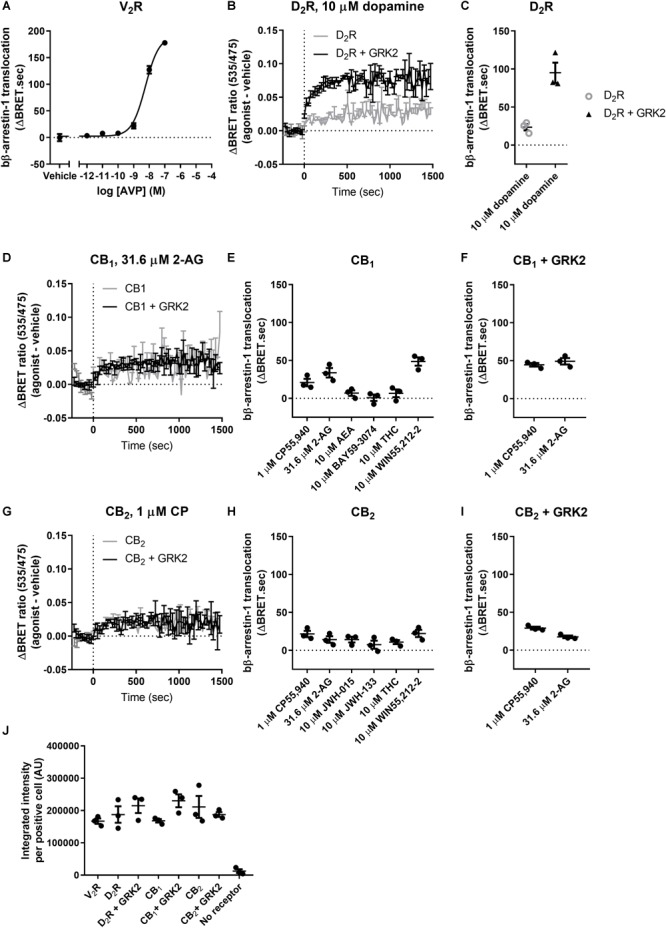
Arrestin translocation and signaling have come to the fore of the G protein-coupled receptor molecular pharmacology field. Some receptor-arrestin interactions are relatively well understood and considered responsible for specific therapeutic or adverse outcomes. Coupling of arrestins with cannabinoid receptors 1 (CB) and 2 (CB) has been reported, though the majority of studies have not systematically characterized the differential ligand dependence of this activity. In addition, many prior studies have utilized bovine (rather than human) arrestins, and the most widely applied assays require reporter-tagged receptors, which prevent meaningful comparison between receptor types. We have employed a bioluminescence resonance energy transfer (BRET) method that does not require the use of tagged receptors and thereby allows comparisons of arrestin translocation between receptor types, as well as with cells lacking the receptor of interest - an important control. The ability of a selection of CB and CB agonists to stimulate cell surface translocation of human and bovine β-arrestin-1 and -2 was assessed. We find that some CB ligands induce moderate β-arrestin-2 translocation in comparison with vasopressin V receptor (a robust arrestin recruiter); however, CB coupling with β-arrestin-1 and CB with either arrestin elicited low relative efficacies. A range of efficacies between ligands was evident for both receptors and arrestins. Endocannabinoid 2-arachidonoylglycerol stood out as a high efficacy ligand for translocation of β-arrestin-2 via CB. Δ-tetrahydrocannabinol was generally unable to elicit translocation of either arrestin subtype via CB or CB; however, control experiments revealed translocation in cells not expressing CB/CB, which may assist in explaining some discrepancy with the literature. Overexpression of GRK2 had modest influence on CB/CB-induced arrestin translocation. Results with bovine and human arrestins were largely analogous, but a few instances of inconsistent rank order potencies/efficacies between bovine and human arrestins raise the possibility that subtle differences in receptor conformation stabilized by these ligands manifest in disparate affinities for the two arrestin species, with important potential consequences for interpretation in ligand bias studies. As well as contributing important information regarding CB/CB ligand-dependent arrestin coupling, our study raises a number of points for consideration in the design and interpretation of arrestin recruitment assays.
抑制蛋白的转位和信号传导已成为G蛋白偶联受体分子药理学领域的研究重点。一些受体与抑制蛋白的相互作用已得到较好理解,并被认为与特定的治疗效果或不良后果有关。虽然已有报道称抑制蛋白与大麻素受体1(CB1)和2(CB2)存在偶联,但大多数研究尚未系统地描述这种活性的不同配体依赖性。此外,许多先前的研究使用的是牛(而非人)抑制蛋白,并且最广泛应用的检测方法需要报告基因标记的受体,这使得不同受体类型之间无法进行有意义的比较。我们采用了一种生物发光共振能量转移(BRET)方法,该方法不需要使用标记的受体,从而能够比较不同受体类型之间以及与缺乏目标受体的细胞(一个重要的对照)之间的抑制蛋白转位情况。我们评估了一系列CB1和CB2激动剂刺激人及牛β-抑制蛋白-1和-2向细胞表面转位的能力。我们发现,与血管加压素V受体(一种强大的抑制蛋白招募剂)相比,一些CB配体诱导适度的β-抑制蛋白-2转位;然而,CB1与β-抑制蛋白-1的偶联以及CB2与任一抑制蛋白的偶联产生的相对效能较低。对于受体和抑制蛋白而言,不同配体之间的效能范围都很明显。内源性大麻素2-花生四烯酸甘油酯是通过CB2使β-抑制蛋白-2转位的高效能配体。Δ-四氢大麻酚通常无法通过CB1或CB2诱导任一抑制蛋白亚型的转位;然而,对照实验显示在不表达CB1/CB2的细胞中存在转位现象,这可能有助于解释与文献之间的一些差异。GRK2的过表达对CB1/CB2诱导的抑制蛋白转位影响不大。牛和人抑制蛋白的实验结果在很大程度上相似,但牛和人抑制蛋白之间存在一些效价/效能排序不一致的情况,这增加了一种可能性,即这些配体稳定的受体构象细微差异表现为对两种抑制蛋白物种的不同亲和力,这对配体偏向性研究的解释具有重要潜在影响。除了提供有关CB1/CB2配体依赖性抑制蛋白偶联的重要信息外,我们的研究还提出了一些在抑制蛋白招募检测的设计和解释中需要考虑的要点。