Thompson Hale M
Section on Population and Behavioral Health, Department of Psychiatry, Rush University Medical Center, Chicago, Illinois.
Transgend Health. 2016 Oct 1;1(1):205-215. doi: 10.1089/trgh.2016.0007. eCollection 2016.
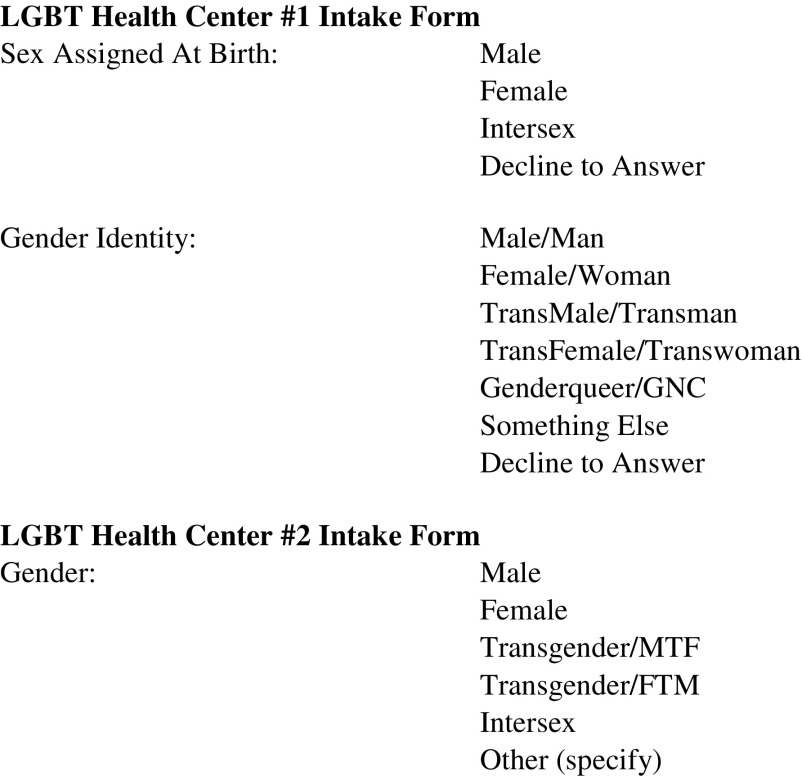
In 2015, the Centers for Medicare and Medicaid Services ruled that health organizations comply with additional requirements for electronic health records (EHRs), known as "Meaningful Use," and develop the capacity to collect gender identity data. Research has established effectiveness of a two-step gender identity question to collect these data. This study examines transgender patient perspectives on the use of a two-step question and experiences with privacy and sensitive disclosures in EHRs and healthcare settings. Four focus groups (=30) were conducted in Chicago, Illinois in 2014-2015. Participants were asked to compare two intake forms-one with a two-step question and one with a single question-and discuss experiences with gender identity disclosure, privacy, and access to care. Narratives were transcribed verbatim to identify patterns and themes; the extended case method was used and grounded the data analysis process in the concept of intersectionality. Participants expressed appreciation for improved reliability and competencies that the two-part question may afford. Narratives reveal concerns related to patient privacy, safety, and access because of the contexts in which these data are collected and transmitted. Virtually all participants described situations whereby sensitive gender identity information had been involuntarily disclosed, misinterpreted, or abused, and safety and care were compromised. Participants recognized the potential of the two-part question as a measurement and competency tool, but anticipated new privacy violations and involuntary disclosures. Narratives indicate that effects of sensitive disclosures may vary intersectionally, whereby white participants experienced lesser harms than their immigrant, HIV-positive, and black trans feminine counterparts. Discrimination and privacy violations may occur regardless of a two-part or one-part gender identity question, but increasing these sensitive disclosures within expanding EHR infrastructures may require a range of mechanisms that have flexibility across contexts to safeguard sensitive information and access to care.
2015年,医疗保险和医疗补助服务中心规定,医疗机构要遵守电子健康记录(EHR)的额外要求,即“有意义使用”,并具备收集性别认同数据的能力。研究已证实两步式性别认同问题在收集这些数据方面的有效性。本研究考察了跨性别患者对使用两步式问题的看法,以及他们在电子健康记录和医疗环境中涉及隐私和敏感信息披露的经历。2014年至2015年期间,在伊利诺伊州芝加哥市开展了四次焦点小组访谈(共30人)。参与者被要求比较两份入院表格,一份有两步式问题,另一份有单一步骤问题,并讨论性别认同披露、隐私及就医方面的经历。访谈内容逐字转录以识别模式和主题;采用扩展案例法,使数据分析过程基于交叉性概念。参与者对两步式问题可能带来的更高可靠性和能力表示赞赏。访谈内容揭示了由于收集和传输这些数据的环境而产生的与患者隐私、安全及就医机会相关的担忧。几乎所有参与者都描述了敏感的性别认同信息被非自愿披露、误解或滥用的情况,安全和医疗受到了损害。参与者认识到两步式问题作为一种测量和能力工具的潜力,但预计会出现新的隐私侵犯和非自愿披露情况。访谈内容表明,敏感信息披露的影响可能因交叉性而有所不同,白人参与者受到的伤害比他们的移民、艾滋病毒呈阳性及黑人跨性别女性对应者要小。无论采用两步式还是单一步骤的性别认同问题,都可能发生歧视和隐私侵犯,但在不断扩展的电子健康记录基础设施中增加这些敏感信息披露,可能需要一系列具有跨环境灵活性的机制,以保护敏感信息和就医机会。