Collin Lindsay, Reisner Sari L, Tangpricha Vin, Goodman Michael
Rollins School of Public Health, Emory University, Atlanta, GA, USA.
The Fenway Institute, Fenway Health, Boston, MA, USA; Department of Epidemiology, Harvard T.H. Chan School of Public Health, Boston, MA, USA.
J Sex Med. 2016 Apr;13(4):613-26. doi: 10.1016/j.jsxm.2016.02.001. Epub 2016 Mar 25.
A systematic review and meta-analysis was conducted to evaluate how various definitions of transgender affect prevalence estimates.
To evaluate the epidemiology of transgender and examine how various definitions of transgender affect prevalence estimates and to compare findings across studies that used different methodologies, in different countries, and over different periods.
PubMed, EMBASE, and Medline were searched to identify studies reporting prevalence estimates of transgender in a population. All studies were grouped based on the case definition applied to the numerator. Summary estimates were derived using a random-effects model for total prevalence of transgender and for male-to-female and female-to-male subgroups. Overall and stratum-specific meta-prevalence estimates (mPs) and 95% confidence intervals (CIs) were accompanied by tests for heterogeneity and meta-regressions to assess sources of heterogeneity.
The main outcome measure was population prevalence of transgender. Secondary outcomes included gender-specific prevalence estimates for male-to-female and female to male subgroups.
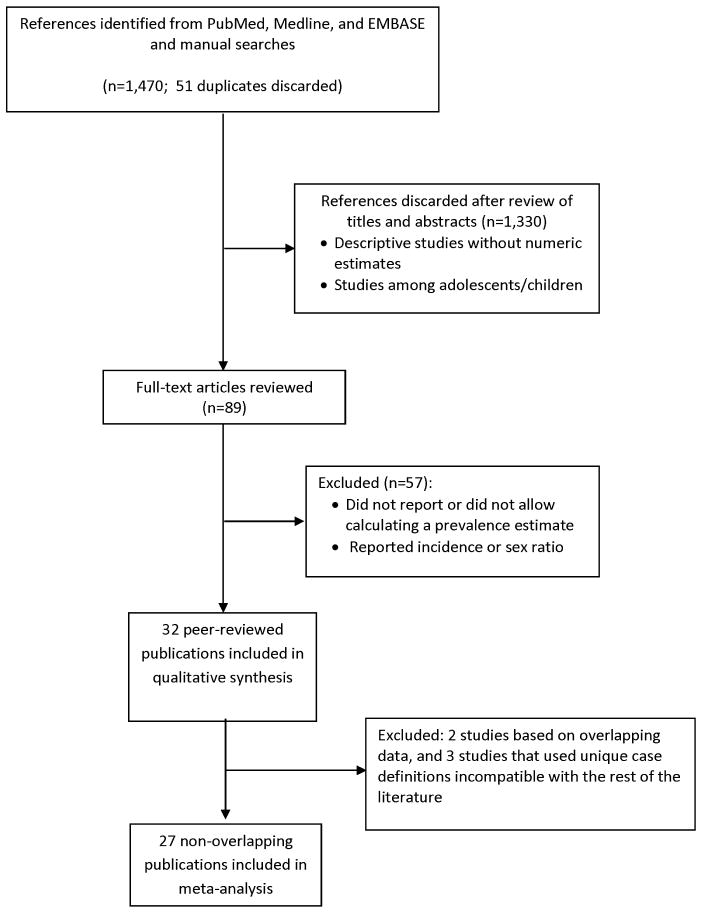
Thirty-two studies met the inclusion criteria for systematic review. Of those, 27 studies provided necessary data for a meta-analysis. Overall mP estimates per 100,000 population were 9.2 (95% CI = 4.9-13.6) for surgical or hormonal gender affirmation therapy and 6.8 (95% CI = 4.6-9.1) for transgender-related diagnoses. Of studies assessing self-reported transgender identity, the mP was 871 (95% CI = 519-1,224); however, this result was influenced by a single outlier study. After removal of that study, the mP changed to 355 (95% CI = 144-566). Significant heterogeneity was observed in most analyses.
The empirical literature on the prevalence of transgender highlights the importance of adhering to specific case definitions because the results can range by orders of magnitude. Standardized and routine collection of data on transgender status and gender identity is recommended.
进行了一项系统评价和荟萃分析,以评估跨性别者的各种定义如何影响患病率估计。
评估跨性别者的流行病学情况,研究跨性别者的各种定义如何影响患病率估计,并比较不同国家、不同时期使用不同方法的研究结果。
检索PubMed、EMBASE和Medline,以确定报告人群中跨性别者患病率估计的研究。所有研究根据应用于分子的病例定义进行分组。使用随机效应模型得出跨性别者总体患病率以及男性向女性和女性向男性亚组的汇总估计值。总体和分层特定的元患病率估计值(mP)以及95%置信区间(CI)伴有异质性检验和元回归,以评估异质性来源。
主要结局指标是跨性别者的人群患病率。次要结局包括男性向女性和女性向男性亚组的特定性别患病率估计值。
32项研究符合系统评价的纳入标准。其中,27项研究提供了荟萃分析所需的数据。每10万人中,接受手术或激素性别确认治疗的总体mP估计值为9.2(95%CI = 4.9 - 13.6),与跨性别相关诊断的mP估计值为6.8(95%CI = 4.6 - 9.1)。在评估自我报告的跨性别身份的研究中,mP为871(95%CI = 519 - 1224);然而,这一结果受到一项异常值研究的影响。剔除该研究后,mP变为355(95%CI = 144 - 566)。在大多数分析中观察到显著的异质性。
关于跨性别者患病率的实证文献强调了遵循特定病例定义的重要性,因为结果可能相差几个数量级。建议对跨性别状况和性别认同进行标准化和常规的数据收集。