Saint Luke's Mid America Heart Institute, Kansas City, MO.
Daiichi Sankyo, Inc, Parsippany, NJ.
J Am Heart Assoc. 2017 Aug 11;6(8):e006703. doi: 10.1161/JAHA.117.006703.
The impact of different types of extracranial bleeding events on health-related quality of life and health-state utility among patients with atrial fibrillation is not well understood.
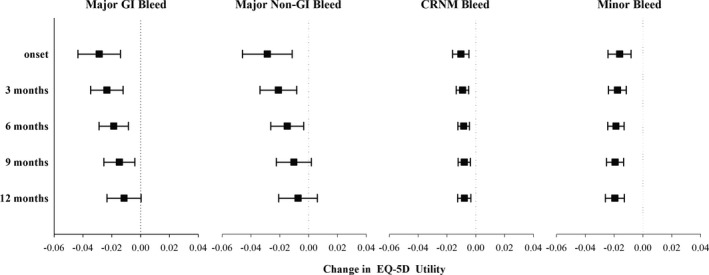
The ENGAGE AF-TIMI 48 (Effective Anticoagulation With Factor Xa Next Generation in Atrial Fibrillation-Thrombolysis in Myocardial Infarction 48) Trial compared edoxaban with warfarin with respect to the prevention of stroke or systemic embolism in atrial fibrillation. Data from the EuroQol-5D (EQ-5D-3L) questionnaire, prospectively collected at 3-month intervals for up to 48 months, were used to estimate the impact of different categories of bleeding events on health-state utility over 12 months following the event. Longitudinal mixed-effect models revealed that major gastrointestinal bleeds and major nongastrointestinal bleeds were associated with significant immediate decreases in utility scores (-0.029 [-0.044 to -0.014; <0.001] and -0.029 [-0.046 to -0.012; =0.001], respectively). These effects decreased in magnitude over time, and were no longer significant for major nongastrointestinal bleeds at 9 months, but remained borderline significant for major gastrointestinal bleeds at 12 months. Clinically relevant nonmajor and minor bleeds were associated with smaller but measurable immediate impacts on utility (-0.010 [-0.016 to -0.005] and -0.016 [-0.024 to -0.008]; <0.001 for both), which remained relatively constant and statistically significant over the 12 months following the bleeding event.
All categories of bleeding events were associated with negative impacts on health-state utility in patients with atrial fibrillation. Major bleeds were associated with relatively large immediate decreases in utility scores that gradually diminished over 12 months; clinically relevant nonmajor and minor bleeds were associated with smaller immediate decreases in utility that persisted over 12 months.
URL: https://www.clinicaltrials.gov/. Unique identifier: NCT00781391.
不同类型的颅外出血事件对房颤患者的健康相关生活质量和健康状态效用的影响尚不清楚。
ENGAGE AF-TIMI 48(房颤中新型 Xa 因子抗凝剂与华法林血栓栓塞预防-48 试验)比较了依度沙班与华法林在预防房颤中的卒中或全身性栓塞。在长达 48 个月的 3 个月间隔内前瞻性收集的 EuroQol-5D(EQ-5D-3L)问卷数据用于估计出血事件发生后 12 个月内不同类型出血事件对健康状态效用的影响。纵向混合效应模型显示,主要胃肠道出血和主要非胃肠道出血与效用评分的显著即刻下降相关(-0.029 [-0.044 至-0.014;<0.001]和-0.029 [-0.046 至-0.012;=0.001])。这些影响随时间而减小,在 9 个月时主要非胃肠道出血不再显著,但在 12 个月时主要胃肠道出血仍接近显著。临床相关非重大和轻微出血与效用的较小但可测量的即刻影响相关(-0.010 [-0.016 至-0.005]和-0.016 [-0.024 至-0.008];<0.001 均),在出血事件后 12 个月内保持相对稳定且具有统计学意义。
所有类型的出血事件均与房颤患者健康状态效用的负性影响相关。主要出血与相对较大的即时效用评分下降相关,这种下降在 12 个月内逐渐减少;临床相关非重大和轻微出血与较小的即时效用下降相关,这种下降在 12 个月内持续存在。