Webb Eika S, Liu Peng, Baleeiro Renato, Lemoine Nicholas R, Yuan Ming, Wang Yao-He
Center for Molecular Oncology, Barts Cancer Institute, Queen Mary University of London, EC1M 6BQ, UK.
Sino-British Research Centre for Molecular Oncology, National Center for International Research in Cell and Gene Therapy, Zhengzhou University, School of Basic Medical Sciences, Academy of Medical Sciences, Zhengzhou University, Zhengzhou, Henan 450002, China.
J Biomed Res. 2018 Sep 29;32(5):317-326. doi: 10.7555/JBR.31.20160168.
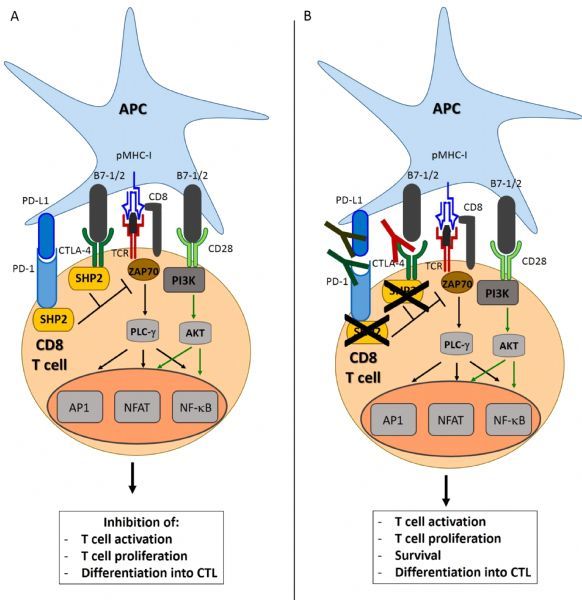
In recent years immune checkpoint inhibitors have garnered attention as being one of the most promising types of immunotherapy on the horizon. There has been particular focus on the immune checkpoint molecules, cytotoxic T-lymphocyte antigen-4 (CTLA-4) and programmed cell death protein 1 (PD-1) which have been shown to have potent immunomodulatory effects through their function as negative regulators of T cell activation. CTLA-4, through engagement with its ligands B7-1 (CD80) and B7-2 (CD86), plays a pivotal role in attenuating the activation of naïve and memory T cells. In contrast, PD-1 is primarily involved in modulating T cell activity in peripheral tissues via its interaction with PD-L1 and PD-L2. The discovery of these negative regulators of the immune response was crucial in the development of checkpoint inhibitors. This shifted the focus from developing therapies that targeted activation of the host immune system against cancer to checkpoint inhibitors, which aimed to mediate tumor cell destruction through the removal of coinhibitory signals blocking anti-tumor T cell responses.
近年来,免疫检查点抑制剂作为最有前景的免疫疗法之一受到了关注。人们特别关注免疫检查点分子,细胞毒性T淋巴细胞抗原4(CTLA-4)和程序性细胞死亡蛋白1(PD-1),它们作为T细胞活化的负调节因子,已被证明具有强大的免疫调节作用。CTLA-4通过与配体B7-1(CD80)和B7-2(CD86)结合,在减弱初始和记忆T细胞的活化中起关键作用。相比之下,PD-1主要通过与PD-L1和PD-L2相互作用,在外周组织中调节T细胞活性。这些免疫反应负调节因子的发现对检查点抑制剂的开发至关重要。这将重点从开发针对激活宿主免疫系统对抗癌症的疗法转移到了检查点抑制剂,后者旨在通过去除阻断抗肿瘤T细胞反应的共抑制信号来介导肿瘤细胞破坏。