Pauli Duke, White Jeffrey W, Andrade-Sanchez Pedro, Conley Matthew M, Heun John, Thorp Kelly R, French Andrew N, Hunsaker Douglas J, Carmo-Silva Elizabete, Wang Guangyao, Gore Michael A
Plant Breeding and Genetics Section, School of Integrative Plant Science, Cornell UniversityIthaca, NY, United States.
United States Department of Agriculture-Agricultural Research Service, Arid Land Agricultural Research CenterMaricopa, AZ, United States.
Front Plant Sci. 2017 Aug 17;8:1405. doi: 10.3389/fpls.2017.01405. eCollection 2017.
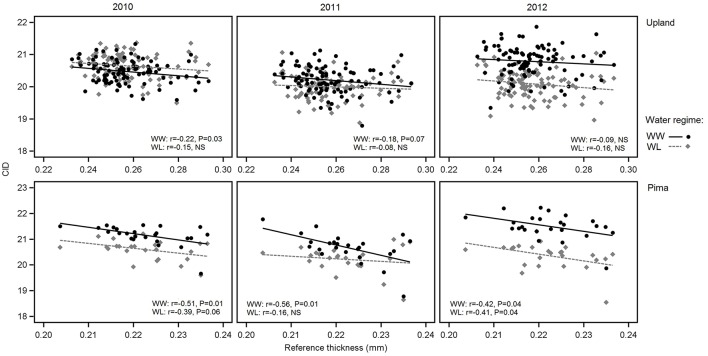
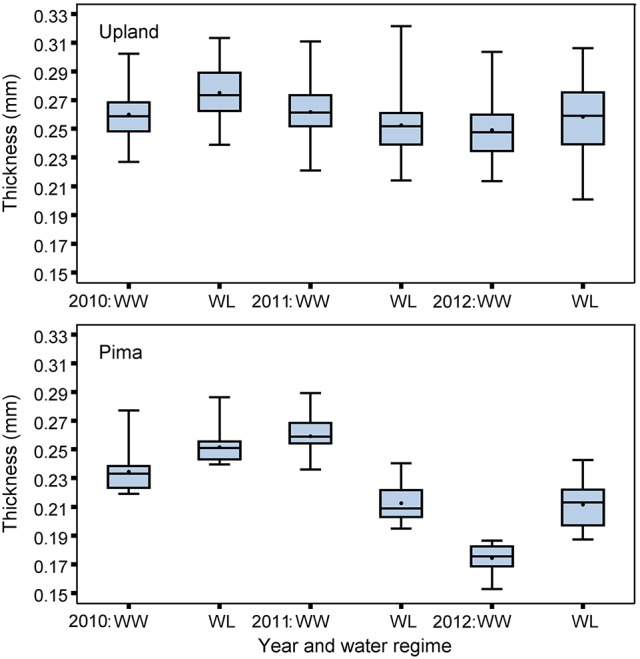
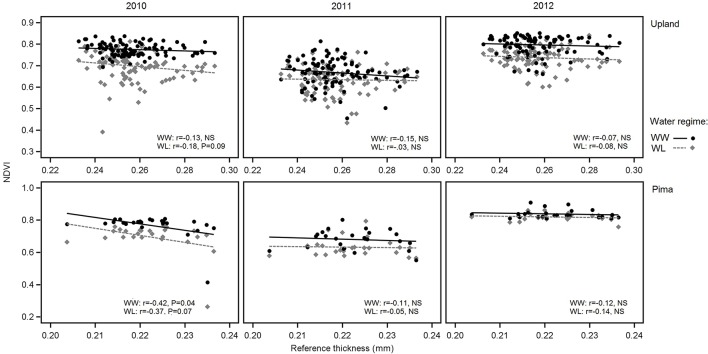
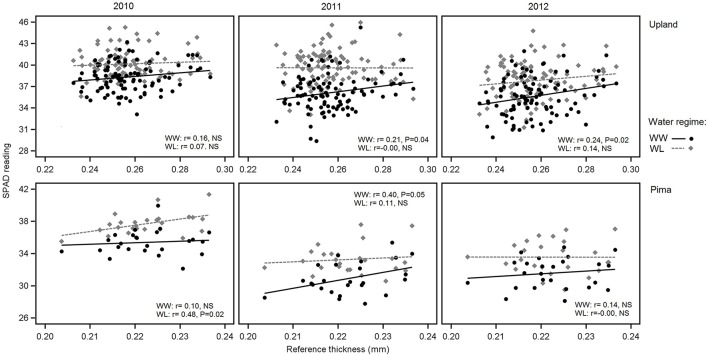
Many systems for field-based, high-throughput phenotyping (FB-HTP) quantify and characterize the reflected radiation from the crop canopy to derive phenotypes, as well as infer plant function and health status. However, given the technology's nascent status, it remains unknown how biophysical and physiological properties of the plant canopy impact downstream interpretation and application of canopy reflectance data. In that light, we assessed relationships between leaf thickness and several canopy-associated traits, including normalized difference vegetation index (NDVI), which was collected via active reflectance sensors carried on a mobile FB-HTP system, carbon isotope discrimination (CID), and chlorophyll content. To investigate the relationships among traits, two distinct cotton populations, an upland ( L.) recombinant inbred line (RIL) population of 95 lines and a Pima ( L.) population composed of 25 diverse cultivars, were evaluated under contrasting irrigation regimes, water-limited (WL) and well-watered (WW) conditions, across 3 years. We detected four quantitative trait loci (QTL) and significant variation in both populations for leaf thickness among genotypes as well as high estimates of broad-sense heritability (on average, above 0.7 for both populations), indicating a strong genetic basis for leaf thickness. Strong phenotypic correlations (maximum = -0.73) were observed between leaf thickness and NDVI in the Pima population, but not the RIL population. Additionally, estimated genotypic correlations within the RIL population for leaf thickness with CID, chlorophyll content, and nitrogen discrimination ([Formula: see text] = -0.32, 0.48, and 0.40, respectively) were all significant under WW but not WL conditions. Economically important fiber quality traits did not exhibit significant phenotypic or genotypic correlations with canopy traits. Overall, our results support considering variation in leaf thickness as a potential contributing factor to variation in NDVI or other canopy traits measured via proximal sensing, and as a trait that impacts fundamental physiological responses of plants.
许多基于田间的高通量表型分析(FB-HTP)系统通过对作物冠层反射辐射进行量化和特征描述来获取表型,同时推断植物功能和健康状况。然而,鉴于该技术尚处于起步阶段,植物冠层的生物物理和生理特性如何影响冠层反射率数据的下游解释和应用仍不清楚。有鉴于此,我们评估了叶片厚度与几个冠层相关性状之间的关系,包括通过移动FB-HTP系统搭载的主动反射传感器收集的归一化植被指数(NDVI)、碳同位素判别率(CID)和叶绿素含量。为了研究这些性状之间的关系,我们在3年时间里,在水分受限(WL)和充分灌溉(WW)这两种对比灌溉制度下,对两个不同的棉花群体进行了评估,一个是由95个品系组成的陆地棉(L.)重组自交系(RIL)群体,另一个是由25个不同品种组成的皮马棉(L.)群体。我们在两个群体中均检测到4个数量性状位点(QTL),基因型间叶片厚度存在显著差异,且广义遗传力估计值较高(两个群体平均均高于0.7),表明叶片厚度具有较强的遗传基础。在皮马棉群体中,叶片厚度与NDVI之间观察到较强的表型相关性(最大值 = -0.73),但在RIL群体中未观察到。此外,在WW条件下,RIL群体中叶片厚度与CID、叶绿素含量以及氮判别率之间的估计基因型相关性(分别为 = -0.32、0.48和0.40)均显著,但在WL条件下不显著。经济上重要的纤维品质性状与冠层性状未表现出显著的表型或基因型相关性。总体而言,我们的结果支持将叶片厚度的变化视为NDVI或其他通过近端传感测量的冠层性状变化的潜在影响因素,以及视为影响植物基本生理反应的一个性状。