Mous Sabine E, Jiang Allan, Agrawal Arpana, Constantino John N
Department of Child and Adolescent Psychiatry/Psychology, Sophia Children's Hospital, Erasmus Medical Center, Wytemaweg 80, 3015 CN, Rotterdam, The Netherlands.
Division of Child Psychiatry, Department of Psychiatry, Washington University School of Medicine, 660 South Euclid Avenue, Campus Box 8504, St Louis, MO, 63110, USA.
J Neurodev Disord. 2017 Sep 5;9(1):32. doi: 10.1186/s11689-017-9212-y.
Recent research has demonstrated that subclinical autistic traits of parents amplify the effects of deleterious mutations in the causation of autism spectrum disorder (ASD) in their offspring. Here, we examined the extent to which two neurodevelopmental traits that are non-specific to ASD-inattention/hyperactivity and motor coordination-might contribute to ASD recurrence in siblings of ASD probands.
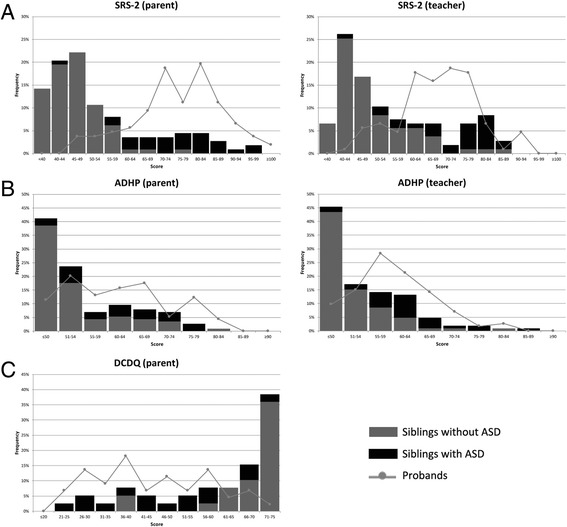
Data from a quantitative trait study of 114 ASD probands and their brothers, 26% of whom also had ASD, were analyzed. Autistic trait severity was ascertained using the Social Responsiveness Scale-2, attention/hyperactivity problems using the Achenbach System of Empirically Based Assessment, and motor coordination (in a subset of participants) using the Developmental Coordination Disorder Questionnaire.
Among siblings (affected and unaffected), both categorical recurrence of ASD (Nagelkerke R = 0.53) and quantitative ASD trait burden (R = 0.55) were predicted by sibling ADHD and motor coordination impairment scores, even though these traits, on average, were not elevated among the unaffected siblings.
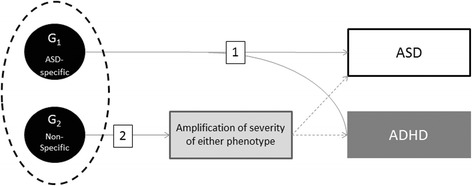
These findings in a clinical family cohort confirm observations from general population studies that inattention/hyperactivity and motor impairment-axes of behavioral development that are non-specific to ASD, and often appreciable before ASD is typically diagnosed-jointly account for over 50% of the variation in autistic impairment of siblings, whether ascertained quantitatively or categorically. This finding within a sibling design suggests that background ASD susceptibilities that are inherited but non-specific ("BASINS") may contribute to additive genetic liability in the same manner that ASD-specific susceptibilities (such as parental subclinical ASD traits and deleterious mutations) engender ASD risk.
近期研究表明,父母的亚临床自闭症特质会增强有害突变在其后代自闭症谱系障碍(ASD)病因中的作用。在此,我们研究了两种并非ASD所特有的神经发育特质——注意力不集中/多动和运动协调能力——在ASD先证者的兄弟姐妹中对ASD复发的影响程度。
对一项针对114名ASD先证者及其兄弟的数量性状研究数据进行了分析,其中26%的兄弟也患有ASD。使用社会反应量表-2确定自闭症特质严重程度,使用基于经验评估的阿肯巴克系统确定注意力/多动问题,并在部分参与者中使用发育协调障碍问卷确定运动协调能力。
在兄弟姐妹(患病和未患病)中,ASD的分类复发率(Nagelkerke R = 0.53)和定量ASD特质负担(R = 0.55)均由兄弟姐妹的注意力缺陷多动障碍(ADHD)和运动协调障碍评分预测,尽管平均而言,这些特质在未患病的兄弟姐妹中并未升高。
在一个临床家系队列中的这些发现证实了来自一般人群研究的观察结果,即注意力不集中/多动和运动障碍——行为发育中并非ASD所特有的方面,且通常在ASD被典型诊断之前就很明显——共同解释了兄弟姐妹自闭症损害超过50%的变异,无论是通过定量还是分类方式确定。在兄弟姐妹设计中的这一发现表明,遗传但非特异性的背景ASD易感性(“BASINS”)可能以与ASD特异性易感性(如父母的亚临床ASD特质和有害突变)导致ASD风险相同的方式,对加性遗传易感性产生影响。