Shimmura Tsuyoshi, Nakayama Tomoya, Shinomiya Ai, Fukamachi Shoji, Yasugi Masaki, Watanabe Eiji, Shimo Takayuki, Senga Takumi, Nishimura Toshiya, Tanaka Minoru, Kamei Yasuhiro, Naruse Kiyoshi, Yoshimura Takashi
Division of Seasonal Biology, National Institute for Basic Biology, National Institutes of Natural Sciences, Okazaki, Aichi, 444-8585, Japan.
Department of Basic Biology, The Graduate University for Advanced Studies (SOKENDAI), Hayama, 240-0193, Japan.
Nat Commun. 2017 Sep 4;8(1):412. doi: 10.1038/s41467-017-00432-8.
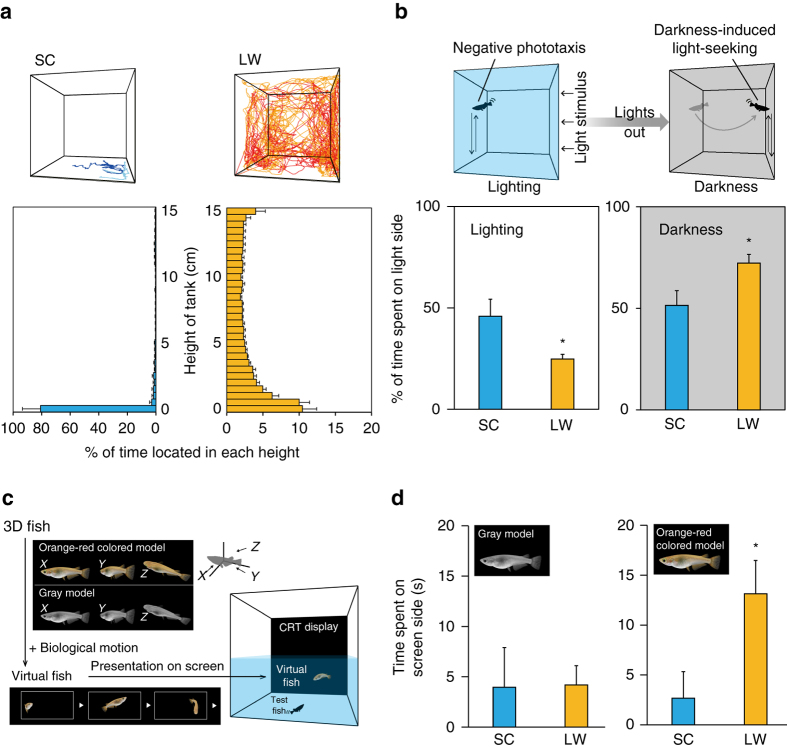
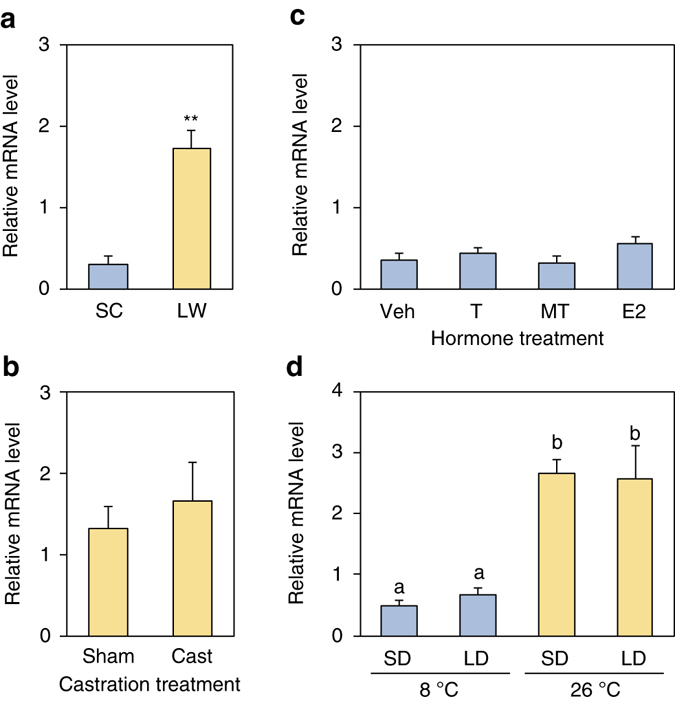
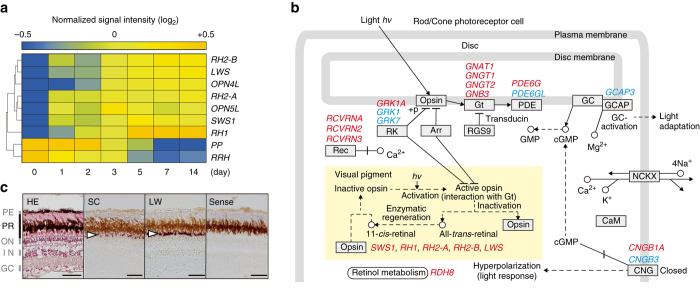
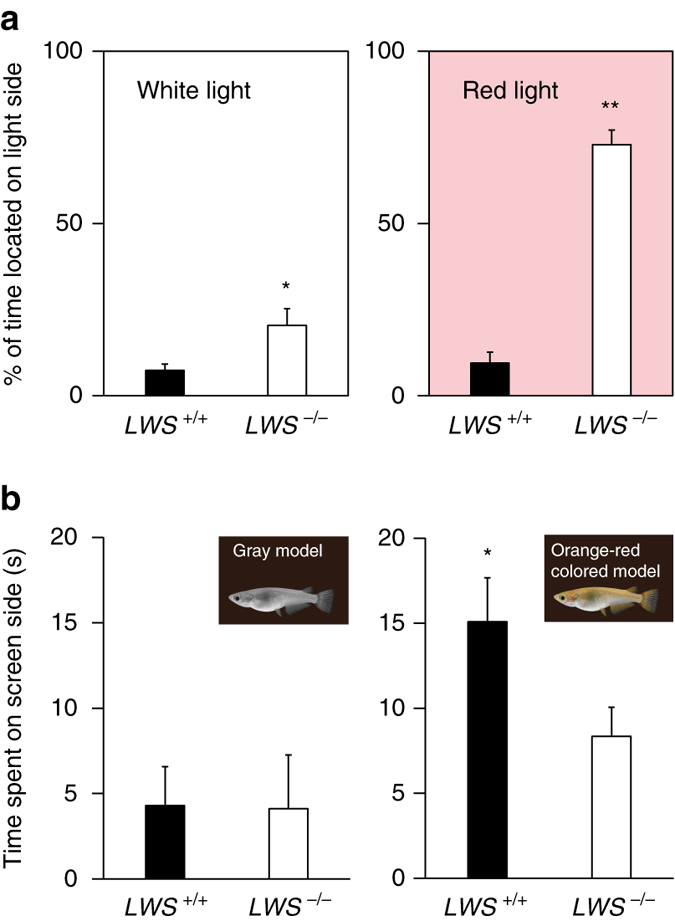
To cope with seasonal changes in the environment, organisms adapt their physiology and behavior. Although color perception varies among seasons, the underlying molecular basis and its physiological significance remain unclear. Here we show that dynamic plasticity in phototransduction regulates seasonal changes in color perception in medaka fish. Medaka are active and exhibit clear phototaxis in conditions simulating summer, but remain at the bottom of the tank and fail to exhibit phototaxis in conditions simulating winter. Mate preference tests using virtual fish created with computer graphics demonstrate that medaka are more attracted to orange-red-colored model fish in summer than in winter. Transcriptome analysis of the eye reveals dynamic seasonal changes in the expression of genes encoding photopigments and their downstream pathways. Behavioral analysis of photopigment-null fish shows significant differences from wild type, suggesting that plasticity in color perception is crucial for the emergence of seasonally regulated behaviors.Animal coloration and behavior can change seasonally, but it is unclear if visual sensitivity to color shifts as well. Here, Shimmura et al. show that medaka undergo seasonal behavioral change accompanied by altered expression of opsin genes, resulting in reduced visual sensitivity to mates during winter-like conditions.
为了应对环境中的季节性变化,生物体调整其生理和行为。尽管颜色感知在不同季节有所变化,但其潜在的分子基础及其生理意义仍不清楚。在这里,我们表明光转导中的动态可塑性调节了青鳉鱼颜色感知的季节性变化。青鳉鱼在模拟夏季的条件下活跃并表现出明显的趋光性,但在模拟冬季的条件下则停留在水箱底部且不表现出趋光性。使用计算机图形创建的虚拟鱼进行的配偶偏好测试表明,青鳉鱼在夏季比冬季更被橙红色模型鱼吸引。眼睛的转录组分析揭示了编码光色素及其下游途径的基因表达的动态季节性变化。对光色素缺失鱼的行为分析显示出与野生型的显著差异,这表明颜色感知的可塑性对于季节性调节行为的出现至关重要。动物的颜色和行为可以随季节变化,但尚不清楚对颜色的视觉敏感性是否也会发生变化。在这里,Shimmura等人表明,青鳉鱼会经历季节性行为变化,同时视蛋白基因的表达也会改变,从而导致在类似冬季的条件下对配偶的视觉敏感性降低。