Patel Dhaval S, Diana Giovanni, Entchev Eugeni V, Zhan Mei, Lu Hang, Ch'ng QueeLim
Centre for Developmental Neurobiology, King's College London.
Interdisciplinary Bioengineering Graduate Program, Georgia Institute of Technology; Wallace H. Coulter Department of Biomedical Engineering, Georgia Institute of Technology; School of Chemical & Biomolecular Engineering, Georgia Institute of Technology.
J Vis Exp. 2017 Aug 16(126):56292. doi: 10.3791/56292.
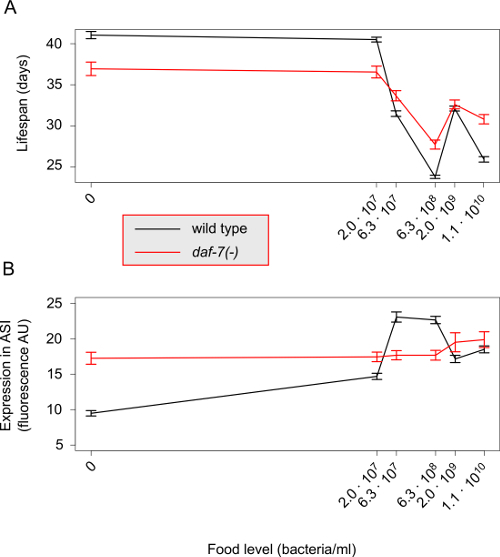
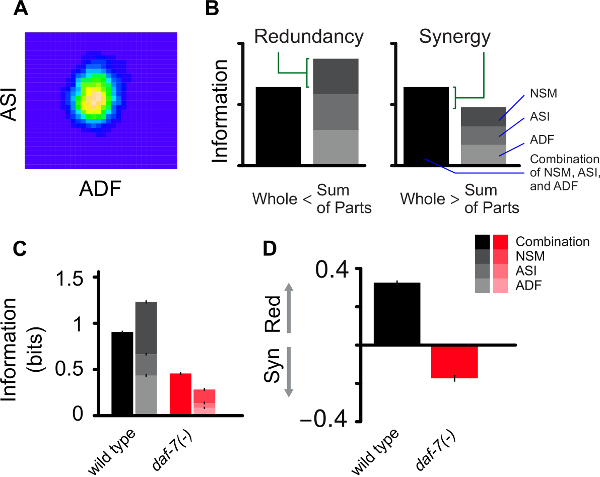
Sensory systems allow animals to detect, process, and respond to their environment. Food abundance is an environmental cue that has profound effects on animal physiology and behavior. Recently, we showed that modulation of longevity in the nematode Caenorhabditis elegans by food abundance is more complex than previously recognized. The responsiveness of the lifespan to changes in food level is determined by specific genes that act by controlling information processing within a neural circuit. Our framework combines genetic analysis, high-throughput quantitative imaging and information theory. Here, we describe how these techniques can be used to characterize any gene that has a physiological relevance to broad-range dietary restriction. Specifically, this workflow is designed to reveal how a gene of interest regulates lifespan under broad-range dietary restriction; then to establish how the expression of the gene varies with food level; and finally, to provide an unbiased quantification of the amount of information conveyed by gene expression about food abundance in the environment. When several genes are examined simultaneously under the context of a neural circuit, this workflow can uncover the coding strategy employed by the circuit.
感觉系统使动物能够检测、处理并对其环境做出反应。食物丰度是一种对动物生理和行为有深远影响的环境线索。最近,我们发现线虫秀丽隐杆线虫中食物丰度对寿命的调节比之前认为的更为复杂。寿命对食物水平变化的反应性由特定基因决定,这些基因通过控制神经回路内的信息处理起作用。我们的框架结合了遗传分析、高通量定量成像和信息理论。在此,我们描述如何使用这些技术来表征任何与广泛饮食限制具有生理相关性的基因。具体而言,该工作流程旨在揭示感兴趣的基因在广泛饮食限制下如何调节寿命;然后确定该基因的表达如何随食物水平变化;最后,对基因表达所传达的关于环境中食物丰度的信息量进行无偏差量化。当在神经回路的背景下同时检查多个基因时,此工作流程可以揭示该回路所采用的编码策略。