Corréard Nadia, Consoloni Julia-Lou, Raust Aurélie, Etain Bruno, Guillot Romain, Job Sophie, Loftus Joséphine, Médecin Isabelle, Bougerol Thierry, Polosan Mircea, Fredembach Benjamin, Gard Sébastien, M'Bailara Katia, Kahn Jean-Pierre, Roux Paul, Homassel Anne-Sophie, Carminati Mathilde, Matos Lucile, Olié Emilie, Bellivier Frank, Courtet Philippe, Henry Chantal, Leboyer Marion, Azorin Jean-Michel, Belzeaux Raoul
Department of Psychiatry, AP-HM, Marseille, France.
FondaMental foundation, Foundation of scientific cooperation, Créteil, France.
PLoS One. 2017 Sep 5;12(9):e0184313. doi: 10.1371/journal.pone.0184313. eCollection 2017.
Poor adherence to medication is frequent in bipolar disorder (BD) and has been associated with several factors. To date, the relationship between low adherence and neuropsychological functioning in BD is still unclear. As age and neuropsychological functioning might have opposing influences on adherence, our aim was to investigate this link with a particular focus on the effect of age.
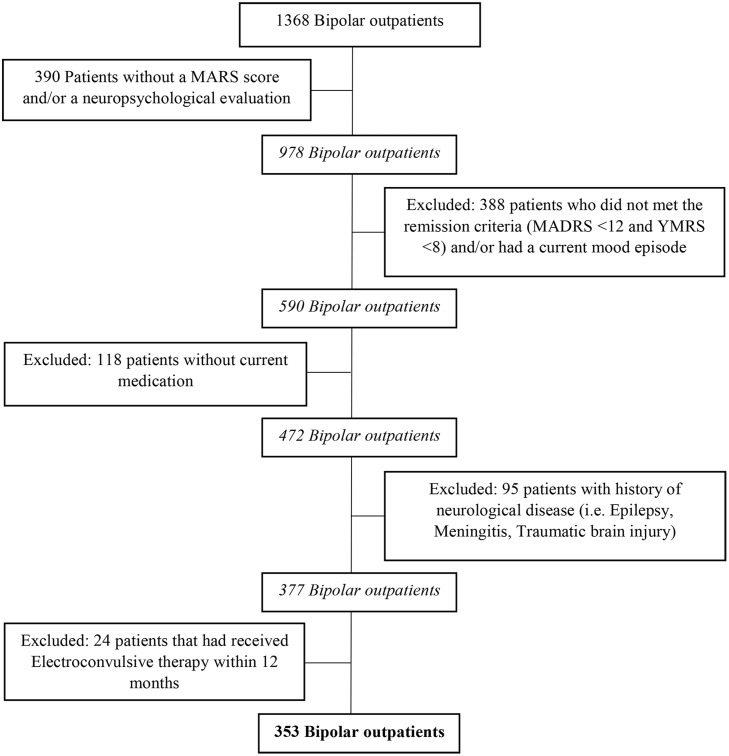
In a cross-sectional study, we included 353 patients divided into two age-groups (16-46; 47-71) from a French cohort diagnosed with BD (type I, II, NOS) and strictly euthymic. All patients had a standardized clinical and neuropsychological assessment and were categorized as high (n = 186) or low (n = 167) adherent based on their score from the Medication Adherence Rating Scale. Clinical information was collected based on a standardized interview and clinical validated scales. Neuropsychological performances were evaluated with an established standardized neuropsychological battery for bipolar disorder patients. After univariate analysis, neuropsychological and clinical predictors of low adherence were included in two age-specific stepwise multiple logistic regressions.
A smaller number of hospitalizations (OR = 0.846, p = 0.012), a shorter illness duration (OR = 0.937, p = 0.003) and higher adverse effects (OR = 1.082, p<0.001) were associated with a greater risk of low adherence in the younger patients. In the older patients, low adherence was also predicted by a smaller number of hospitalizations (OR = 0.727, p = 0.008) and higher adverse effects (OR = 1.124, p = 0.005). Interestingly poor inhibition performance was also a significant predictor of low adherence in older patients (OR = 0.924, p = 0.030).
We found an age-specific relationship between cognitive functioning and adherence in patients with BD. Poor inhibition performances predicted low adherence in older patients only. Our results highlight the need to provide age-adapted therapeutic interventions to improve adherence in patients with BD.
双相情感障碍(BD)患者中药物依从性差的情况很常见,且与多种因素相关。迄今为止,BD患者中依从性低与神经心理功能之间的关系仍不明确。由于年龄和神经心理功能可能对依从性有相反的影响,我们的目的是研究这种联系,特别关注年龄的影响。
在一项横断面研究中,我们纳入了来自法国队列的353名患者,分为两个年龄组(16 - 46岁;47 - 71岁),这些患者被诊断为BD(I型、II型、未特定型)且处于严格的心境正常状态。所有患者都进行了标准化的临床和神经心理评估,并根据药物依从性评定量表的得分分为高依从性组(n = 186)或低依从性组(n = 167)。临床信息通过标准化访谈和临床验证量表收集。使用针对双相情感障碍患者建立的标准化神经心理测试组合评估神经心理表现。单因素分析后,低依从性的神经心理和临床预测因素被纳入两个针对特定年龄的逐步多元逻辑回归分析。
住院次数较少(OR = 0.846,p = 于1.082,p < 0.001)与年轻患者依从性低的风险增加相关。在老年患者中,住院次数较少(OR = 0.727,p = 0.008)和不良反应较多(OR = 1.124,p = 0.005)也可预测依从性低。有趣的是,抑制功能差也是老年患者依从性低的一个重要预测因素(OR = 0.924,p = 0.030)。
我们发现BD患者的认知功能与依从性之间存在特定年龄的关系。仅抑制功能差可预测老年患者的依从性低。我们的结果强调需要提供适合年龄的治疗干预措施,以提高BD患者的依从性。