Pita Sebastián, Lorite Pedro, Vela Jesús, Mora Pablo, Palomeque Teresa, Thi Khoa Pham, Panzera Francisco
Sección Genética Evolutiva, Facultad de Ciencias, Universidad de la República, Calle Iguá 4225, 11400, Montevideo, Uruguay.
Departamento de Biología Experimental, Área de Genética, Universidad de Jaén, Paraje Lagunillas s/n, 23071, Jaén, Spain.
Parasit Vectors. 2017 Sep 6;10(1):410. doi: 10.1186/s13071-017-2349-4.
The analysis of the chromosomal and genome evolution in organisms with holocentric chromosomes is restricted by the lack of primary constriction or centromere. An interesting group is the hemipteran subfamily Triatominae, vectors of Chagas disease, which affects around 6 to 7 million people worldwide. This group exhibits extensive variability in the number and chromosomal location of repeated sequences such as heterochromatin and ribosomal genes. This paper tries to reveal the significant differences of the repeated sequences among Triatoma species through the use of genomic DNA probes.
We analysed the chromosomal distribution and evolution of repeated sequences in Triatoma species by genomic in situ hybridization (GISH) using genomic DNA probes from two North American Triatoma species. These genomic probes were hybridized both on their own chromosomes and on other Triatoma species from North and South America, with different amounts and chromosome location of C-heterochromatin. The results were compared with those previously described using South American Triatoma genomic probes.
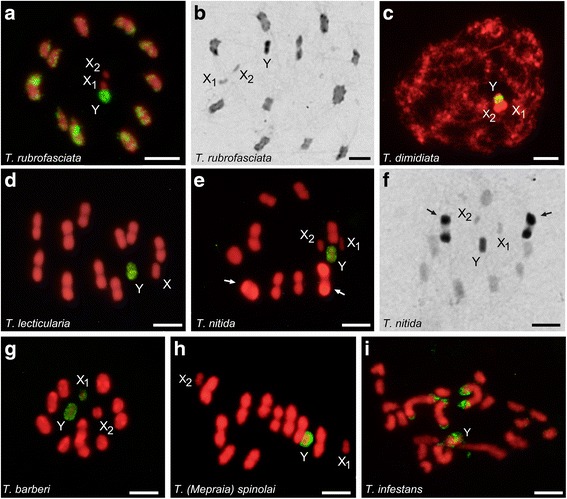
We observed two chromosomal hybridization patterns: (i) very intense hybridization signals concentrated on specific chromosomal regions or particular chromosomes; and (ii) lower intensity hybridization signals dispersed along all chromosomes. Self-GISH on T. rubrofasciata and T. dimidiata chromosomes presented strong hybridization signals on all C-heterochromatin regions. However, when we perform genomic cross-hybridizations, only strong signals are detected on the Y chromosome, leaving the C-heterochromatic autosomal regions unmarked.
We confirm that repeated DNA of the Y chromosome is shared among Triatoma species and probably represents an ancestral character of the Triatomini tribe. On the contrary, autosomal heterochromatic regions are constituted by species-specific DNA repeats, most probably satDNA families, suggesting that Triatoma speciation involved the amplification of diverse types of autosomal repeats. Molecular characterization of principal repetitive DNAs seems to be an appropriate approach to infer evolutionary relationships in triatomines.
全着丝粒染色体生物的染色体和基因组进化分析因缺乏主缢痕或着丝粒而受到限制。一个有趣的类群是半翅目锥蝽亚科,它是恰加斯病的传播媒介,全球约有600万至700万人受其影响。该类群在异染色质和核糖体基因等重复序列的数量和染色体定位上表现出广泛的变异性。本文试图通过使用基因组DNA探针揭示锥蝽属物种之间重复序列的显著差异。
我们使用来自两种北美锥蝽属物种的基因组DNA探针,通过基因组原位杂交(GISH)分析了锥蝽属物种中重复序列的染色体分布和进化。这些基因组探针在它们自身的染色体以及来自北美和南美、具有不同数量和染色体定位的C-异染色质的其他锥蝽属物种的染色体上进行杂交。将结果与先前使用南美锥蝽属基因组探针描述的结果进行比较。
我们观察到两种染色体杂交模式:(i)非常强烈的杂交信号集中在特定的染色体区域或特定染色体上;(ii)较低强度的杂交信号沿所有染色体分散。红带锥蝽和二色锥蝽染色体的自基因组原位杂交在所有C-异染色质区域呈现出强烈的杂交信号。然而,当我们进行基因组交叉杂交时,仅在Y染色体上检测到强信号,而C-异染色质常染色体区域未被标记。
我们证实Y染色体的重复DNA在锥蝽属物种之间是共享的,并且可能代表锥蝽族的一个祖先特征。相反,常染色体异染色质区域由物种特异性的DNA重复序列组成,很可能是卫星DNA家族,这表明锥蝽属物种形成涉及多种类型常染色体重复序列的扩增。主要重复DNA的分子特征似乎是推断锥蝽进化关系的一种合适方法。