Department of Biological, Geological and Environmental Sciences, University of Bologna, Via Irnerio 42, 40126, Bologna, Italy.
J Ethnobiol Ethnomed. 2017 Sep 6;13(1):50. doi: 10.1186/s13002-017-0177-4.
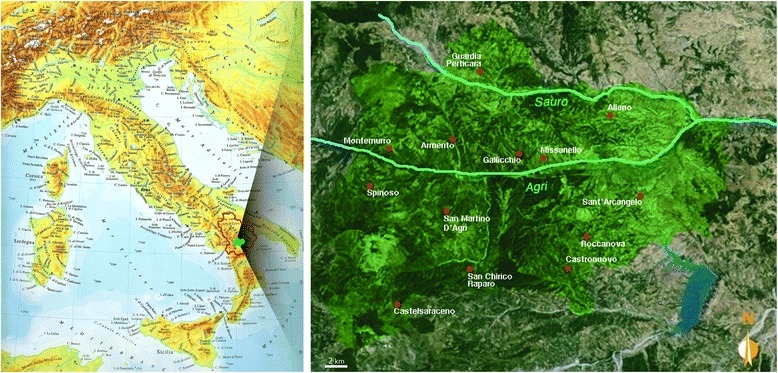
This research was carried out in a scarcely populated area of the Middle Agri Valley (Basilicata region, southern Italy). The aim of the study was to record local knowledge on the traditional uses of wild food plants, as well as to collect information regarding the practices (gathering, processing and cooking) and the medicinal uses related to these plants.
Fifty-eight people still possessing traditional local knowledge (TLK), 74% women and 26% men, were interviewed between May-August 2012 and January 2013, using open and semi-structured ethnobotanical interviews. For each described plant species, the botanical family, the Italian common and folk names, the plant parts used, the culinary preparation and, when present, the medicinal use, were recorded and the relative frequency of citation index (RFC) was determined.
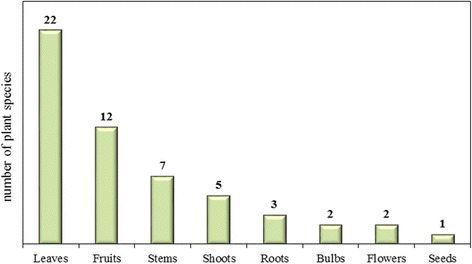
The 52 plant species mentioned by the respondents belong to 23 botanical families, with Asteraceae (12 plants) and Rosaceae (7 plants) being most frequently cited. The species with the highest RFC index is Cichorium intybus L. (0.95), followed by Sonchus spp. (S. oleraceus L., S. asper L. and S. arvensis L.) (0.76). The plant parts preferably used are leaves (22 plants), fruits (12) and stems (7). Only six wild plants were indicated as having both food use and therapeutic effect.
The survey conducted on the traditional use of wild food plants in the Middle Agri Valley revealed that this cultural heritage is only partially retained by the population. Over the last few decades, this knowledge has been in fact quickly disappearing along with the people and, even in the rural context of the study area, is less and less handed down to younger generations. Nevertheless, data also revealed that the use of wild plants is recently being revaluated in a way closely related to local habits and traditions.
本研究在意大利南部阿格里河谷(巴西利卡塔地区)人口稀少的地区进行。本研究的目的是记录有关野生食用植物传统用途的当地知识,以及收集与这些植物相关的采集、加工和烹饪实践以及药用用途的信息。
2012 年 5 月至 8 月和 2013 年 1 月期间,采用开放式和半结构式民族植物学访谈,对 58 名仍具有传统当地知识(TLK)的人进行了访谈,其中 74%为女性,26%为男性。对于每个描述的植物物种,记录了植物科、意大利通用和民间名称、使用的植物部分、烹饪准备以及存在时的药用用途,并确定了相对引用频率指数(RFC)。
受访者提到的 52 种植物属于 23 个科,其中菊科(12 种)和蔷薇科(7 种)最为常见。RFC 指数最高的物种是菊苣(Cichorium intybus L.)(0.95),其次是蒲公英属植物(S.oleraceus L.、S. asper L. 和 S. arvensis L.)(0.76)。首选使用的植物部分是叶子(22 种)、果实(12 种)和茎(7 种)。只有 6 种野生植物被认为具有食用和治疗作用。
对阿格里河谷中部野生食用植物传统用途的调查显示,这种文化遗产仅部分保留在人群中。在过去几十年中,这种知识实际上随着人们的消失而迅速消失,即使在研究地区的农村环境中,也越来越少地传给年轻一代。然而,数据还表明,野生植物的使用最近正在以一种与当地习惯和传统密切相关的方式重新得到重视。