Thomas Adelina, Mazigo Humphrey D, Manjurano Alphaxard, Morona Domenica, Kweka Eliningaya J
School of Pharmacy, Catholic University of Health and Allied Sciences, P.O. Box 1464, Mwanza, Tanzania.
Department of Medical Parasitology and Entomology, School of Medicine, Catholic University of Health and Allied Sciences, P.O. Box 1464, Mwanza, Tanzania.
Parasit Vectors. 2017 Sep 6;10(1):411. doi: 10.1186/s13071-017-2355-6.
Mosquitoes are well-known vectors of many diseases including malaria and lymphatic filariasis. Uses of synthetic insecticides are associated with high toxicity, resistance, environmental pollution and limited alternative, effective synthetic insecticides. This study was undertaken to evaluate the larvicidal efficacy of clove and cinnamon essential oils against laboratory Anopheles gambiae (sensu stricto) and wild An. arabiensis larvae.
The standard WHO guideline for larvicides evaluation was used, and the GC-MS machine was used for active compounds percentage composition analysis and structures identification. Probit regression analysis was used for LC and LC calculations while a t-test was used to test for significant differences between laboratory-reared and wild larvae populations in each concentration of plant extract.
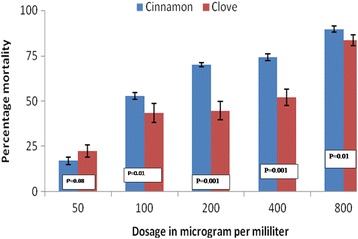
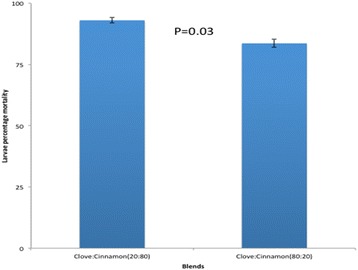
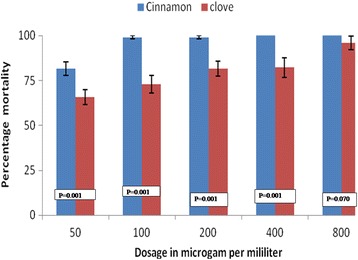
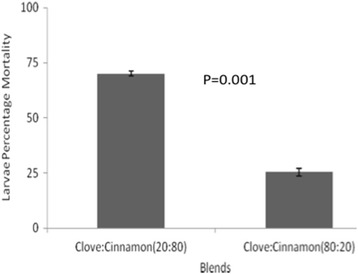
Mortality effect of clove and cinnamon essential oils against wild and laboratory-reared larvae had variations indicated by their LC and LC values. The mortality at different concentrations of cinnamon and clove post-exposure for wild and laboratory-reared larvae were dosage-dependent and were higher for cinnamon than for clove essential oils. The mortality effect following exposure to a blend of the two essential oils was higher for blends containing a greater proportion of cinnamon oil. In the chemical analysis of the active ingredients of cinnamon essential oil, the main chemical content was Eugenol, and the rarest was β-Linalool while for clove essential oil, the main chemical content was Eugenol and the rarest was Bicyclo.
The essential oils showed a larvicidal effect which was concentration-dependent for both laboratory and wild collected larvae. The active ingredient compositions triggered different responses in mortality. Further research in small-scale should be conducted with concentrated extracted compounds.
蚊子是包括疟疾和淋巴丝虫病在内的许多疾病的著名传播媒介。合成杀虫剂的使用与高毒性、抗药性、环境污染以及有效的替代合成杀虫剂有限有关。本研究旨在评估丁香和肉桂精油对实验室冈比亚按蚊(严格意义上)和野生阿拉伯按蚊幼虫的杀幼虫效果。
采用世界卫生组织杀幼虫剂评估标准指南,并使用气相色谱 - 质谱联用仪进行活性成分百分比组成分析和结构鉴定。使用概率回归分析进行致死浓度(LC)计算,同时使用t检验来检验每种植物提取物浓度下实验室饲养和野生幼虫种群之间的显著差异。
丁香和肉桂精油对野生和实验室饲养幼虫的致死效果因它们的致死浓度值而有所不同。野生和实验室饲养幼虫在接触不同浓度肉桂和丁香后,死亡率呈剂量依赖性,肉桂精油的死亡率高于丁香精油。接触两种精油混合物后,含肉桂油比例更高的混合物的致死效果更高。在肉桂精油活性成分的化学分析中,主要化学成分为丁香酚,最罕见的是β - 芳樟醇;而对于丁香精油,主要化学成分为丁香酚,最罕见的是双环化合物。
精油对实验室和野外采集的幼虫均显示出浓度依赖性的杀幼虫效果。活性成分组成引发了不同的死亡反应。应使用浓缩提取化合物进行小规模的进一步研究。