Department of Cell Biology, University of Virginia, Charlottesville, VA, 22908, USA.
Sci Rep. 2017 Sep 5;7(1):10481. doi: 10.1038/s41598-017-07667-x.
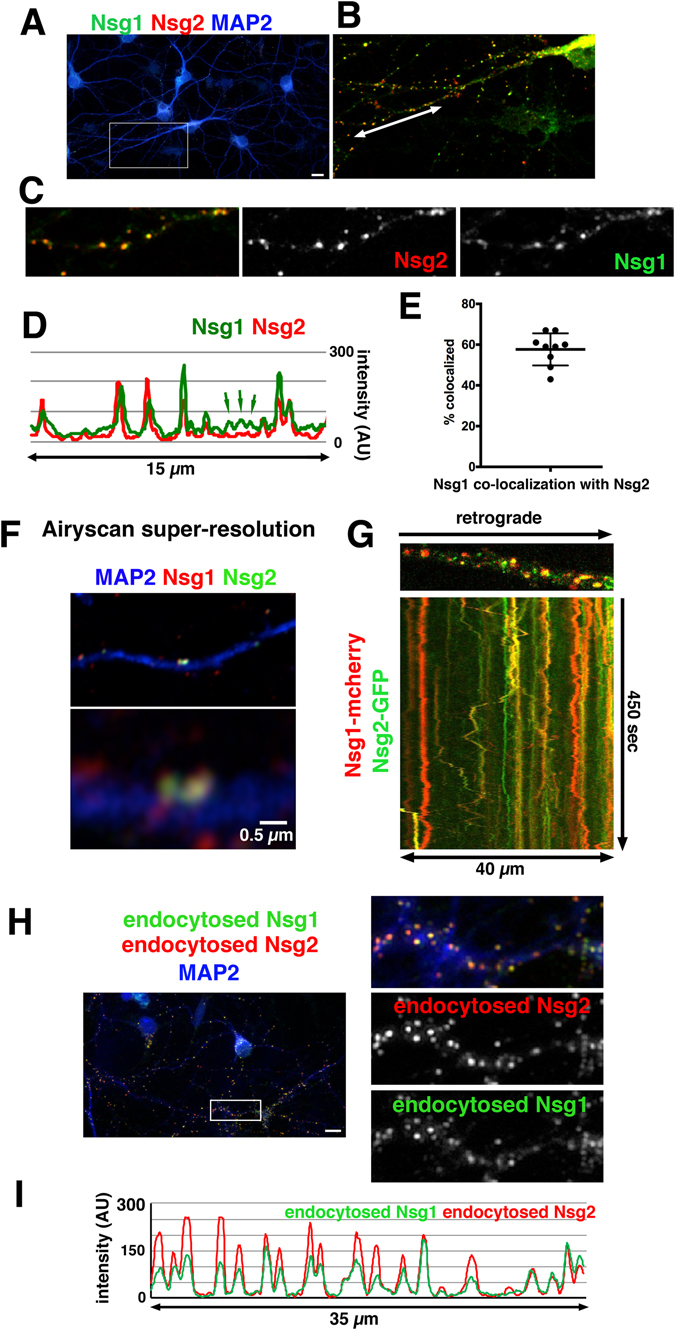
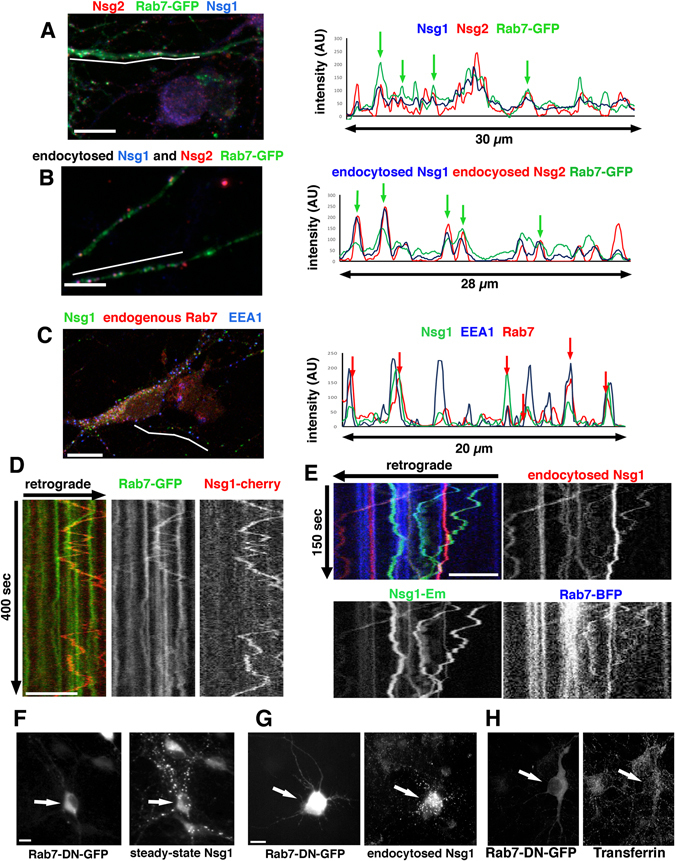
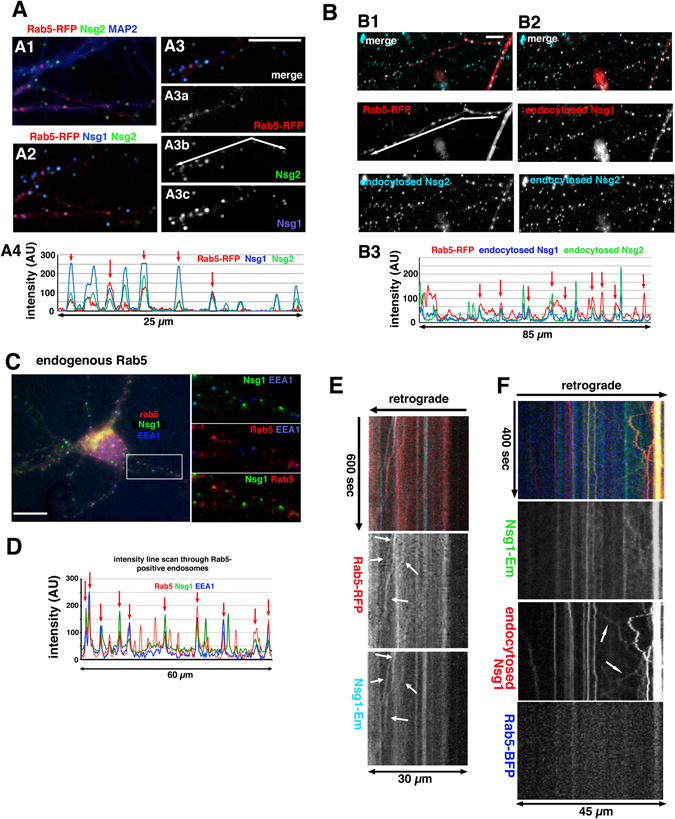
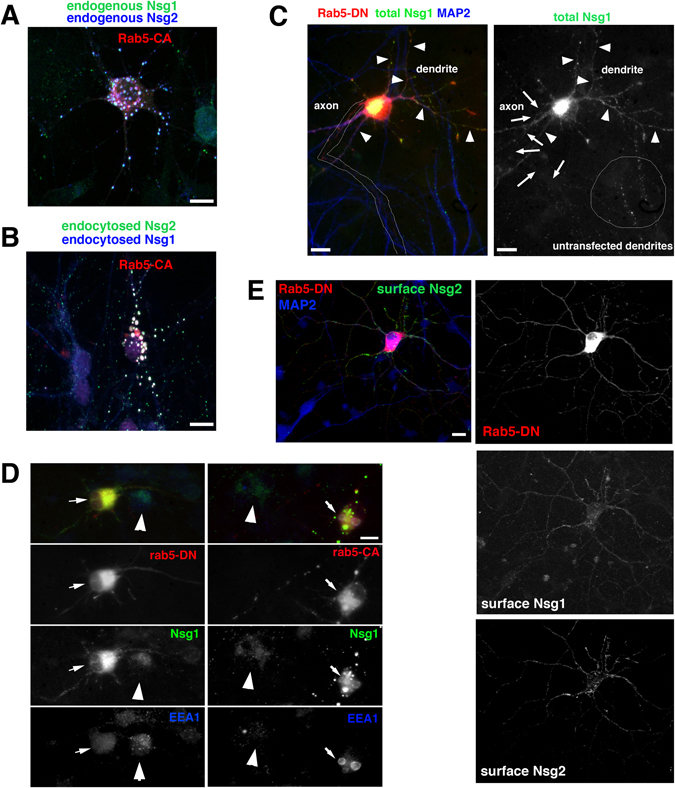
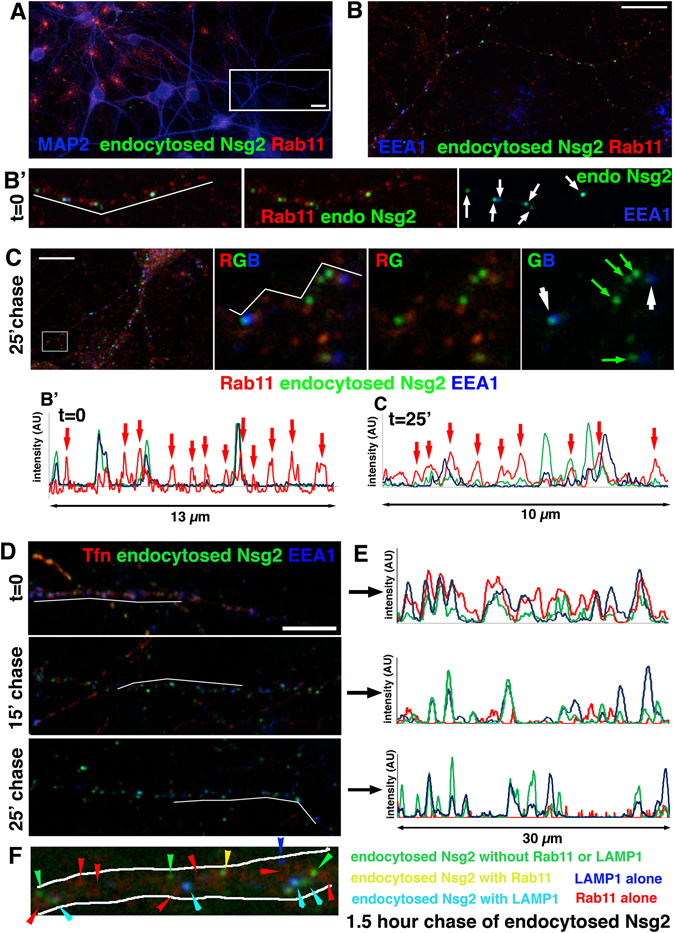
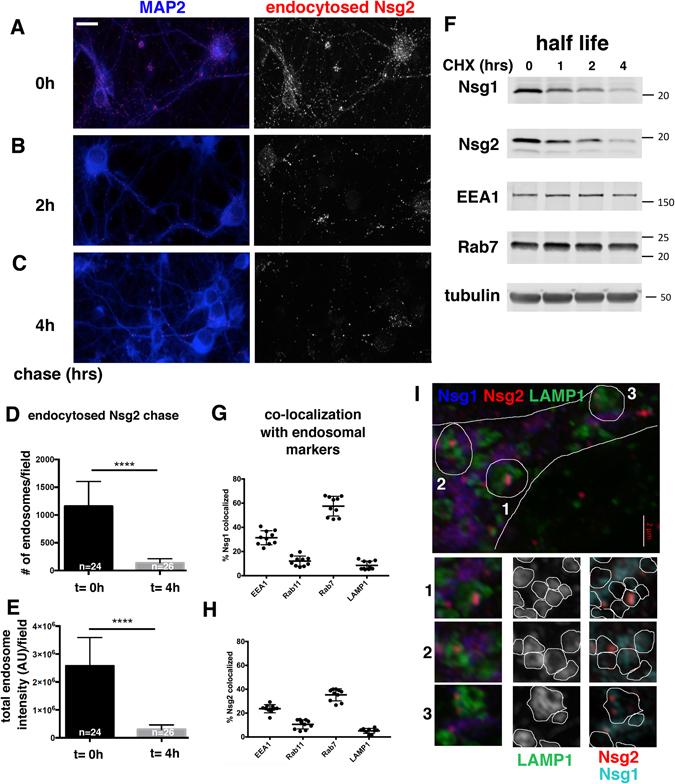
Membrane traffic critically regulates most aspects of neuronal function. Neurons express many neuronal-specific proteins that regulate membrane traffic, including the poorly understood small transmembrane proteins neural-specific gene 1 and 2 (Nsg1/NEEP21 and Nsg2/P19). Nsg1 has been implicated in regulating endosomal recycling and sorting of several important neuronal receptors. Nsg2 is largely unstudied. At steady-state, Nsg1 and Nsg2 only partially co-localize with known endosomal compartments, and it was suggested that they mark a neuronal-specific endosome. Since Nsg1 localizes to and functions in the dendritic endosome, we set out to discover how Nsg1 and Nsg2 localization to endosomes is regulated in primary rat hippocampal neurons, using quadruple immunolocalization against endogenous proteins, live imaging of dendritic endosomes, and interference approaches against the endosomal regulators Rab5 and Rab7. In contrast to previous conclusions, we now show that Nsg1 and Nsg2 are not resident endosomal proteins, but traffic rapidly from the cell surface to lysosomes and have a half-life of less than two hours. Their partial co-localization with canonical endosomal markers thus reflects their rapid flux towards degradation rather than specific targeting to a singular compartment. These findings will require rethinking of how this class of endosomal proteins regulates trafficking of much longer-lived receptors.
膜转运对神经元功能的大多数方面都至关重要。神经元表达许多调节膜转运的神经元特异性蛋白,包括了解甚少的小跨膜蛋白神经元特异性基因 1 和 2(Nsg1/NEEP21 和 Nsg2/P19)。Nsg1 被认为参与调节内体再循环和几种重要神经元受体的分拣。Nsg2 则研究甚少。在稳定状态下,Nsg1 和 Nsg2 仅与已知的内体区室部分共定位,因此它们被认为标记了神经元特异性内体。由于 Nsg1 定位于树突状内体并在内体中发挥作用,我们着手研究在原代大鼠海马神经元中,内体调节蛋白 Rab5 和 Rab7 的干扰方法、对内源性蛋白的四重免疫定位和树突状内体的活细胞成像,如何调节 Nsg1 和 Nsg2 向内体的定位。与之前的结论相反,我们现在表明,Nsg1 和 Nsg2 不是驻留内体蛋白,而是从细胞表面快速转运到溶酶体,半衰期不到两小时。因此,它们与经典内体标志物的部分共定位反映了它们快速向降解方向流动,而不是特异性靶向单一隔室。这些发现将需要重新思考这一类内体蛋白如何调节寿命更长的受体的转运。