The Institute for Drug Research, The School of Pharmacy, Faculty of Medicine, The Hebrew University, Jerusalem, Israel.
Department of Surgery and Transplantation Unit, Hadassah Medical Center, Ein-Karem, Jerusalem, Israel.
Sci Rep. 2017 Sep 5;7(1):10428. doi: 10.1038/s41598-017-10699-y.
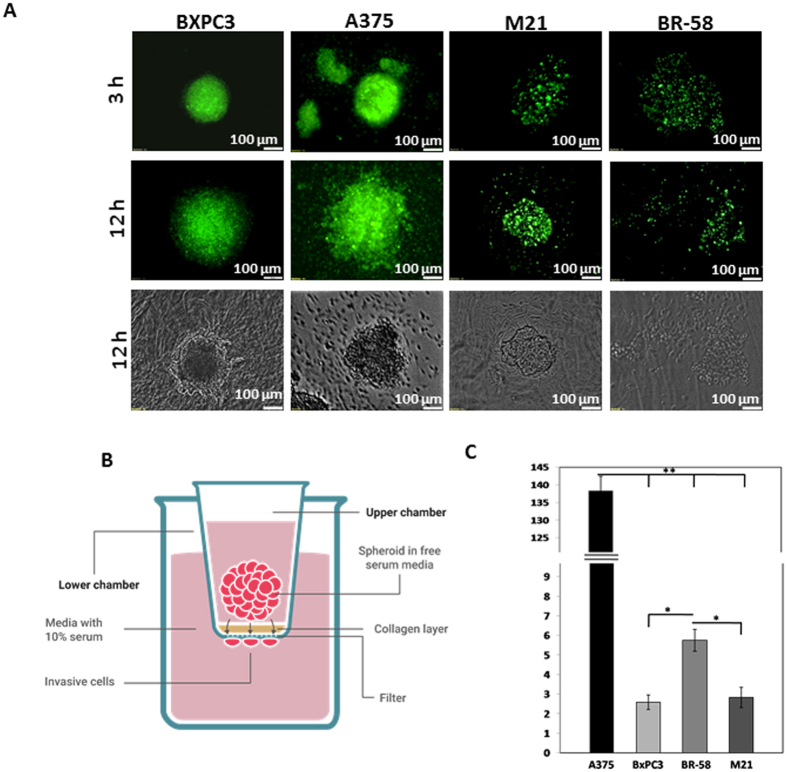
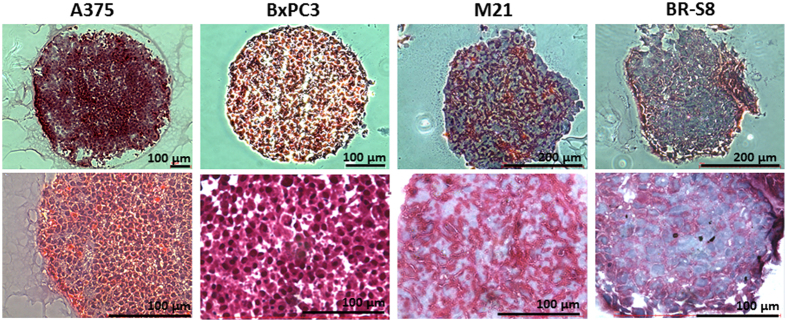
Recapitulating the tumor microenvironment is a central challenge in the development of experimental model for cancer. To provide a reliable tool for drug development and for personalized cancer therapy, it is critical to maintain key features that exist in the original tumor. Along with this effort, 3-dimentional (3D) cellular models are being extensively studied. Spheroids are self-assembled cell aggregates that possess many important components of the physiological spatial growth and cell-cell interactions. In this study we aimed to investigate the interconnection between tumor and endothelial cells (EC) in hybrid spheroids containing either tumor cell (TC) lines or patient derived cancer cells. Preparation protocols of hybrid spheroids were optimized and their morphology and tissue-like features were analyzed. Our finding show that capillary-like structures are formed upon assembly and growth of TC:EC spheroids and that spheroids' shape and surface texture may be an indication of spatial invasiveness of cells in the extra-cellular matrix (ECM). Establishing a model of hybrid tumor/stroma spheroids has a crucial importance in the experimental approach for personalized medicine, and may offer a reliable and low-cost method for the goal of predicting drug effects.
重现肿瘤微环境是癌症实验模型发展的核心挑战。为了为药物开发和个性化癌症治疗提供可靠的工具,关键是要保持原始肿瘤中存在的关键特征。随着这方面的努力,三维(3D)细胞模型正在被广泛研究。球体是自组装的细胞聚集体,具有生理空间生长和细胞间相互作用的许多重要组成部分。在这项研究中,我们旨在研究含有肿瘤细胞(TC)系或患者来源的癌细胞的杂交球体中肿瘤细胞和内皮细胞(EC)之间的相互联系。优化了杂交球体的制备方案,并对其形态和组织样特征进行了分析。我们的发现表明,在 TC:EC 球体的组装和生长过程中形成了类似毛细血管的结构,并且球体的形状和表面纹理可能是细胞在细胞外基质(ECM)中空间侵袭性的指示。建立杂交肿瘤/基质球体模型对于个性化医学的实验方法具有至关重要的意义,并且可能为预测药物效果的目标提供可靠且低成本的方法。